
The Invisible Bridge Between Orbit and Home
Every time you open a sat-nav, watch a weather image sweep across a screen, hear an astronaut’s voice from the International Space Station, or see a dish pointed fixedly at the southern sky, you are witnessing one of the quiet miracles of the modern world. A machine far above the Earth is speaking to us with something we can neither see nor touch. No cable. No air to carry sound. Just exquisitely controlled energy crossing space at the speed of light. In the end, the answer is wonderfully simple: satellites talk to Earth using radio. But the simplicity of that statement hides one of the finest engineering achievements humanity has ever built.
At its heart, satellite communication is not so different from amateur radio. There is a transmitter, a receiver, an antenna, and a path between them. Information is placed onto a radio wave by modulation, sent out into space, collected by an antenna at the far end, and turned back into something useful. The difference is that in space the path is longer, the targets are moving, the signals are weaker, the timing is tighter, and failure matters a great deal more. A missed contact on the bands is frustrating. A missed command to a spacecraft can be mission-critical.
It is not one conversation, but several
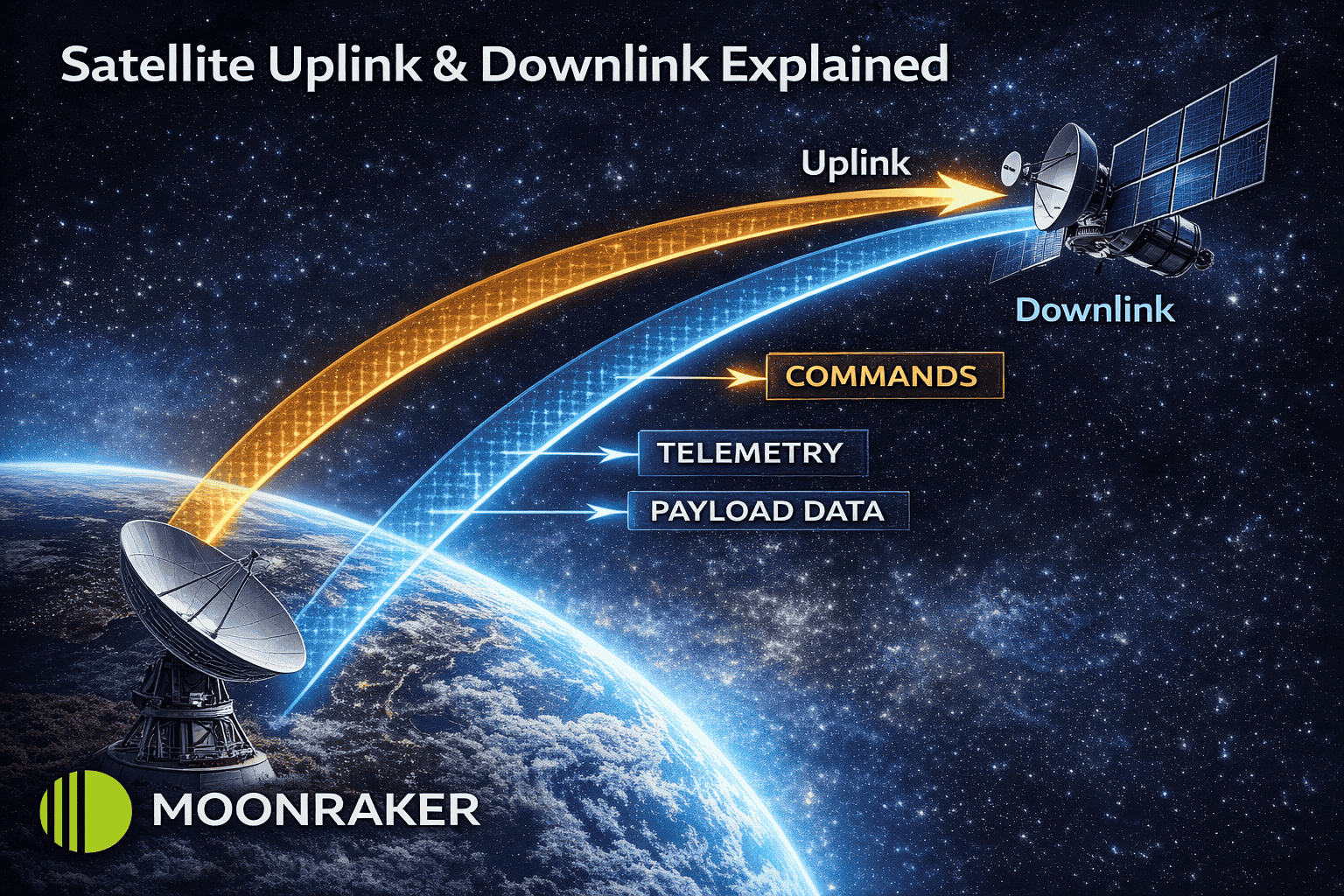
When we say a satellite is “talking to Earth”, we usually imagine one straightforward exchange. In reality, several different conversations may be happening at once. One stream carries commands from Earth to the spacecraft. Another carries telemetry back down: battery voltage, internal temperatures, pointing status, fuel levels, and countless other pieces of housekeeping data that tell engineers whether the spacecraft is healthy. A third may carry the actual payload data the satellite exists to gather: weather images, GPS timing signals, television broadcasts, radar observations, scientific measurements, or photographs of the Earth and beyond. ESA groups these functions under Telemetry, Tracking and Command, with payload data transmission treated as the mission’s real prize.
That distinction matters, because it reveals what a satellite truly is. It is not just a camera, repeater, telescope, or weather sensor floating in orbit. It is a remote radio system that must constantly prove it is alive, obey instructions, report its condition, and then deliver the information we launched it to collect. Without that continuous invisible bridge, the most sophisticated satellite in the world would be little more than silent hardware circling overhead.
The basic pattern: uplink and downlink
The classic space link has two halves. The uplink is the signal sent from Earth to the satellite. That might be a command telling it to change mode, adjust attitude, fire a thruster, or switch on an instrument. The downlink is the signal coming back to Earth. That may be telemetry, a stream of science data, an image, a voice transmission, or simply a beacon announcing, “I am here, and I am working.” NASA’s guidance describes these as the three core functions of a communications system: receiving commands from Earth, transmitting data down to Earth, and in some cases passing information to or from another satellite via a crosslink.
For the reader who is not especially technical, the easiest way to picture it is as a conversation with an echo of control. Earth says, “Turn this on.” The satellite replies, “Done — and here is what I am seeing.” Sometimes that reply is tiny and simple. Sometimes it is a torrent of data. But the principle never changes: Earth sends intention upward, and the satellite sends knowledge back down.
Why radio is so well suited to space
Spacecraft use radio because radio waves are practical, mature, efficient, and extraordinarily capable across long distances. Different missions use different frequency bands depending on what they need to do. NASA notes that small satellites have traditionally used VHF and UHF, while modern systems increasingly move into S-band, X-band, and Ka-band as demand for higher data rates grows. Higher frequencies can carry more information and support narrower beams from smaller antennas, but they also bring penalties: greater atmospheric attenuation, more rain fade, more free-space loss, and tighter pointing requirements. That is why frequency choice in space is always a trade-off between robustness and capacity.
This is one reason amateur satellite work feels so satisfying to radio amateurs: the same decisions we make in the shack appear again in orbit, only magnified. Lower frequencies are often more forgiving. Higher frequencies can be more capable, but they demand more care. It is still radio engineering — just with the Earth falling away beneath it.
The satellite has to see you
One of the great truths of satellite communication is that line of sight rules everything. A low Earth orbit satellite can only talk directly to a ground station when the two can physically “see” each other. Once the spacecraft drops below the horizon, the Earth itself blocks the path. That is why many amateur and scientific satellites are only available in short windows as they pass overhead. A contact begins, rises to a peak, and then vanishes as the spacecraft races away.
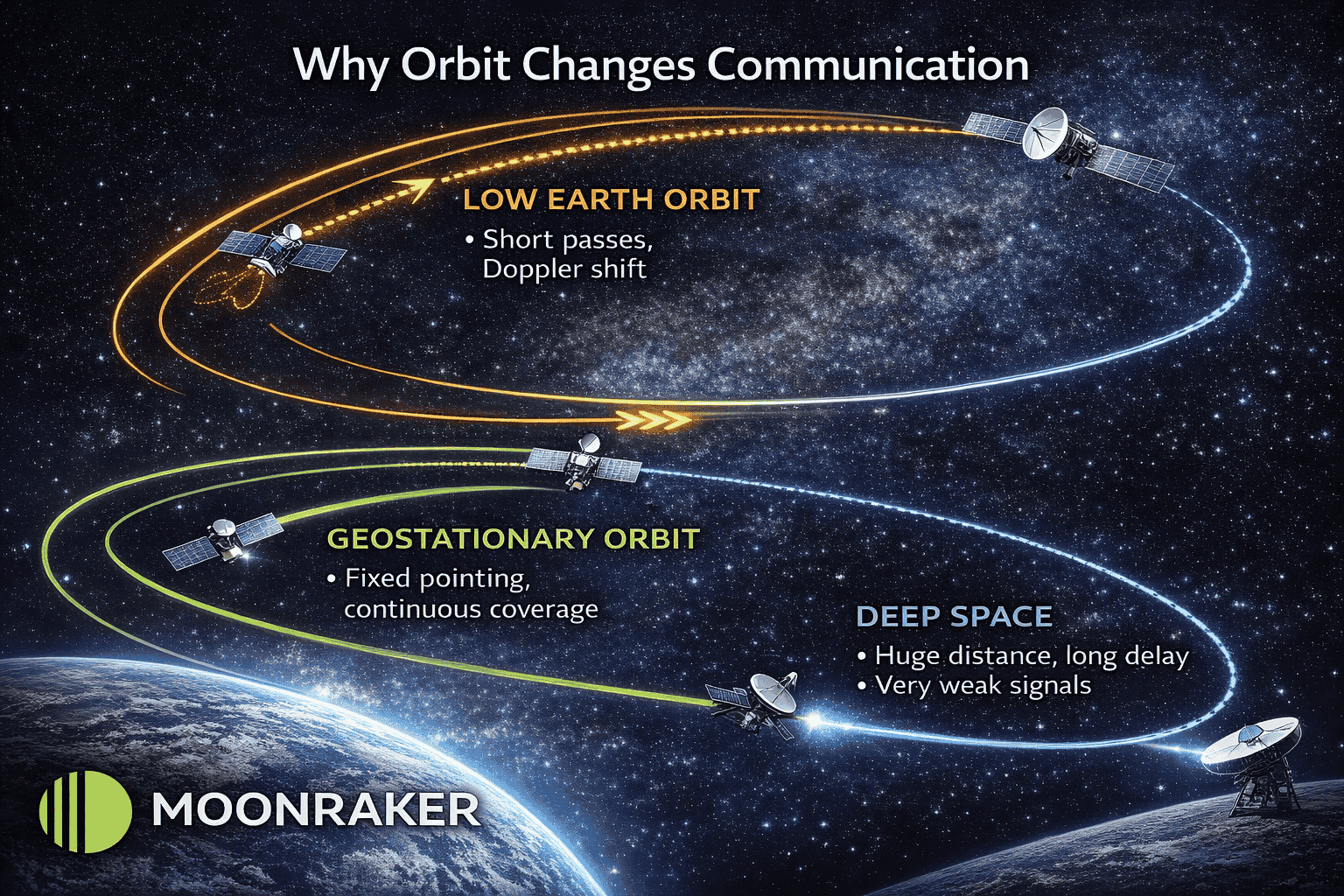
This is also why orbit changes the whole character of communication. A low Earth orbit spacecraft is fast, fleeting, and constantly changing position. A geostationary satellite is almost the opposite: it appears fixed in the sky because it orbits at the same rate the Earth rotates. ESA explains that GEO satellites allow permanent communication links from fixed antennas on the ground, receiving a signal, amplifying it, and sending it back down over distances of thousands of kilometres. That is why television dishes and many communications antennas can simply be pointed at one spot and left there.
Orbit changes the signal too
With fast-moving satellites, the challenge is not only seeing them but following their shifting frequency. This is the Doppler effect. As a satellite approaches, the signal appears slightly higher in frequency than its published value. As it recedes, the signal drops. AMSAT’s beginner guidance explains that amateur satellite operators must account for this on both uplink and downlink. That is why satellite operation feels more alive than ordinary terrestrial working: the spacecraft is not just passing overhead, it is dragging the radio link through a continuously changing geometry.
For anyone who has never tried it, this is one of the most magical aspects of the subject. You are not tuning a static station. You are chasing a moving machine in space, listening to physics announce its motion in real time. Doppler is not an abstraction in satellite work. It is something you hear.
Antennas: the art of concentrating energy
If frequency is one half of the story, antennas are the other. ESA points out that spacecraft often carry both high-gain and low-gain antennas. A high-gain antenna focuses energy into a narrow beam, producing a stronger signal at the far end but demanding far more accurate pointing. A low-gain antenna spreads energy over a wider area, making it easier to maintain contact but at a lower data rate. This is not a luxury. It is often essential. A spacecraft may rely on a low-gain antenna during safe mode or recovery, then switch to a high-gain system when it is stable and correctly pointed at Earth.
This is a beautiful engineering compromise. The narrow beam is the precision instrument; the broad beam is the lifeline. One gives performance, the other gives resilience. The same logic is familiar to amateur operators comparing a beam with a simple omnidirectional antenna. Spacecraft simply live by that rule at a far more serious level.
The ground station is half the spacecraft
A satellite cannot talk to Earth unless Earth is prepared to listen properly. That means the ground station is not some secondary detail. It is half the system. NASA’s communications guidance makes this clear: every mission depends on a space segment and a ground segment. On the ground, that means antennas, tracking systems, low-noise receiving equipment, decoding systems, timing references, control software, and the engineers who bring it all together.
At the grandest scale, this becomes the Deep Space Network. NASA’s DSN spans facilities in the United States, Spain, and Australia, allowing coverage as the Earth rotates. Its largest antennas are 70 metres across, and NASA describes them as the most sensitive DSN antennas, capable of tracking spacecraft at astonishing distances. The reason is simple: by the time a signal has crossed the Solar System, it is unimaginably weak. Huge dishes and exquisitely quiet receivers are needed to pull meaning out of the noise.
There is something profoundly humbling about that. A whisper leaves a spacecraft far beyond Earth, spreads across an ocean of space, and arrives as a vanishingly faint trace. On our side, a giant dish in a desert turns and listens — and the universe answers.
Example one: the ISS, where space suddenly feels close
The International Space Station is the perfect example of how accessible space radio can be. Through ARISS, the ISS carries amateur radio equipment operating in the familiar 2 metre and 70 centimetre bands, supporting voice, packet, and SSTV activity. That is why the station holds such power over the public imagination. It is not just a distant object in orbit. It is a real radio station in the sky, sometimes workable with equipment many amateurs already understand.
This matters because it collapses the emotional distance between “space communications” and “ordinary radio”. Suddenly the leap is not from Earth to some impossible technological realm. It is from your shack to orbit. That is a thrilling bridge for beginners and experienced operators alike.
Example two: amateur satellites as repeaters in the sky
AMSAT offers perhaps the clearest lay explanation of many amateur satellites: they work much like cross-band repeaters in the sky. A transponder receives your uplink and retransmits what it hears on a different downlink frequency. Some are simple FM systems. Others are linear transponders handling a wider slice of spectrum. The principle, however, is instantly familiar to a radio amateur. The satellite is not mysterious. It is a repeater made far more interesting by orbital motion, Doppler, and the unforgiving physics of line of sight.
That may be the finest educational gift satellites offer the hobby. They take the principles of everyday radio and elevate them into something dramatic. The fundamentals remain the same. Only the stage has become the whole sky.
Example three: GPS, the one-way conversation that changed civilisation
Not all satellites “talk” in the same way. GPS is a powerful reminder that some of the most important space systems are essentially one-way broadcasters for the user. GPS satellites transmit extraordinarily precise timing information, generated by multiple atomic clocks aboard each satellite. GPS.gov notes that this allows users to determine time to within 100 billionths of a second without owning an atomic clock themselves. Your receiver mostly listens, compares the timing from multiple satellites, and uses that to determine position and time.
It is hard to overstate how revolutionary that is. A constellation of satellites quietly broadcasts time so accurately that navigation, networks, infrastructure, and financial systems lean on it every day. It is satellite communication stripped of romance and turned into civilisational plumbing — invisible, constant, indispensable.
Example four: satellites that talk through satellites
Some spacecraft do not maintain direct contact with Earth all the time. Instead, they talk through relay satellites. NASA’s Tracking and Data Relay Satellite system exists precisely for this reason. TDRS satellites in geosynchronous orbit provide near-continuous relay services to more than 25 missions, including the Hubble Space Telescope and the ISS. In other words, the path may be spacecraft to relay satellite to ground station rather than spacecraft straight to Earth.
This is a crucial point, because it shows how sophisticated the architecture can become. “Satellite to Earth” is sometimes a shorthand for a far more elegant chain of hand-offs. Spacecraft do not always whisper directly into our ears. Sometimes another satellite catches the whisper and passes it on.
Example five: weather satellites you can actually receive
Weather satellites offer another compelling example because they make the invisible visible. NOAA’s direct-readout material lists services such as APT, HRPT, LRIT, GRB, HRD, and HRIT, all designed to send data directly from space to suitably equipped receiving stations. For the hobbyist, this is one of the great delights of satellite work: the downlink becomes an image, a map, or a stream of weather information gathered above the Earth and received in real time on the ground.
This is where satellite communication stops feeling abstract. The signal is no longer merely “data”. It becomes cloud tops, storm systems, surface temperatures, and the living face of the atmosphere itself.
Deep space: the same idea, only far more brutal
For deep-space missions, the fundamentals do not change — but the numbers become staggering. The signal is still sent by radio. The antenna still has gain. The ground station still listens. But distance turns everything brutal. Weak signals, long delays, and immense link losses dominate the design. NASA’s deep-space infrastructure exists because these missions demand huge antennas, powerful uplinks, and exceptional sensitivity. Even then, communication is not instant. Signals to the Moon take a little over a second one way. To Mars, depending on where the planets are, the delay can stretch to many minutes.
That is why spacecraft at great distances cannot be “flown” in real time. They must be planned for, trusted, and commanded with patience. In deep space, radio is not just communication. It is delayed conversation across a gulf so vast that human intuition struggles to grasp it.
The future may include light as well as radio
Although radio remains the backbone of space communication, NASA is also pushing optical systems. Its optical communications overview explains that space and ground optical transceivers can send and receive information using light rather than traditional RF alone. This does not make radio obsolete, but it does hint at the next chapter: hybrid systems in which radio and optical links each do what they do best.
Even so, radio is still the great enduring bridge. It is robust, proven, flexible, and astonishingly capable. It carried the first voices from orbit. It tracks probes in deep space. It guides aircraft and ships, powers GPS, supports weather satellites, and lets amateurs work stations overhead from back gardens and hilltops.
So how do satellites talk to Earth?
They do it the same way radio has always worked: by shaping invisible waves, launching them into space, and recovering meaning at the far end. Earth sends commands up. Satellites send data down. Some repeat, some relay, some broadcast, some whisper across the Solar System. Frequency, antenna gain, orbit, Doppler, coding, and timing all decide how well that conversation survives the journey. But the essence never changes.
The machine in orbit speaks in radio.
Earth listens.
And between them, across emptiness, a bridge appears.
For more information please visit our online store or alternatively contact us and our team will be happy to assist you.