
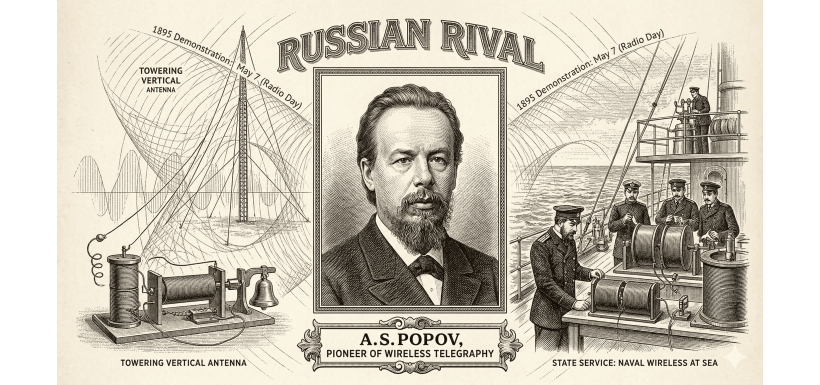
If you walk down a street in London or New York and ask a passerby who invented the radio, the answer will almost certainly be Guglielmo Marconi. But if you walk down a street in Moscow or St. Petersburg and ask the exact same question, the answer will be given with absolute, unyielding certainty: Alexander Popov.
The story of radio is not a neat line of solitary geniuses passing a baton; it is a messy, simultaneous race. Until 1895, radio waves (then called "Hertzian waves") were mere laboratory curiosities. They could travel barely a few meters across a lecture hall. The great race of that pivotal year was all about range. Who could take this invisible spark and force it to travel out into the open world?
While Marconi is celebrated as the man who commercialized the wireless telegraph, Alexander Stepanovich Popov is the unrecognized co-inventor of practical radio. Working entirely in parallel with the young Italian, Popov solved the single biggest obstacle to distance. He didn't just build a better receiver; he invented the very tool that allows your car, your television, and your smartphone to pull invisible signals out of the air.
Popov invented the first practical receiving antenna. Yet, his legacy was immediately veiled by his service to the Imperial Russian Navy, turning him into one of history’s greatest "what ifs."
The Scholarly Service
Alexander Popov was born in 1859 in a small village in the Ural Mountains, the son of a local priest. Expected to follow in his father's footsteps, he attended a seminary, but his mind was drawn to the physical world rather than the spiritual one. He transferred to St. Petersburg University, where he proved to be a brilliant academic, excelling in mathematics and physics.
Unlike Marconi, who possessed the ruthless, visionary drive of a global entrepreneur, Popov was a quiet, meticulous scholar. He was a man of the state. After graduating, he chose a path of service, becoming an instructor of physics and electrical engineering at the Russian Navy's Torpedo School on the island fortress of Kronstadt.
This location is crucial to understanding Popov’s work. The Russian Imperial Navy in the early 1890s was desperately searching for a way to communicate between its massive warships while at sea, without relying on visual flags or flashing lights that were rendered useless by fog. Popov was tasked by the military to find a solution. He was not looking to start a global corporation; he was trying to solve a tactical problem for his country.

Image: The Problem of Capture
The Problem of "Hearing"
To understand Popov's genius, we have to look at the state of the art in the early 1890s.
Heinrich Hertz had proven that electromagnetic waves existed, but his receiver was incredibly crude—just a small loop of wire with a microscopic gap that would produce a tiny spark if a wave hit it perfectly. It was nearly blind and deaf. Later, the French physicist Édouard Branly invented the "coherer" (a tube of metal filings that became conductive when hit by radio waves), and the British scientist Oliver Lodge added a mechanical "tapper" to automatically reset it.
The coherer was a fantastic "ear," but there was a massive problem: it was just a component sitting on a lab bench.
Imagine trying to catch rainwater to survive, but you are only using a thimble. Hertz’s tiny wire loops and the bare wires of early coherer circuits were like that thimble. They were simply too small to capture the microscopic "ripple" of electromagnetic energy arriving from a distant spark transmitter. If radio was ever going to work across miles of ocean, the receiver itself needed a radical redesign.
Inventing the Antenna: Capturing the Energy
Popov’s massive breakthrough didn't come from trying to send Morse code; it came from trying to listen to the weather.
He was deeply interested in using Branly's coherer to detect the natural electrical discharges of approaching thunderstorms—essentially, listening to the static of lightning strikes from miles away.
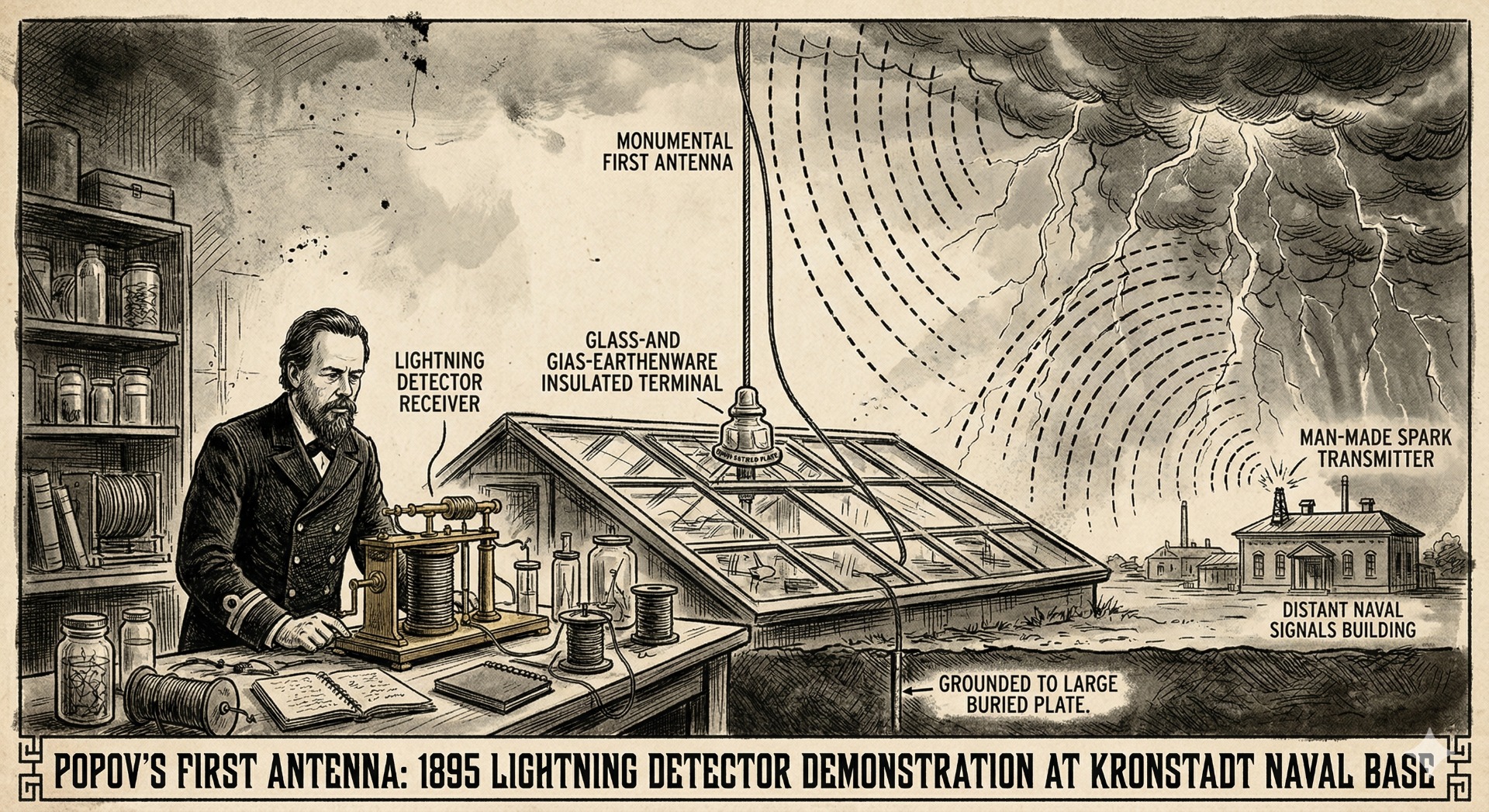
In the spring of 1895, Popov had an intuition that would change the world. He realized that to catch more of the invisible electrical wave, he needed a bigger "net." He took a long, vertical wire—originally rigged up as a conventional lightning rod on the roof of his laboratory—and connected it directly to one side of his coherer receiver. Crucially, he connected the other side of the coherer deep into the earth, grounding the circuit.
This was the paradigm shift. He hadn't just attached a wire; he had created a resonant system. By elevating a long vertical wire into the air and grounding the receiver, he essentially turned the earth and the sky into two halves of a massive capacitor.
This was the birth of the practical receiving antenna. This single, brilliant addition dramatically increased the sensitivity of his receiver. Suddenly, he wasn't just detecting lightning from a few miles away; he could detect man-made spark transmissions from entirely different buildings.
The Demonstration of May 7, 1895 (Radio Day)
Popov knew he had something extraordinary. On May 7, 1895, he presented his findings to the Russian Physical and Chemical Society at St. Petersburg University.
The scene was electric. Popov had set up his modified coherer receiver, connected to its new, towering vertical antenna and a solid earth ground. A separate spark-gap transmitter had been set up several hundred meters away, located in an entirely different building on the campus.
When the distant transmitter was fired, the invisible waves passed through the brick walls of the university, struck Popov's vertical antenna, surged down into the coherer, and automatically triggered a relay that rang a bell. He had successfully transmitted and received an artificial, intelligible signal over a significant distance, completely wirelessly.
To this day, May 7th is celebrated annually across Russia as Radio Day. For millions of people, this demonstration marks the true, indisputable birth of radio communication.

Veiled by the State: Popov vs. Marconi
If Popov achieved this in May of 1895, why does Marconi get all the credit in the history books? The answer lies in the diverging paths of the entrepreneur and the civil servant.
In 1895 and 1896, Guglielmo Marconi was conducting very similar experiments in Italy, also discovering the necessity of an elevated antenna and an earth ground. But Marconi immediately packed his bags, moved to England (the maritime superpower of the world), filed for a broad, sweeping patent in June 1896, and began staging highly publicized, sensational demonstrations for the press and the government. He formed a company and aggressively protected his intellectual property.
Popov’s reality was entirely different. He was an employee of the Russian Imperial Navy. When the military brass saw what his "lightning detector" could do for ship-to-ship communication, they immediately clamped down.
Popov’s work was classified. He was strictly forbidden from publishing the detailed technical specifications of his transmitters or filing international patents. While Marconi’s fame was spreading across the globe via the newspapers of London and New York, Popov was quietly outfitting Russian naval vessels in the Baltic Sea with wireless sets, his brilliance hidden behind the veil of military secrecy.
It wasn't until years later, when Marconi's patents began to dominate the global market, that the Russian government realized their mistake and tried to retroactively claim priority for Popov. But by then, the commercial war had already been won.
Conclusion: The Man Who Reached for the Sky
Alexander Stepanovich Popov did not copy Guglielmo Marconi. He was a brilliant physicist who worked in parallel, looking at the exact same scientific puzzle and arriving at the exact same brilliant solution.
While Marconi can rightly be called the "Midwife of Radio"—the man with the sheer force of will to drag the technology out of the lab and build a global industry—Alexander Popov is indisputably one of its true technical fathers.
He solved the vital problem of receiving energy from a distance by creating the fundamental tool that every single radio, television, satellite, and mobile phone still relies upon today. He looked at a deaf machine, raised a wire to the sky, and finally allowed the world to listen.
For more information please visit our online store or alternatively contact us and our team will be happy to assist you.