
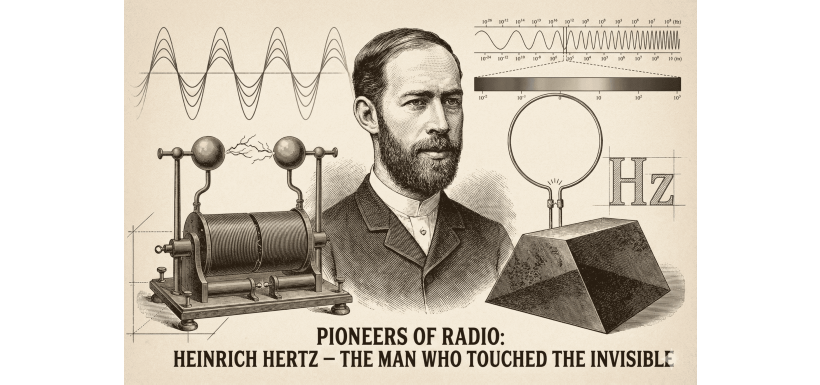
Every time you look at a computer monitor running at 60 Hz, tune a radio to 100 MHz, or check the specs of a new processor running at 3 GHz, you are speaking his name.
Heinrich Hertz is one of the few scientists in history to have his surname become a fundamental unit of the universe. As the unit of frequency—one cycle per second—he is immortalized in every piece of modern electronics.
Yet, Hertz is also famous for making perhaps the most spectacularly wrong prediction in the history of technology. When he first successfully generated and received radio waves in his laboratory, a student asked him what this magnificent discovery might be used for. Hertz shrugged and famously replied:
"It's of no use whatsoever... this is just an experiment that proves Maestro Maxwell was right. We have these mysterious electromagnetic waves that we cannot see with the naked eye. But they are there."
"So, what comes next?" the student pressed.
"Nothing, I guess," Hertz replied.
He was a man who found a new continent but didn't think it was worth settling. He provided the raw clay that Marconi and others would sculpt into a global civilization, yet he died tragically young, never knowing that he had discovered the key to the modern world.
The Theoretical Ghost: Chasing Maxwell
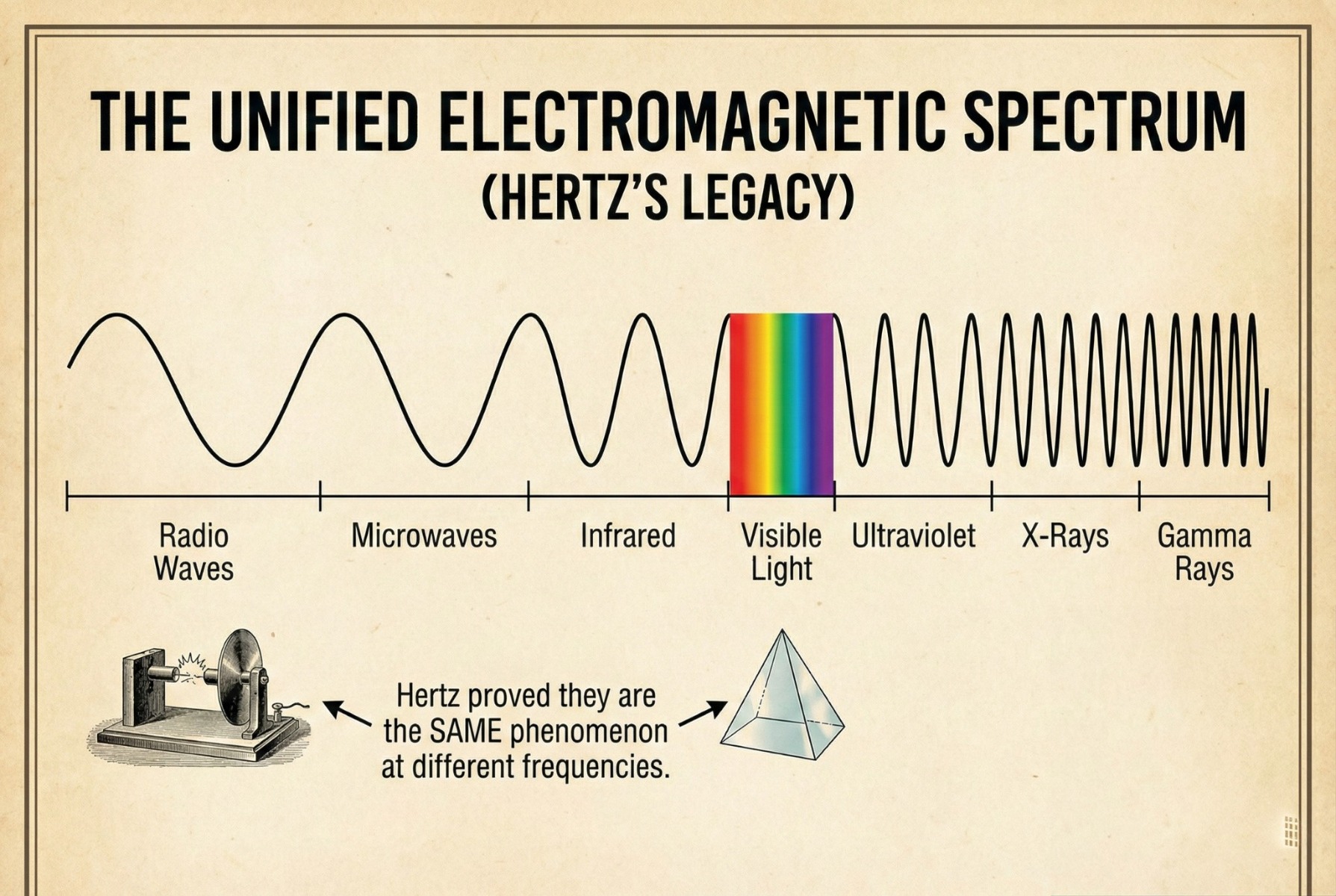
To understand Hertz’s achievement, we have to look at the scientific landscape of the late 19th century. The Scottish physicist James Clerk Maxwell had published a set of elegant equations predicting that electricity and magnetism were linked, and that they moved through space in waves at the speed of light.
But for decades, this was just a "ghost story." It was beautiful math, but no one could find these waves in the real world. They were a theoretical fantasy. The Berlin Academy of Sciences even offered a prize to anyone who could prove experimentally that they existed.
Enter Heinrich Hertz. A brilliant young German physicist and student of the legendary Hermann von Helmholtz, Hertz took a position at the University of Karlsruhe in 1885. He decided to hunt the ghost.
The Spark in the Dark: The 1887 Experiment
Hertz’s laboratory setup was, by modern standards, incredibly primitive. He didn't have vacuum tubes, amplifiers, or loudspeakers. He had only sparks.
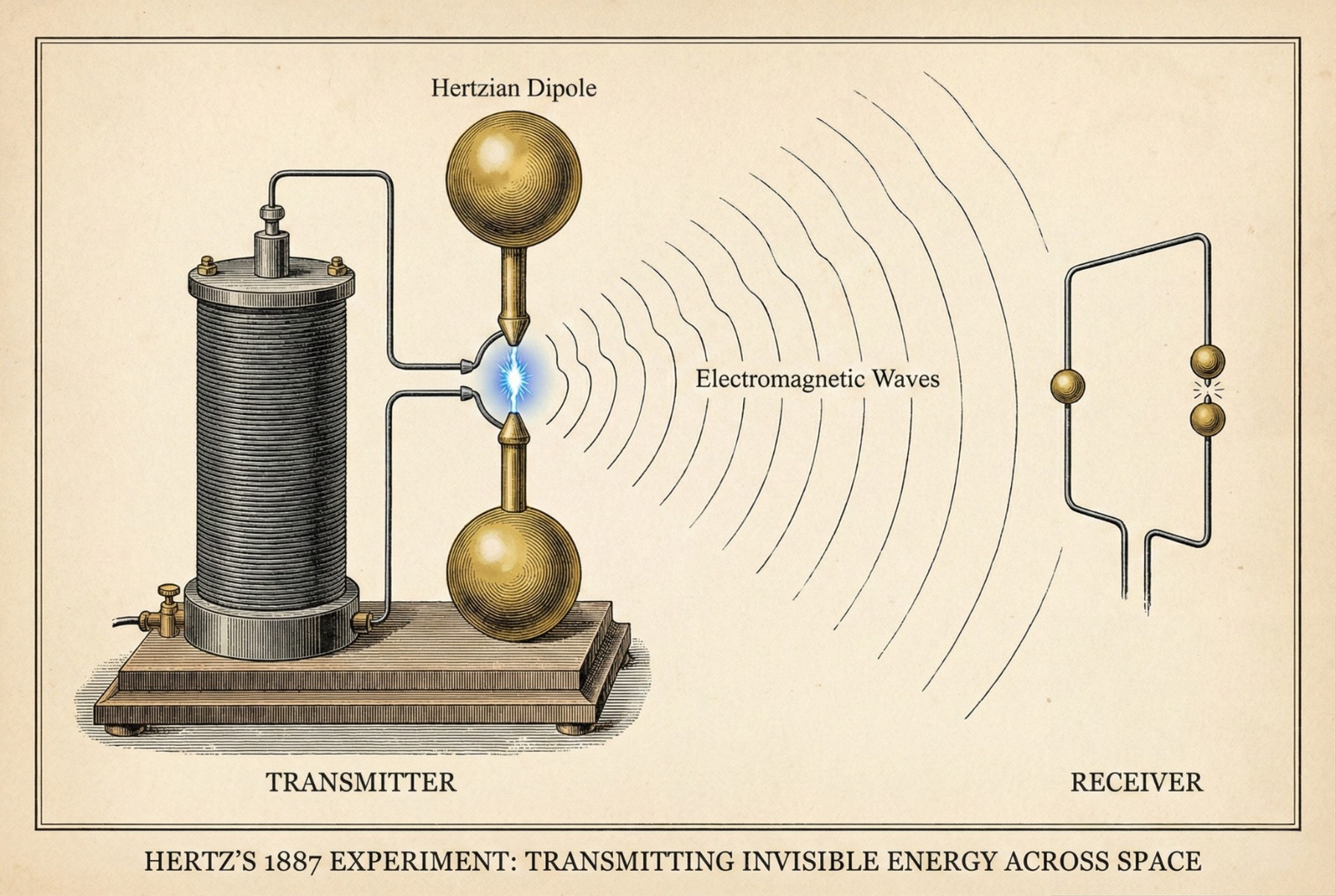
He built a transmitter consisting of a high-voltage induction coil connected to a "Hertzian Dipole"—two brass spheres separated by a tiny air gap. When the coil was activated, a high-voltage spark would crackle across the gap. According to Maxwell’s theory, this oscillating spark should send invisible ripples of energy flying out into the room.
But how to catch them?
Hertz built a receiver that was nothing more than a loop of copper wire with a microscopic gap at the end. The theory was that if the invisible waves hit the wire, they would induce a tiny current that would jump across that gap.
In November 1887, in a darkened lecture hall, Hertz fired his transmitter. CRACK! The blue-white spark snapped between the brass spheres.
Hertz peered through the darkness at his simple wire loop held several meters away. There, barely visible to the naked eye, was a faint, microscopic spark jumping across the receiver gap.
There were no wires connecting them. Energy had traveled through the air. The "action at a distance" was real. He had touched the invisible.
Light and Radio are Twins
Hertz was a rigorous scientist. He wasn't satisfied with just making sparks jump. He wanted to know what these waves were.
In a series of brilliant experiments, he treated these invisible waves exactly like beams of light.
- He built a massive prism out of hard pitch (asphalt) and proved the waves could be refracted (bent), just like light through glass.
- He used sheets of zinc to prove the waves could be reflected, just like light off a mirror.
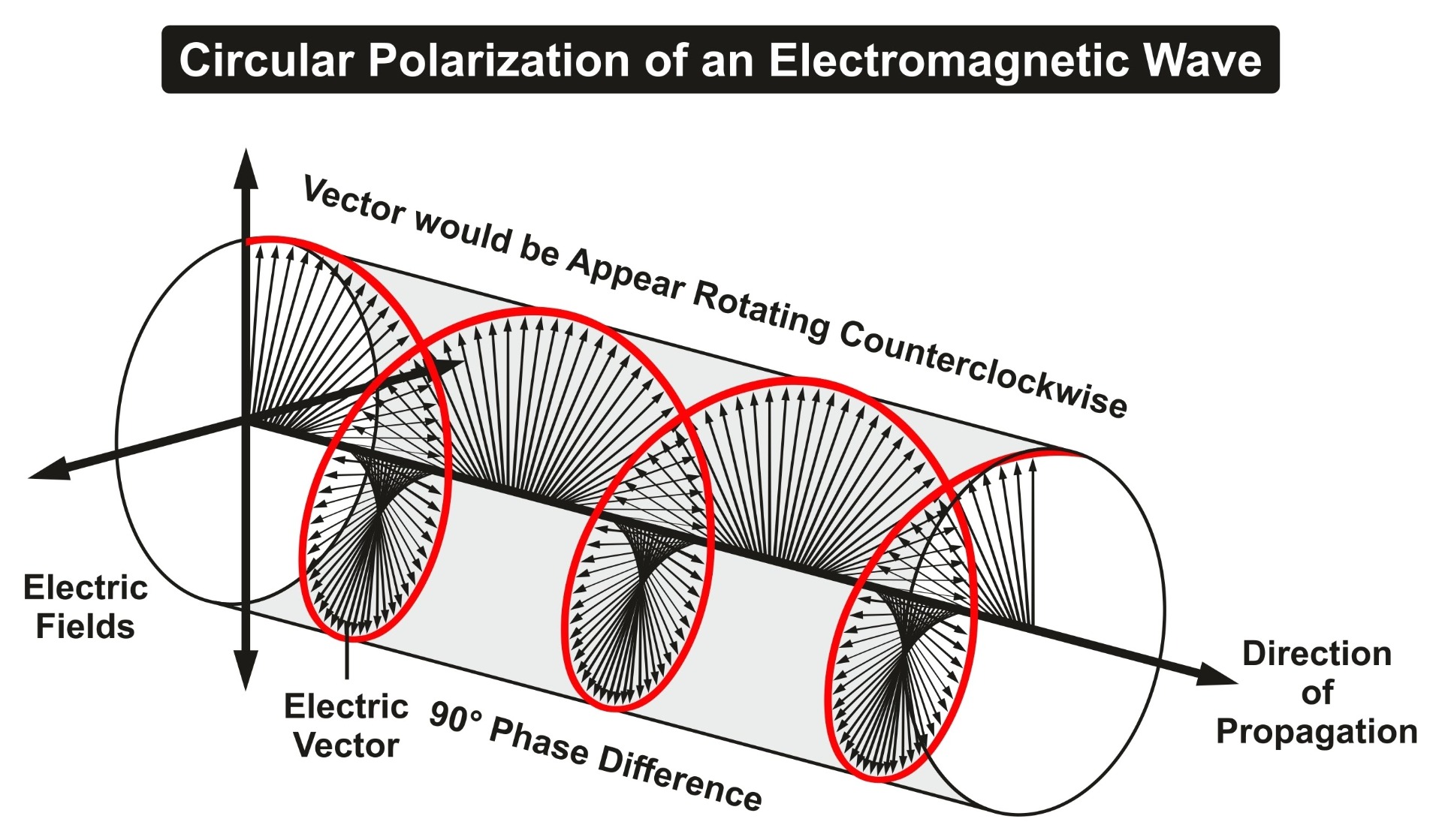
- He used a grid of parallel wires to prove the waves could be polarized.
This was the final piece of the puzzle. Hertz proved conclusively that "radio" waves and "light" waves were the exact same phenomenon—electromagnetic radiation—simply vibrating at different frequencies. He had unified the spectrum.
The Accidental Discovery: The Photoelectric Effect
During these experiments, Hertz stumbled upon another mystery. He noticed that the spark in his receiver loop was stronger and easier to produce when the ultraviolet light from the transmitter spark hit the metal directly. If he shielded the receiver from the light, the spark got weaker.
He carefully recorded this strange behavior, but he couldn't explain it.
He had accidentally discovered the Photoelectric Effect—the phenomenon where light striking a material knocks electrons loose. Hertz moved on, but his notes on this "nuisance" would eventually be picked up by a young patent clerk named Albert Einstein. Einstein’s explanation of Hertz’s accidental discovery—proving that light acts as a particle (photon)—would win Einstein the Nobel Prize and birth Quantum Mechanics.
The Tragedy of the "Pure Scientist"
Why didn't Hertz invent the radio? Why isn't his name on the patents that made Marconi rich?
The answer lies in the difference between a physicist and an engineer. Hertz was a "pure scientist." His goal was to verify a theory, to add to the sum of human knowledge. Once he proved Maxwell was right, his job was done. He lacked the practical imagination—or perhaps the capitalist drive—to see that these waves could carry messages.
Furthermore, his equipment was too insensitive for communication. His primitive "spark loop" receiver could only detect signals from a few meters away. It would take the invention of the Coherer (by Edouard Branly) and the grounded antenna (by Marconi) to turn Hertz's science into a technology.
Tragically, Hertz never got the chance to change his mind. In 1892, he developed a severe infection (likely Wegener’s granulomatosis), which led to a series of painful operations on his nose and throat. He died on New Year's Day, 1894, at the age of 36.

Legacy
Heinrich Hertz died before he could see Marconi send a signal across his garden, let alone the Atlantic Ocean. He died believing his work was "useless."
But history has corrected his humility. In 1930, the International Electrotechnical Commission (IEC) officially established the unit of frequency as the Hertz.
Hertz found the waves, but he didn't ride them. He left that for the dreamers who followed. But every time a signal travels through the air to bring you news, music, or a voice from a loved one, it is traveling on the path that Heinrich Hertz cut through the darkness.
For more information, please visit our online store or alternatively contact us and our team will be happy to assist you!