

Ask almost anyone on the street who invented radio, and one name will invariably come up: Marconi. It’s the name that adorns equipment, companies, and awards a century later. While historians and engineers know the true story is far more complex—woven from the brilliant contributions of Hertz, Branly, Lodge, Tesla, and many others—Guglielmo Marconi remains the undisputed figurehead of the wireless revolution.
He was not a classically trained physicist, nor was he the original inventor of many of the components he used. But Marconi possessed a different kind of genius. He was the supreme integrator, the visionary entrepreneur who took delicate laboratory curiosities and forged them into a robust, globe-spanning communication system. Today, in our 'Pioneers of Radio' series, we look beyond the myth to meet the man who defied scientific consensus, gambled everything on the impossible, and fundamentally changed human communication forever.
The Attic Tinkerer: Inspiration at Villa Griffone
Guglielmo Marconi was born in Bologna, Italy, in 1874, the son of a wealthy Italian landowner and an Irish mother whose family owned the Jameson whiskey distillery. Unlike many of the academics we’ve covered in this series, Marconi had little formal university training. He was, however, possessed by an intense, almost obsessive, curiosity about electricity.
The spark that ignited his life's work came in 1894, when he read an obituary for Heinrich Hertz, the German physicist who had experimentally proven the existence of electromagnetic waves. While most physicists saw "Hertzian waves" as a fascinating scientific phenomenon to be studied in a lab, the 20-year-old Marconi saw something else entirely. He saw a way to send messages without wires.
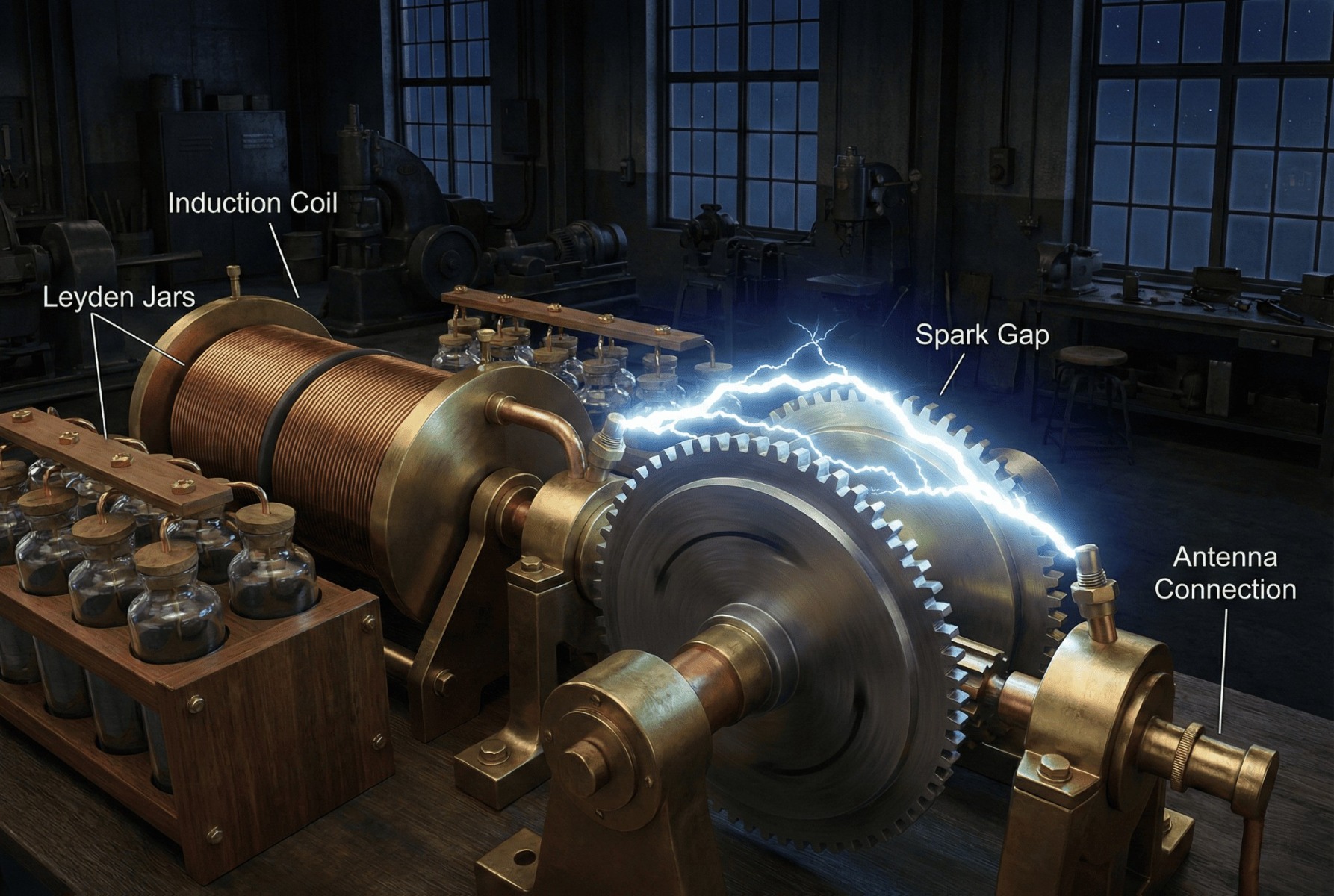
Image: Spark Gap, TX
He retreated to the attic of his family’s estate, Villa Griffone, turning it into a makeshift laboratory. There, surrounded by coils, batteries, and crude spark-gap generators, he began to tinker. He replicated Hertz’s experiments and incorporated the coherer detector invented by Édouard Branly and refined by Oliver Lodge.
At first, he could only ring a bell across the room. But he was relentless. He slowly increased the range, moving his receiver out into the garden. The defining moment of his early experiments came in 1895. He sent his brother and an assistant over a hill behind the villa with a receiver and a shotgun. Marconi tapped his key in the attic. Moments later, the distant sound of a gunshot echoed back across the Italian countryside. He had successfully transmitted a signal beyond the line of sight, proving that these mysterious waves could travel over obstacles. The lab curiosity had just become a communication tool.
The Crucial Insight: The Grounded Vertical Antenna
Marconi’s success wasn't just due to persistence; he made a critical technical leap that differentiated his work from the physicists before him.
Heinrich Hertz and Oliver Lodge were using what we would now call dipole antennas—relatively small metal rods perfectly suited for generating high-frequency waves across a laboratory workbench. Marconi realized that to get real distance, he needed something radically different. Through trial and error, he developed the grounded vertical antenna.

Instead of using two small rods, Marconi connected one side of his spark transmitter (and receiver) to a tall vertical wire suspended in the air—the aerial. The other side he connected directly to the Earth itself via a metal plate buried in the ground.
This was a monumental change. By connecting his system to the ground, he was essentially using the Earth as part of his circuit. This configuration drastically lowered the frequency of the radio waves and increased the power radiated. More importantly, it generated ground waves—radio waves that hugged the curvature of the Earth, allowing them to travel far beyond the horizon. While he didn't fully understand the physics at the time, this practical discovery was the key to unlocking long-distance communication.
The Entrepreneur: Britain and the Business of Wireless
Marconi knew he had something world-changing, but the Italian government showed little interest in his "wireless telegraph." Undeterred, and aided by his mother’s connections, he took his invention to the world’s greatest maritime power: Great Britain.
Arriving in London in 1896, the young, well-dressed Italian caused a sensation. He filed the world’s first patent for a system of wireless telegraphy. Britain, with its massive merchant fleet and navy desperate for ship-to-shore communication, was the perfect market. He demonstrated his system to the Post Office and the Admiralty, steadily increasing the range from miles to tens of miles, eventually spanning the English Channel.
In 1897, he founded the Wireless Telegraph & Signal Company (later the Marconi Company). Here, Marconi displayed a business acumen that matched his technical ambition. He realized that the real value wasn't just in selling boxes of wires; it was in controlling the network.
Marconi developed a business model based on providing a service. He didn't just sell a radio to a shipping line; he leased the equipment and provided the trained Marconi operator to run it. Crucially, company policy initially dictated that Marconi operators could only communicate with other Marconi stations (except in emergencies). This created a powerful monopoly; if a shipping line wanted to be part of the global wireless network, they had to go with Marconi. He had effectively captured the maritime communication market.
The Impossible Feat: Bridging the Atlantic (1901)
By the turn of the century, Marconi was famous and wealthy, but he was not satisfied. He had a grand, seemingly impossible vision: to send a wireless signal across the Atlantic Ocean.
The scientific establishment was united in its scepticism. Leading physicists argued that radio waves, like light waves, travelled in straight lines. They predicted that any signal sent from Europe would simply shoot off into space once it reached the horizon. To send a signal 2,000 miles over the curvature of the Earth was considered physically impossible.
Marconi, not being a physicist, simply refused to believe them. He bet his company’s fortune and his reputation on proving the experts wrong.
He built a massive, thunderously powerful transmission station at Poldhu on the cliffs of Cornwall, England. The roaring spark-gap transmitter, powered by a 25-horsepower generator, was terrifying to behold, discharging lightning-like bolts that could be heard miles away.
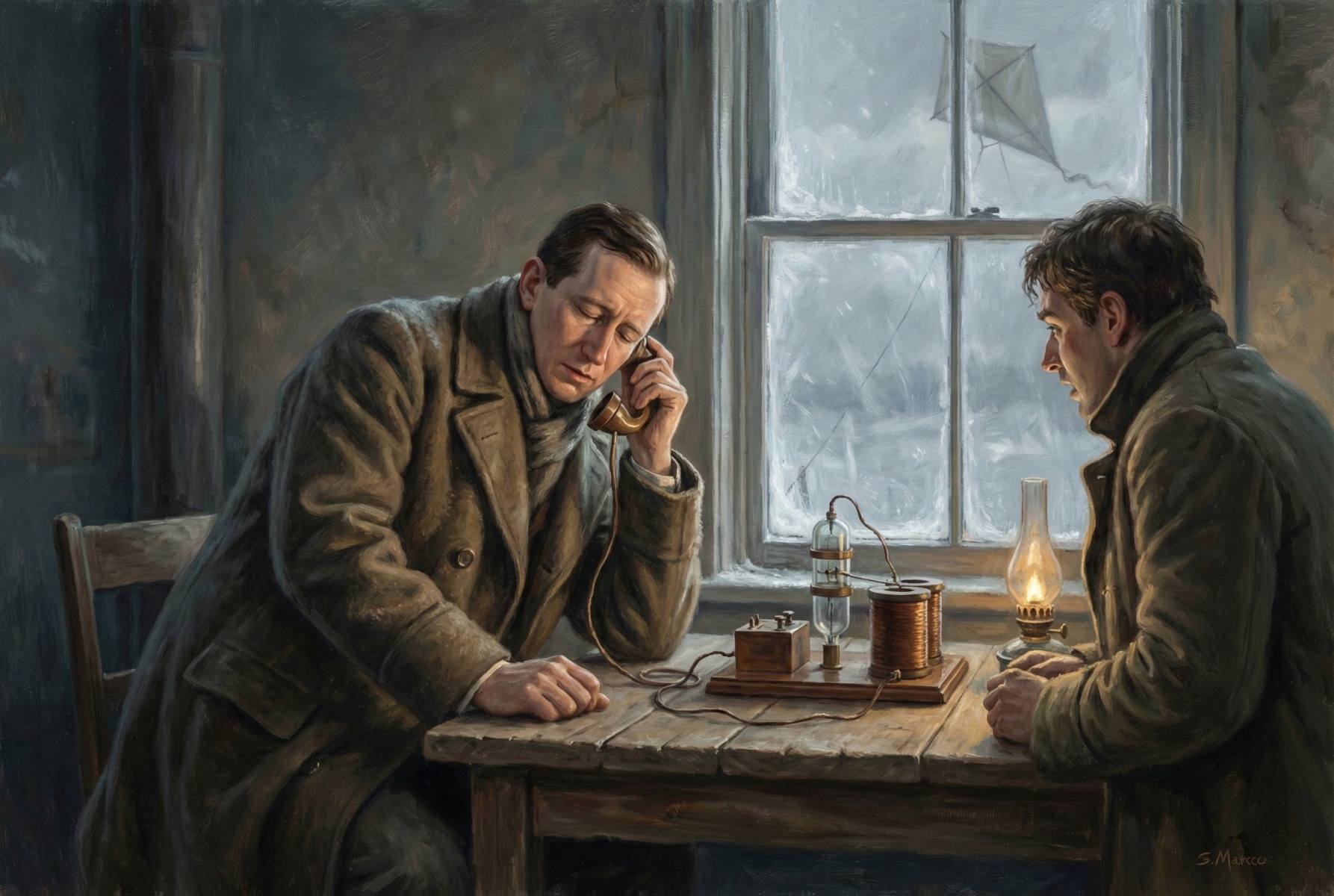
On the other side of the Atlantic, Marconi set up a receiving station on a bleak, freezing hill in St. John’s, Newfoundland (now part of Canada). In December 1901, amidst howling gales, he and his assistants struggled to launch kites and balloons to hoist their long wire antenna hundreds of feet into the stormy sky.
On December 12th, Marconi sat at his receiver, listening through the static of the atmospheric noise. At the appointed time, three faint, distinct clicks came through his headset—the dots of the Morse letter "S"—transmitted from Poldhu, over 2,000 miles away.
It was a sensation that stunned the world. Marconi had done the impossible. He had proven that radio waves could somehow bend around the globe. (He didn’t know it at the time, but the signals were bouncing off the ionosphere, a phenomenon later theorized by Oliver Heaviside, another of our pioneers). The world had suddenly, and dramatically, shrunk.
The Titanic and the maturity of Wireless
While the transatlantic test was a scientific triumph, it was a tragic event a decade later that cemented wireless as an indispensable part of the modern world. When the RMS Titanic struck an iceberg in April 1912, its two Marconi wireless operators, Jack Phillips and Harold Bride, stayed at their posts until the very end, tapping out distress signals.
Those signals were picked up by the liner Carpathia, which raced to the scene and rescued over 700 survivors. Without wireless, it is likely no one would have survived the sinking. Marconi, who happened to be in New York at the time, was hailed as a hero. The disaster led to international laws making wireless telegraphy mandatory on all large ships, ensuring the Marconi Company's dominance for years to come.
Wireless had moved from a novelty to a necessity for survival.
Synergies with Ham Radio: The Ultimate DXer
Marconi’s spirit is deeply embedded in the DNA of amateur radio. He was, in many ways, the ultimate "ham."
- The Spirit of DX: Marconi is the patron saint of DXing (long-distance communication). His relentless drive to push the range further, to make contacts that "experts" said were impossible, is the exact spirit that drives hams to chase distant stations and awards today.
- Antenna Experimentation: His tireless, trial-and-error experiments with tall verticals, kites, balloons, and grounding systems mirror the activities in countless ham shacks every weekend. He knew that the antenna was the secret to success.
- QRP to QRO: He started in an attic with tiny, feeble sparks (QRP) and scaled up to massive, ground-shaking stations to conquer the world (QRO).
Marconi himself recognized the contribution of amateurs. In later years, when professional thinking was stuck on long waves, it was radio amateurs who pioneered the use of shortwaves for global communication. Marconi, always the innovator, paid attention, saw the potential, and developed his highly efficient shortwave "beam system" in the 1920s, proving he was still willing to learn and adapt.
Conclusion: The Great Synthesizer
Guglielmo Marconi was a complex figure—a fierce competitor, a ruthless businessman, and a man driven by immense ego. Yet, his contribution to humanity is undeniable. He was the great synthesizer, the visionary who saw the practical potential in scattered scientific discoveries and combined them into a world-changing technology.
He took radio from a laboratory curiosity and turned it into a global utility. He connected ships at sea to the shore, and continents to one another. His unwavering belief in the power of the wireless signal shrunk the globe and laid the physical foundation for the interconnected, always-on world we live in today.
What are your thoughts on Marconi's legacy? Do you see him as the inventor of radio, or as the brilliant entrepreneur who brought it to the world? Let me know in the comments below!
For more information please visit our online store or alternatively contact us and our team will be happy to assist you!