
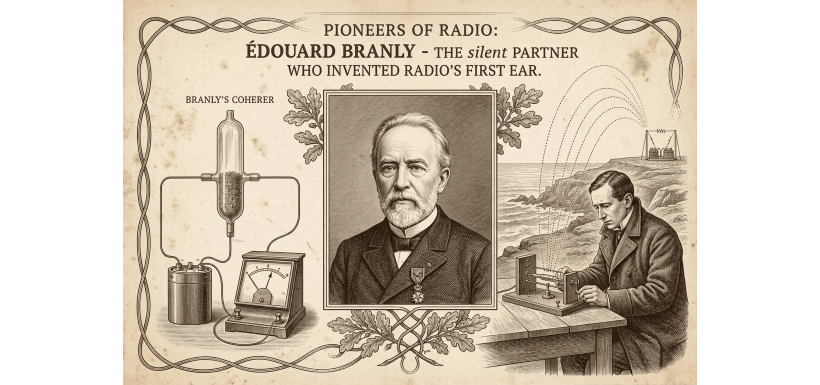
In 1909, the scientific world paused to watch the awarding of the Nobel Prize in Physics. The honor, for "contributions to the development of wireless telegraphy," went to two men: the magnetic, business-savvy Guglielmo Marconi, and a German physicist named Karl Ferdinand Braun.
Marconi’s fame was assured, but in laboratories across France, the mood was not celebratory. It was one of outrage. Scientists, journalists, and public figures believed a crucial name had been stolen from the list.
They were furious that the Nobel committee had overlooked a quiet, humble professor from the Institut Catholique de Paris. A man who, a full five years before Marconi’s first tests, had invented the single most important component of early radio.
His name was Édouard Branly.
Branly was the "silent partner" in the birth of the wireless age. He didn't build the giant transmitters, nor did he form the monopolies. He did something far more profound: he invented radio's first practical "ear." Marconi’s entire empire, which achieved the impossible feat of trans-Atlantic communication, was built squarely upon the extreme sensitivity of Édouard Branly’s fundamental invention.
The Humble Professor
Édouard Branly, born in Amiens, France, in 1844, was the antithesis of the commercial entrepreneurs who would later define radio. He was a pure scientist—a dedicated academic who viewed the study of physics as a pursuit of universal truth, not corporate profit.
While Marconi was a bold systems engineer focused on global communication, Branly was content in his dusty Paris laboratory, meticulously studying the way invisible electrical currents interacted with matter. He viewed his work as pure science, a continuation of the great French scientific tradition, and he showed almost zero interest in the commercial applications that others would quickly derive from his discoveries.
The Discovery of Coherence (1890)
The problem facing early radio experimenters in the 1890s was sensitivity.
Heinrich Hertz had proven that invisible "Hertzian waves" existed, but his receiver was a blind and deaf curiosity. It was just a loop of wire with a microscopic gap. It only worked within a few yards of the powerful transmitter, requiring a giant spark to create the tiniest flicker across the room.
If these waves were ever going to be useful for communication, they needed a device that could "hear" them from miles away.
Following Hertz's work, Branly began experimenting with the strange optical properties of invisible electricity. In 1890, while looking for a way to measure these fleeting waves, he reached for a common laboratory substance: fine metal filings.
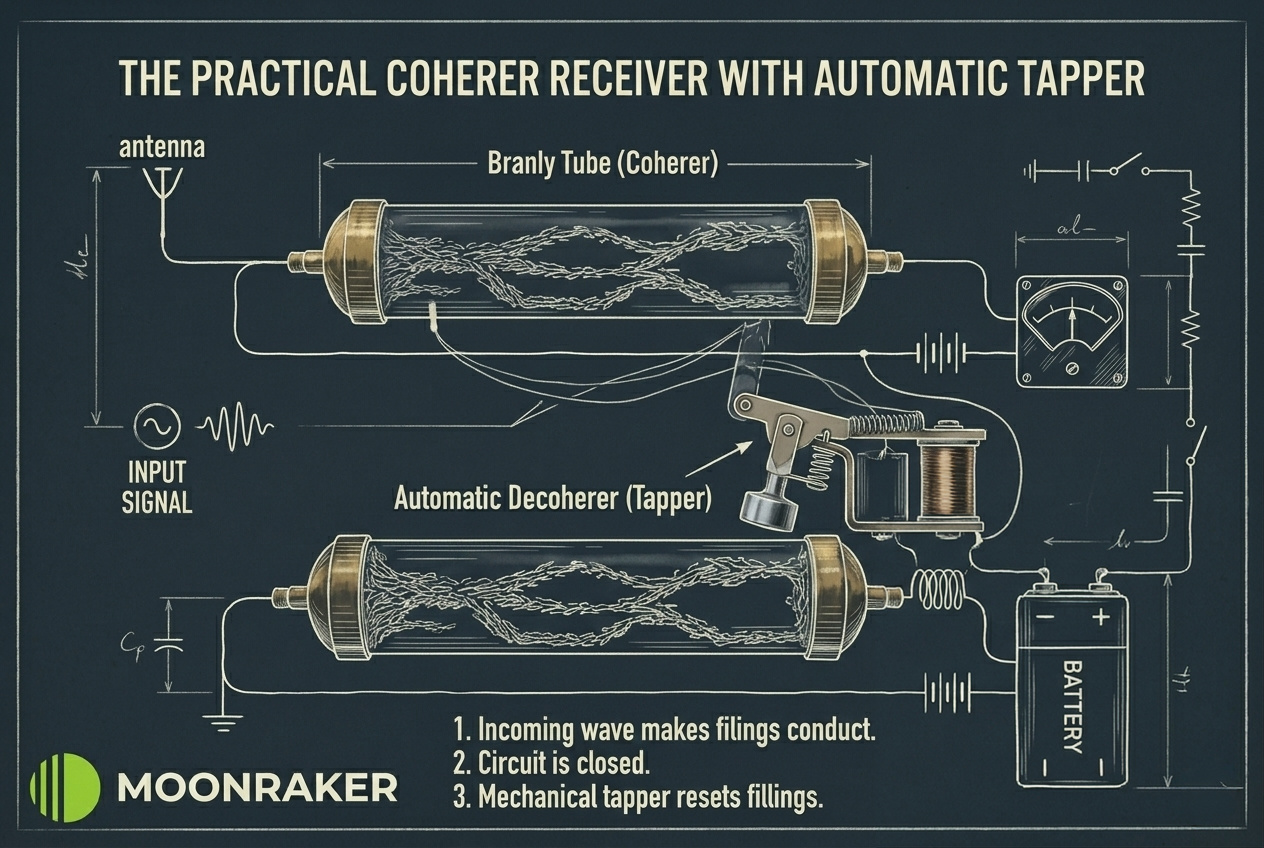
Image: Diagram of Branly's original 1890 coherence experiment, showing the tube of filings between brass terminals.
He filled a small glass tube with loose nickel and iron filings and suspended it between two brass terminals, connecting it to a battery and a simple measuring meter. Normally, loose filings are full of gaps and are terrible conductors; the meter registered only a whisper of current.
But then, Branly created an intense electrical spark on the other side of his workshop.
What happened next was magic. Instantly, the filings in the distant tube seemed to "clasp hands." They cohered, sticking together to form a solid conductive path. The resistance evaporated, and the battery current surged through the tube, causing the distant meter to jump violently.
He had made a switch. He had found a physical change triggered by invisible energy. He called this phenomenon "Radio-conduction."
The Coherer: Radio’s First Practical "Ear"
Branly had made a monumental discovery. He had created the very first device that could "capture" the fleeting energy of a radio wave and translate it into a measurable, continuous flow of battery current.
But his new component had a fundamental flaw. Once the filings cohered and stuck together, they stayed that way. The switch was "on." It couldn't reset itself to receive a second signal, meaning it couldn't handle the rapid on-off dots and dashes of Morse code.
It fell to others, most notably Sir Oliver Lodge (whom we covered in our previous post), to name Branly's device the "Coherer" and to invent the vital "tapper" (decoherer) to reset it automatically.
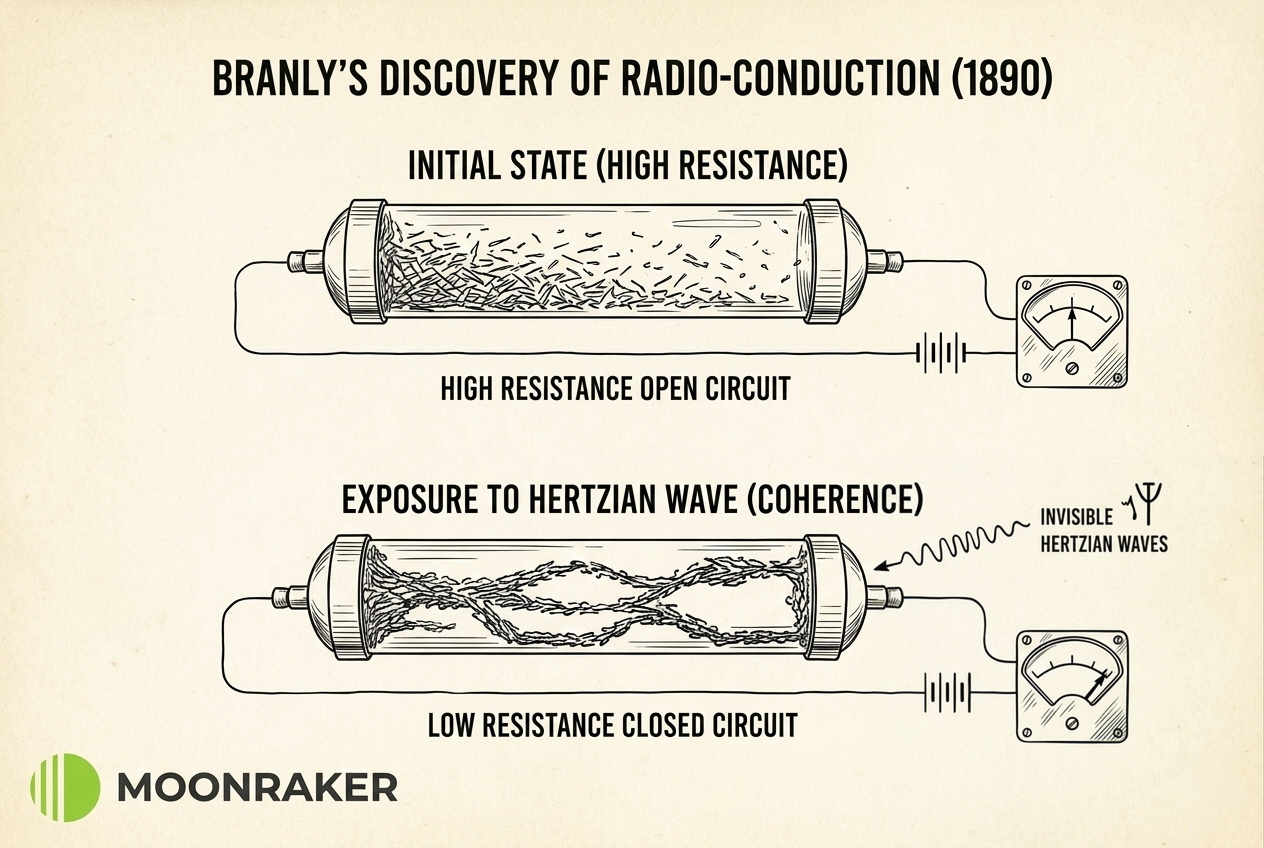
Image: Diagram of Branly Coherer with a mechanical decoherer tapper mechanism attached.
But the science belonged to Branly. From 1895 until the vacuum tube was perfected, "Branly’s Coherer" was the absolute, undisputed standard detector in every radio set in the world. It was the necessary sensitivity that turned radio from a lab curiosity into a world-changing communication tool.
The Heart of Marconi's System
This is where the relationship between the professor and the entrepreneur becomes clear. Marconi’s genius was not in deep physics. He was a brilliant systems engineer who synthesized the best components in the world to achieve a commercial result.
Marconi needed the most sensitive detector possible to send a signal across the Atlantic (1901). He didn't use a device he invented; he built his receiver entirely around a highly refined version of Branly’s highly sensitive "Italian Navy Coherer" design.
Without the extreme sensitivity of Édouard Branly’s discovery, the infinitesimally weak radio signal arriving in Newfoundland from Cornwall was simply too weak to be heard. Branly provided the crucial link. He provided the "ear" that made Marconi famous.
A Legacy of Controversy and Late Recognition
The scientific community’s memory is long, and the snub of Branly by the Nobel committee in 1909 was widely seen as a disgrace.
Why was Braun, who merely patented improvements, honored over Branly, who discovered the fundamental physics of detection? The scientific elite in France rallied around their humble professor, feeling he had been robbed by the forces of commercial power and patent law.
Branly himself, a true gentleman, never publicly complained. He quietly continued his teaching at the Institute Catholique, content to remain the pure scientist. He famously dismissed his oversight with a simple philosophy: "I made the discoveries; others made the inventions."
In his later years, recognition eventually arrived. He was awarded the French Légion d'honneur, and Pope Pius XI honored him with high pontifical decorations. He was celebrated by the public as a national hero of France, always remaining the quiet professor who preferred the solitude of his lab to the noise of the public square.
Conclusion: The Professor Who Unlocked the Future
Édouard Branly did not build the powerful spark transmitters that dominated the early airwaves. He did something far more vital: he built the receivers.
He was the humble physicist who gave radio its first sense of hearing. He discovered the subtle physical interaction that allowed invisible waves to become intelligible signals, providing the foundational sensitivity that enabled the entire Marconi empire to exist.
Every time we tune a modern digital receiver to a weak signal, we must pause to remember the quiet professor from Amiens who, in a dusty Paris lab, invented the vital tool that allowed the world to finally listen to the silence.
For more information please visit our online store or alternatively contact us and our team will be happy to assist you.