

Imagine the two most fundamental tools in a radio amateur's world: the transmitter that sends the signal out into the ether, and the oscilloscope that lets you see its very shape and form. It's almost inconceivable that these two cornerstones of our hobby – one for creating waves, the other for visualising them – could have a common ancestor. What if I told you that a single, brilliant German physicist was responsible for a foundational invention behind both? Today in our 'Pioneers of Radio' series, we meet Karl Ferdinand Braun, the Nobel laureate who invented the cathode-ray tube and perfected the radio transmitter, transforming wireless from a brute-force art into an elegant science.
Early Life and Academic Foundations
Ferdinand Braun was born in Fulda, Germany, in 1850. From an early age, he displayed a remarkable aptitude for the natural sciences. He pursued a distinguished academic path, studying at the University of Marburg before moving to the prestigious University of Berlin, where he received his doctorate in physics in 1872.
Braun was the quintessential 19th-century German professor – rigorous, meticulous, and deeply committed to experimental physics. He built a respected academic career, holding professorships at several universities, including Marburg, Strasbourg, and Tübingen. It was in this environment of scholarly inquiry and hands-on experimentation that he would make two of the most significant and surprisingly distinct breakthroughs in the history of electronics.
The Braun Tube (1897): Teaching Electrons to Draw
In the late 19th century, physicists and engineers were working blind. They could generate and use alternating currents, but they had absolutely no way to see what was happening. They couldn't visualise the waveform, check for distortion, or accurately measure its frequency. I can't even imagine trying to design a circuit without an oscilloscope; it would be utterly maddening, a case of fumbling in the dark.
Building on the work of physicists like William Crookes and his fascinating discharge tubes, Braun saw a solution. He took the basic principle of the Crookes tube – a stream of "cathode rays" (which we now know are electrons) travelling through a vacuum – and ingeniously adapted it into a measurement device.
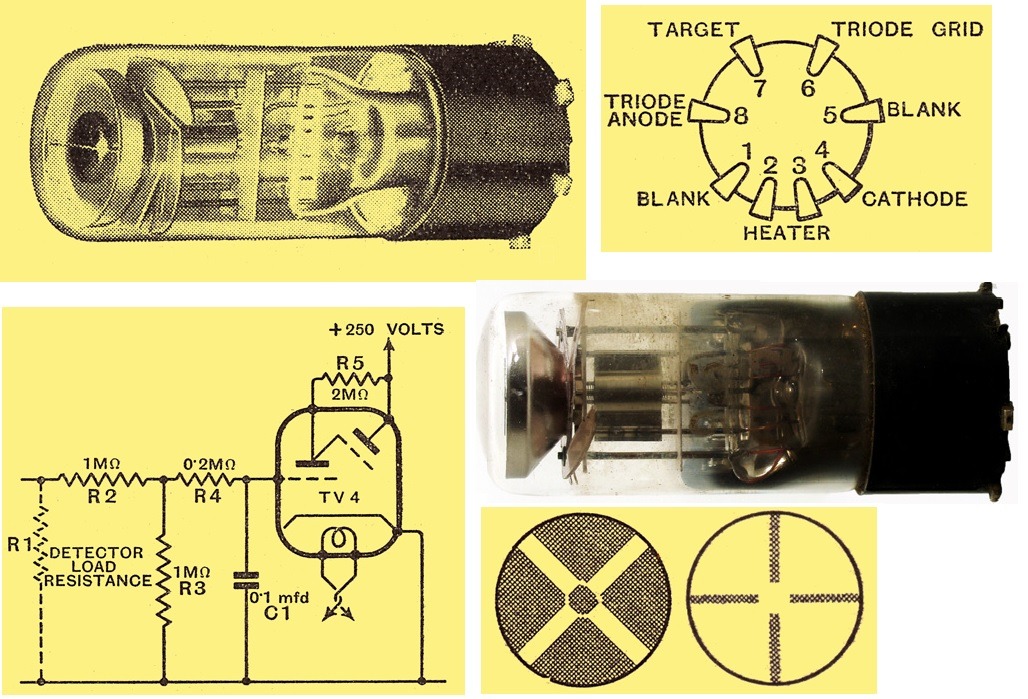
His invention, which he modestly called the thode-ray indicator tube" but which became universally known as the "Braun tube," was a masterpiece of scientific insight. Its key features were:
- A high-vacuum glass tube with a cathode at one end that, when heated, produced a narrow, focused beam of electrons.
- A fluorescent screen at the other end, coated with a material that would glow brightly where the electron beam struck it, creating a single, visible dot.
- And this was the genius part: a set of electromagnetic coils placed around the neck of the tube.
By passing the alternating current he wanted to study through these external coils, Braun created a varying magnetic field. This field would deflect the electron beam up and down at an incredible speed, precisely tracing the exact shape, or waveform, of the current on the screen. He had created the world's first cathode-ray oscilloscope.
This wasn't just a clever gadget; it was a revolutionary scientific instrument. For the first time, the invisible, lightning-fast dance of alternating current was made visible. It was like giving sight to the blind.
The Braun tube became the direct ancestor of every television picture tube, every radar display, and every oscilloscope that has ever sat on an engineer's or a ham's workbench.
Taming the Spark: Perfecting the Radio Transmitter
At the same time as he was inventing a way to see electricity, Braun turned his formidable intellect to the biggest problem in practical radio: the transmitter. Marconi's early spark-gap transmitters were groundbreaking, but they were also incredibly crude and inefficient.
The problem was that Marconi's circuit was "directly coupled." The spark gap, the tuning components, and the antenna were all part of a single, unified circuit. I like to think of it as trying to ring a beautiful church bell by hitting it with a sledgehammer. You get a massive, loud 'thud' and a chaotic, messy vibration that dies out almost immediately. This is what engineers call a heavily "damped" wave. It was a burst of raw energy spread over a huge range of frequencies, creating massive interference (QRM, in ham-speak) and wasting most of its power.
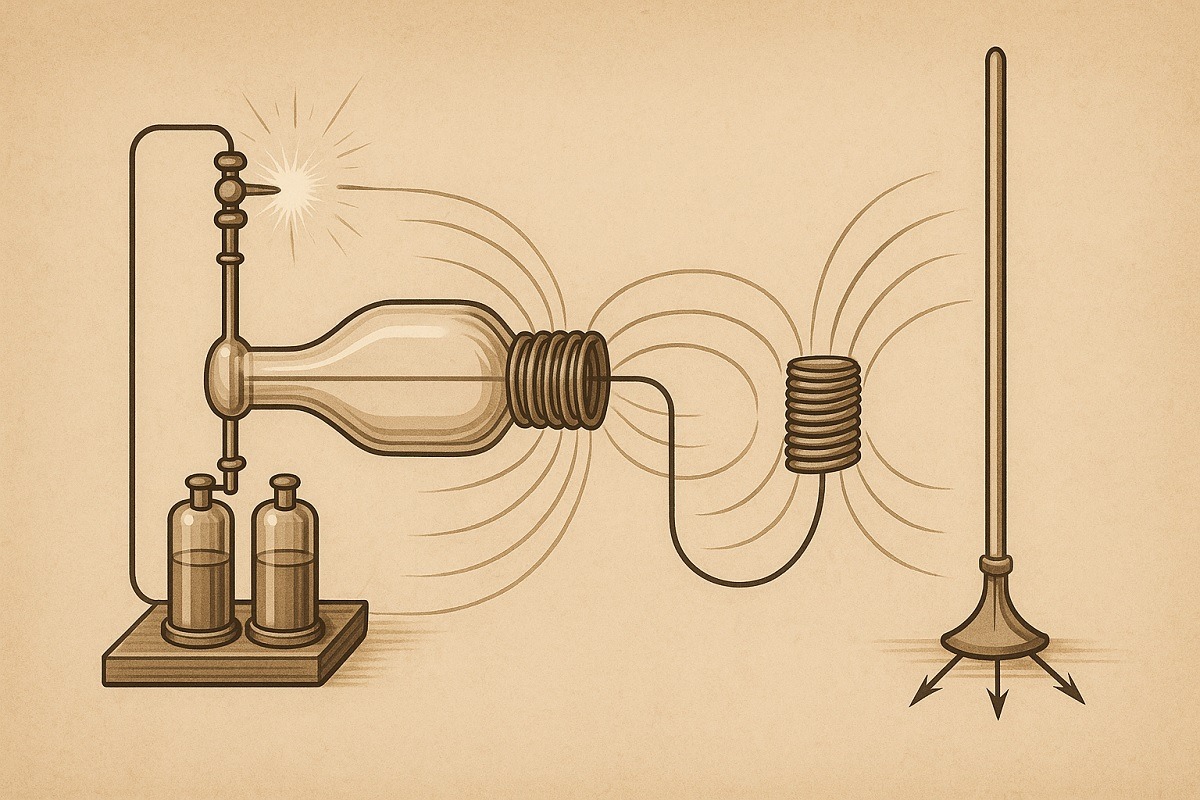
In 1898, Braun applied his rigorous physicist's mind to the problem and came up with a solution of pure elegance. He separated the system into two inductively-coupled circuits.
- The Primary Circuit (The Power Circuit):
- The Secondary Circuit (The Radiating Circuit):
This was a "closed" circuit containing the spark gap, capacitors, and an inductor. It was designed to do one thing and one thing only: oscillate powerfully and efficiently, building up energy into a sustained, clean wave. This was like striking the bell cleanly with a proper hammer, allowing it to ring with a pure, sustained tone.
This was an "open" circuit containing the antenna and its own inductor. This circuit was placed near, but not physically connected to, the primary circuit. The powerful oscillations in the primary circuit were transferred to the antenna circuit via magnetic induction – the same principle used in every transformer.
The results were transformative. Braun's inductively-coupled, or "sparkless," transmitter was vastly superior. It could handle much higher power, was far more efficient, and, most importantly, it produced a lightly damped, resonant wave. The signal was concentrated on a much narrower band of frequencies. He had replaced the sledgehammer with a tuning fork.
Beyond the Transmitter: A Glimpse into the Future
As if inventing the CRT and perfecting the transmitter weren't enough, Braun's work touched upon other areas that were years ahead of their time.
- The Crystal Detector:
- Phased Antennas:
While experimenting with crystals for his physics research, he discovered way back in 1874 that certain materials, like galena, exhibited a property called "asymmetrical conduction" – they would allow current to flow in one direction but not the other. This is the principle of rectification. In 1899, he patented this discovery, laying the groundwork for the crystal detector, which would soon replace the clumsy coherer and become the heart of millions of early, sensitive radio receivers.
Even more remarkably, he conducted pioneering experiments with phased antennas. He worked on arranging multiple vertical antennas and carefully phasing the signals fed to them to create a directional radiation pattern – the ability to aim the radio signal in a specific direction. This is the fundamental concept behind every modern beam antenna, from the Yagis on ham radio towers to the complex phased arrays used in radar and satellite communications.

The Nobel Prize and a Poignant End
Braun's immense contributions did not go unnoticed. In 1909, he shared the Nobel Prize in Physics with Guglielmo Marconi "in recognition of their contributions to the development of wireless telegraphy." It was a fitting tribute, acknowledging that the success of radio depended on both Marconi's visionary application and Braun's critical scientific improvements. His patents became a cornerstone of the German electronics giant, Telefunken, placing him at the centre of the great commercial and national rivalry against Marconi's British-based company.
Sadly, Braun's life had a poignant and unexpected final chapter. Before the United States entered the First World War, he travelled to New York City to testify in a patent lawsuit. Once the war began in earnest and America joined the Allies, he was unable to return to his beloved Germany. Classified as an "enemy alien," he was forced to live out his final years in Brooklyn, a world away from his German laboratory, a scientific giant in quiet exile. He passed away there in 1918, before the war had even ended.
Synergies with Ham Radio: The DNA of the Modern Shack
Ferdinand Braun's legacy is woven into the very fabric of amateur radio. It's almost impossible to overstate his influence:
- The Oscilloscope:
- The Transmitter Circuit:
- Clean Signals:
- Beam Antennas:
Every ham who uses an oscilloscope to check their transmitter's modulation, a spectrum analyser to hunt for signals, or even just looks at a waterfall display on their SDR is using a direct descendant of the Braun tube. He gave us the ability to see our signals.
Braun's inductively-coupled circuit is the ancestor of virtually every modern transmitter. The concept of a stable power oscillator being coupled to a radiating antenna circuit is fundamental to everything we do. It’s the reason we have antenna tuners, matching networks, and power amplifiers.
His work on creating a sharper, less-damped signal is the very foundation of good amateur practice – the constant effort to avoid QRM (interference) and transmit a clean, efficient signal that respects our fellow operators.
His early work on phased arrays was a glimpse into the future, directly foreshadowing the Yagis, quads, and other directional antennas that are the holy grail for any serious DXer looking to focus their signal and hear the world.
Conclusion: The Quiet Architect of the Electronic Age
Ferdinand Braun was the quintessential scientific engineer. He didn't just invent; he perfected. He brought a physicist's rigour and a deep theoretical understanding to the chaotic, trial-and-error world of early radio. He created the tools and techniques that were not just functional, but elegant and efficient. He truly tamed the unruly spark of early transmitters and taught electrons to draw pictures on a screen. In doing so, he helped build the foundations not just of radio, but of our entire electronic world.
What are your thoughts on Ferdinand Braun's incredible dual legacy? Does his story change how you think about the oscilloscope on your bench or the transmitter in your shack? Let me know in the comments below! And, as always, if you have suggestions for other "Pioneers of Radio" that you'd like to see featured, don't hesitate to share.
For more information please visit our online store or alternatively contact us and our team will be happy to assist you!
REFERENCE