
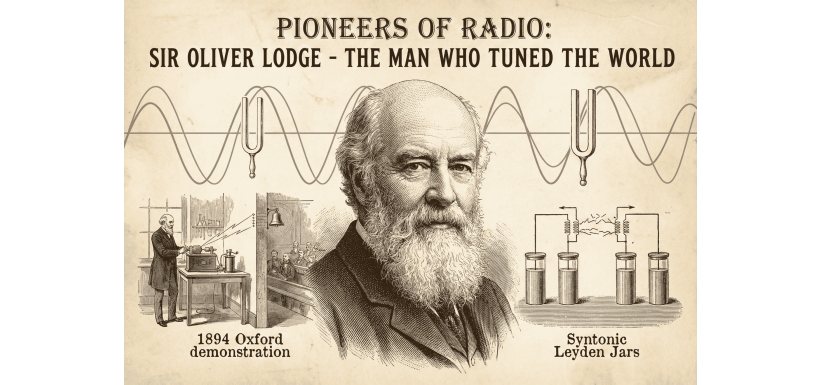
In the grand narrative of radio’s invention, there is a persistent legend of the "missed opportunity." It is the story of a man who held all the keys to the wireless kingdom in his hands years before Guglielmo Marconi became a household name, but who was too much of a pure scientist to unlock the door to commerce.
That man was Sir Oliver Lodge.
If Heinrich Hertz discovered the raw clay of radio waves, and Marconi built the factory that mass-produced them, Oliver Lodge was the artisan who refined the process. He took the chaotic, noisy sparks of early experiments and gave them intelligence. He invented tuning.
Without Oliver Lodge’s contribution, the airwaves would be a cacophony of useless noise. Every time you turn a dial in your car to select a specific station, ignoring thousands of others, you are using the principles discovered by this gentle, brilliant professor who famously admitted, "I was too busy working to bother with making money."
The Bridge from Hertz
The story begins in 1894 with the tragic, premature death of Heinrich Hertz, the man who first proved the existence of electromagnetic waves.
Oliver Lodge, a professor of physics at the University College of Liverpool, deeply admired Hertz. He decided the best way to honor the German physicist was to replicate his experiments and, if possible, improve upon the crude equipment Hertz had used.
Hertz’s main problem was his receiver—a simple loop of wire with a tiny gap. It was notoriously insensitive, only able to detect powerful signals from a few yards away. Lodge knew that for "Hertzian waves" to be useful for anything, they needed a better ear.
Lodge turned his attention to a laboratory curiosity discovered by Frenchman Édouard Branly. Branly had noticed that loose metal filings inside a glass tube normally resisted electricity. But if a radio wave hit them, the filings would suddenly cling together, closing the circuit and allowing electricity to flow.
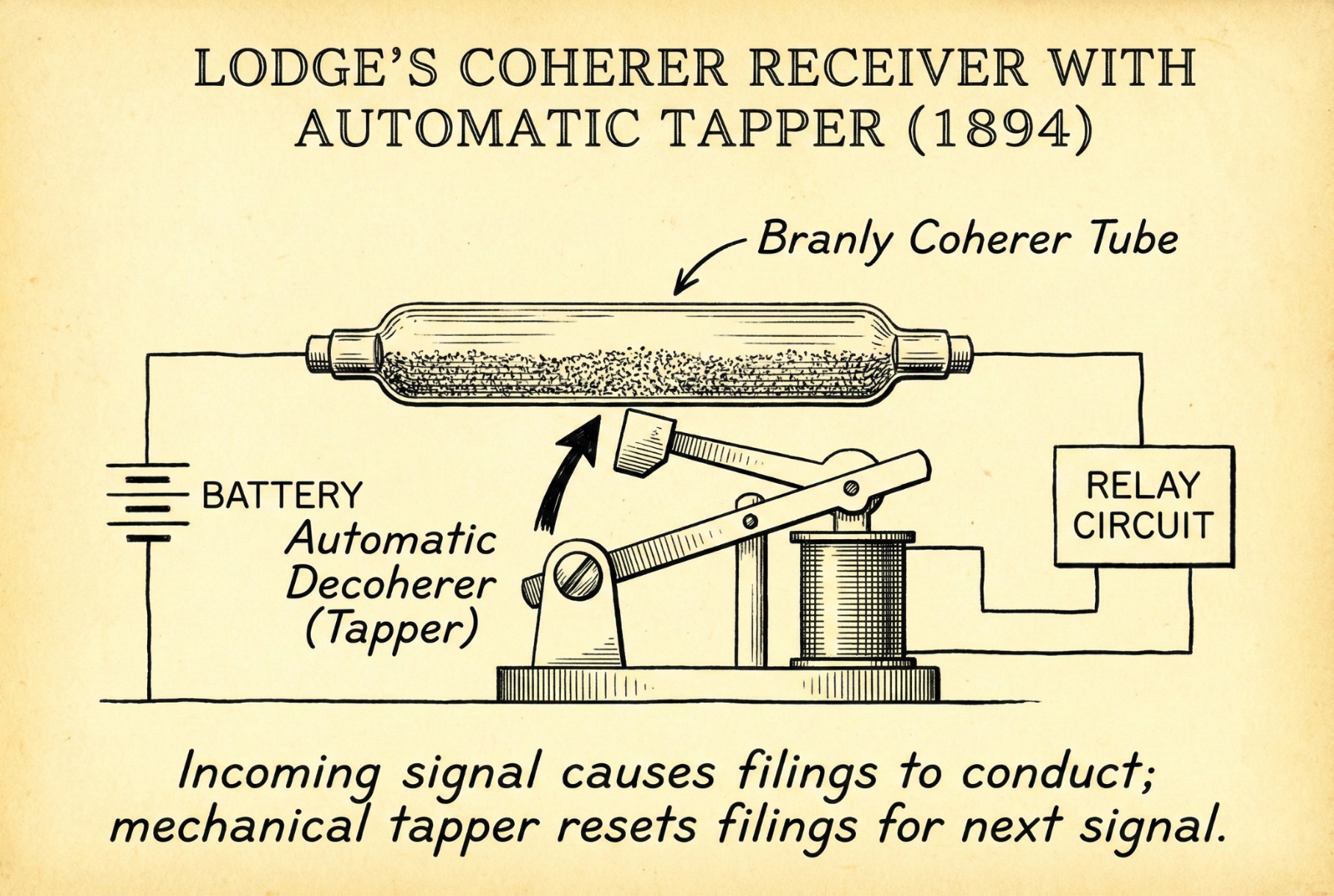
It was a brilliant detector, but it had a fatal flaw: once the filings stuck together, they stayed stuck. The receiver went "on" and couldn't turn "off" to receive the next dot or dash of Morse code.
Lodge’s innovation was elegantly simple. He realized the filings needed to be physically shaken loose after every signal. He built a device that used a small mechanical hammer—much like the striker inside an electric doorbell—to tap the glass tube automatically after every impulse.
He called this device the "coherer" (because the filings cohered) and combined it with the "tapper" (decoherer). Suddenly, he had a practical, sensitive radio receiver that could handle rapid Morse code.

The Oxford Demonstration: The "Missed Opportunity"
By the summer of 1894, Lodge was ready to show off his new apparatus. The setting was the prestigious annual meeting of the British Association for the Advancement of Science, held that year at Oxford University.
On August 14, 1894—a full year before Marconi’s first experiments in his father’s attic in Italy—Oliver Lodge demonstrated wireless telegraphy to a packed audience of Britain’s top scientists.
His transmitter was set up in the nearby Clarendon Laboratory building. His receiver, equipped with the new coherer and tapper, was in the University Museum lecture hall, about 60 yards away, separated by several thick stone walls.
As Lodge tapped out signals in the laboratory, a bell rang loudly in the lecture hall, and a galvanometer needle swung back and forth, proving the reception of the invisible waves.
It was a definitive demonstration of wireless communication. So why isn't Lodge credited as the inventor of radio?
The answer lies in intention. Lodge was a physicist, not an engineer or an entrepreneur. To him, this was not the birth of a new communications industry; it was a brilliant lecture demonstration proving the optical properties of Hertzian waves. He saw it as a scientific teaching tool, not a product to patent and sell.
He didn't file for patents on the system. He didn't seek investors. He simply published his findings in scientific journals, where a young Italian teenager named Guglielmo Marconi eagerly read them and realized exactly what the professor had missed.
The Big Idea: Syntony (Tuning)
While Marconi raced ahead with commercialization, Lodge turned his mind to the single biggest problem facing the nascent technology: interference.
Early spark-gap transmitters were "broadband" devices. They didn't transmit on a single, clean frequency like a modern radio station (e.g., 101.5 FM). Instead, they created a massive, chaotic splash of radio energy across the spectrum.
If you had two transmitters operating in the same city, they would utterly drown each other out. The receiver wouldn't know which signal to listen to.
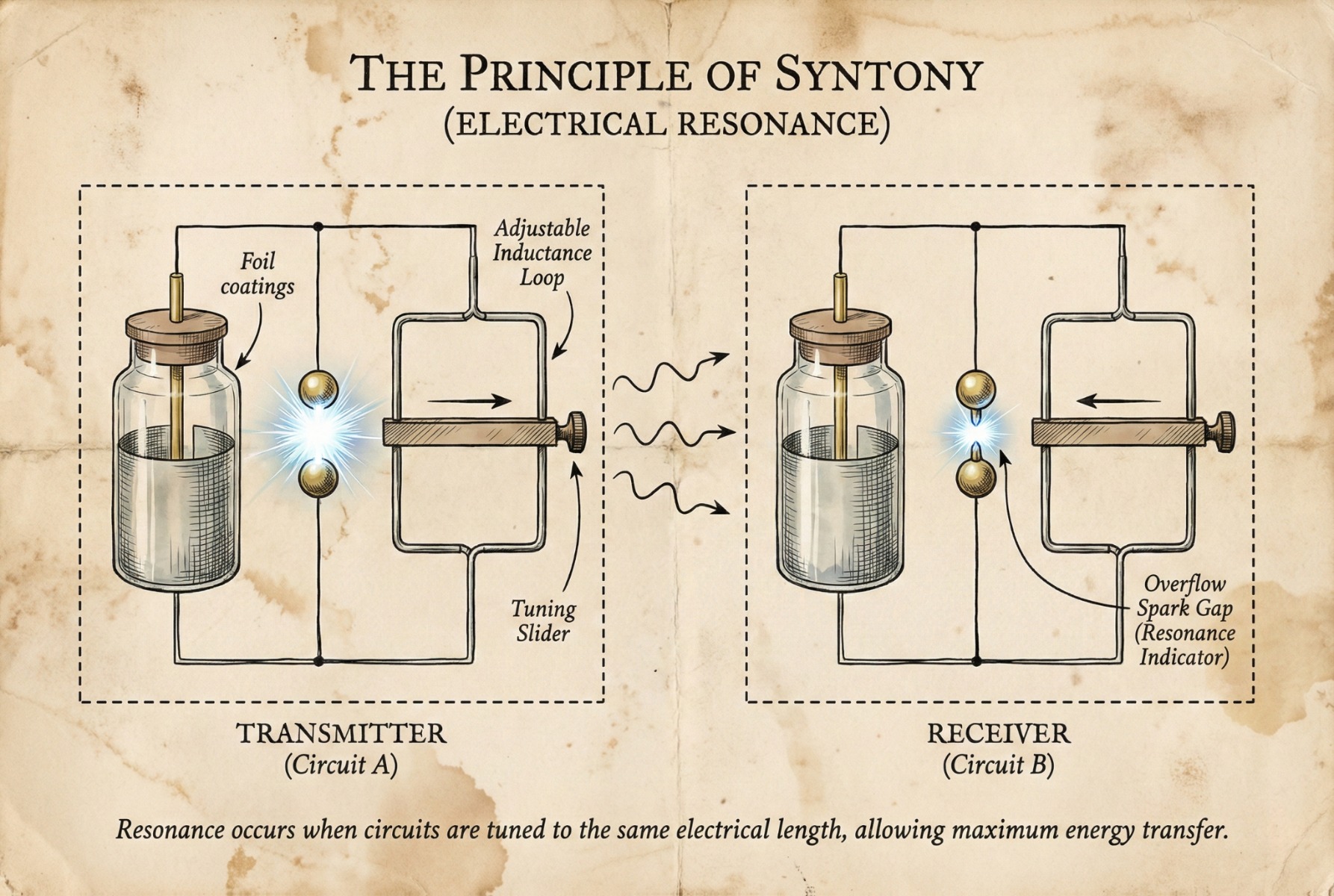
Lodge, with his deep understanding of physics, realized the solution lay in resonance. He thought of it like musical instruments. If you have two tuning forks of the exact same pitch across a room, striking one will cause the other to sympathetically vibrate. If they are different pitches, nothing happens.
Lodge applied this to electricity. He built circuits using Leyden jars (early capacitors) and adjustable loops of wire (inductors). By sliding the wires to change the length of the circuit, he could change its electrical "pitch," or resonant frequency.
He demonstrated that a receiver would only respond to a transmitter if they were both adjusted to the exact same electrical length—if they were in resonance. He called this concept "Syntony."
In 1897, Lodge finally filed the fundamental patent for "Syntonic" wireless telegraphy. It was the invention of tuning—the ability to select one station out of the noise.
The Battle with Marconi
Marconi initially dismissed tuning, believing brute power was the key to distance. But as more stations came online, interference became a nightmare. Marconi realized he needed tuning for his business to survive.
In 1900, Marconi filed his famous "7777" patent for a tuned system. To many observers, it looked suspiciously like a practical application of Oliver Lodge's Syntony patent from three years earlier.
Lodge, usually a non-confrontational man, eventually realized he was being cut out of the revolution he helped start. He challenged Marconi in court. The legal battle was protracted, but the science was undeniable. Syntony belonged to Lodge.
In 1911, the mighty Marconi Company was forced to settle. They purchased Lodge’s patent for a massive sum and paid him an annual salary as a "scientific advisor," essentially paying him not to compete with them. It was a complete vindication of his work.
The Spiritualist Turn
Sir Oliver Lodge lived a long life, dying in 1940 at the age of 89. However, his reputation among hardline scientists suffered in his later years due to a tragic turn in his personal life.
During World War I, his youngest son, Raymond, was killed in Flanders. Devastated, Lodge turned his scientific mind toward the study of the afterlife. He became a prominent leader in the Spiritualist movement, attending séances and writing best-selling books claiming he was communicating with his dead son through mediums.
While Lodge saw this as a legitimate extension of his investigation into invisible forces, many of his colleagues saw it as embarrassing pseudo-science. This obsession tended to overshadow his genuine scientific achievements in the public eye during the mid-20th century.
Conclusion: The Professor Who Unlocked the Door
Today, Sir Oliver Lodge is recognized as the crucial link between the pure theory of Hertz and the commercial reality of Marconi.
He provided the hardware—the coherer with its tapper—that made receivers sensitive enough to be practical. More importantly, he provided the intelligence—Syntony—that allowed radio to scale from a single curiosity into a global network of thousands of simultaneous stations.
He was the benevolent professor who unlocked the door to the future, even if he stepped aside to let a more aggressive salesman walk through it first.
For more information please visit our online store or alternatively contact us and our team will be happy to assist you.