
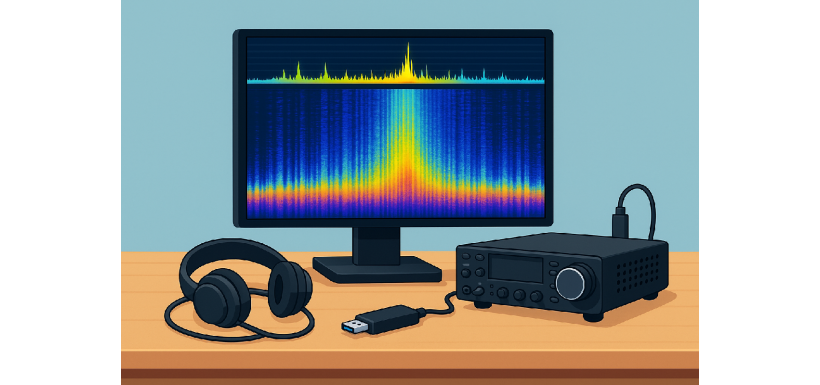
For most of my radio life, tuning the bands was an act of faith. You'd turn a dial, listening intently through the hiss and crackle for a faint voice to emerge from the noise. You were essentially blind, navigating an invisible world with only your ears as a guide. Then, SDR came along, and for the first time, we could see the radio spectrum. I'll never forget the moment a vibrant, living waterfall of signals first scrolled across my screen; it was a complete revelation, and it fundamentally changed my relationship with the hobby forever.
But what exactly is a Software Defined Radio, or SDR? In simple terms, it's a radio where the complex, dedicated hardware components of old are replaced by clever software. It represents a paradigm shift in how we interact with radio waves. In this post, we'll explore the journey of SDR – where it came from, how it works, and the truly transformative benefits it offers compared to the traditional radios we all grew up with.
The Old Guard: A Quick Look at the Superheterodyne
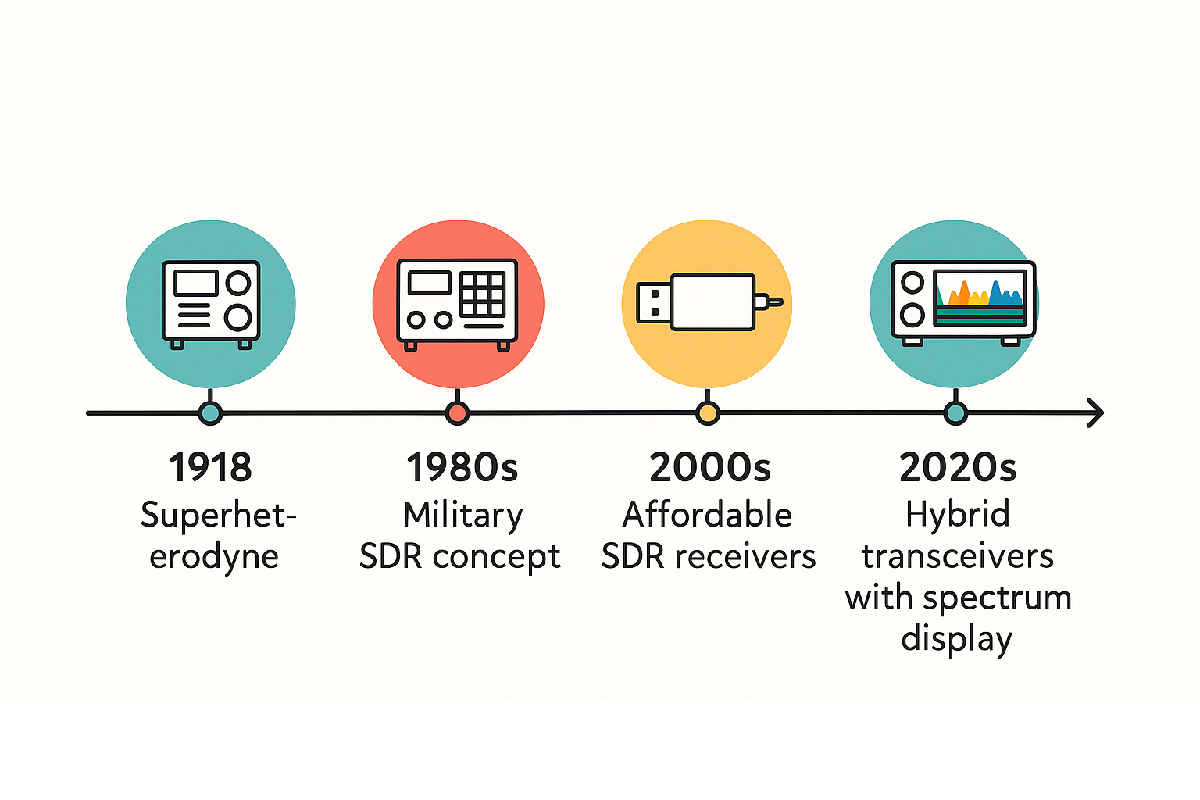
To truly appreciate the SDR revolution, we first need to understand the king it dethroned: the superheterodyne receiver. For nearly a century, this architecture, developed by another of our great pioneers, Edwin Armstrong, was the undisputed champion of radio design, and for good reason. It was, and still is, a powerful and effective design.
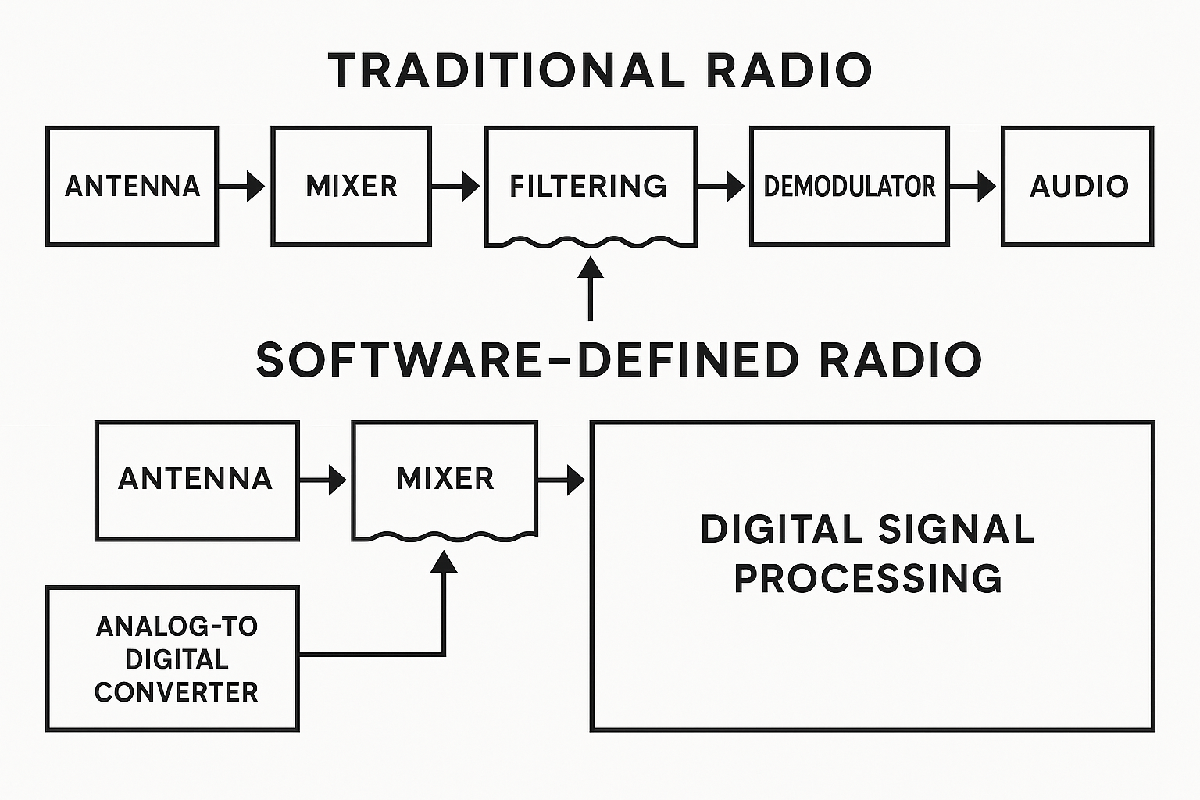
Think of a traditional superhet radio like a highly specialised factory assembly line, with each stage performing a very specific, hardware-defined task.
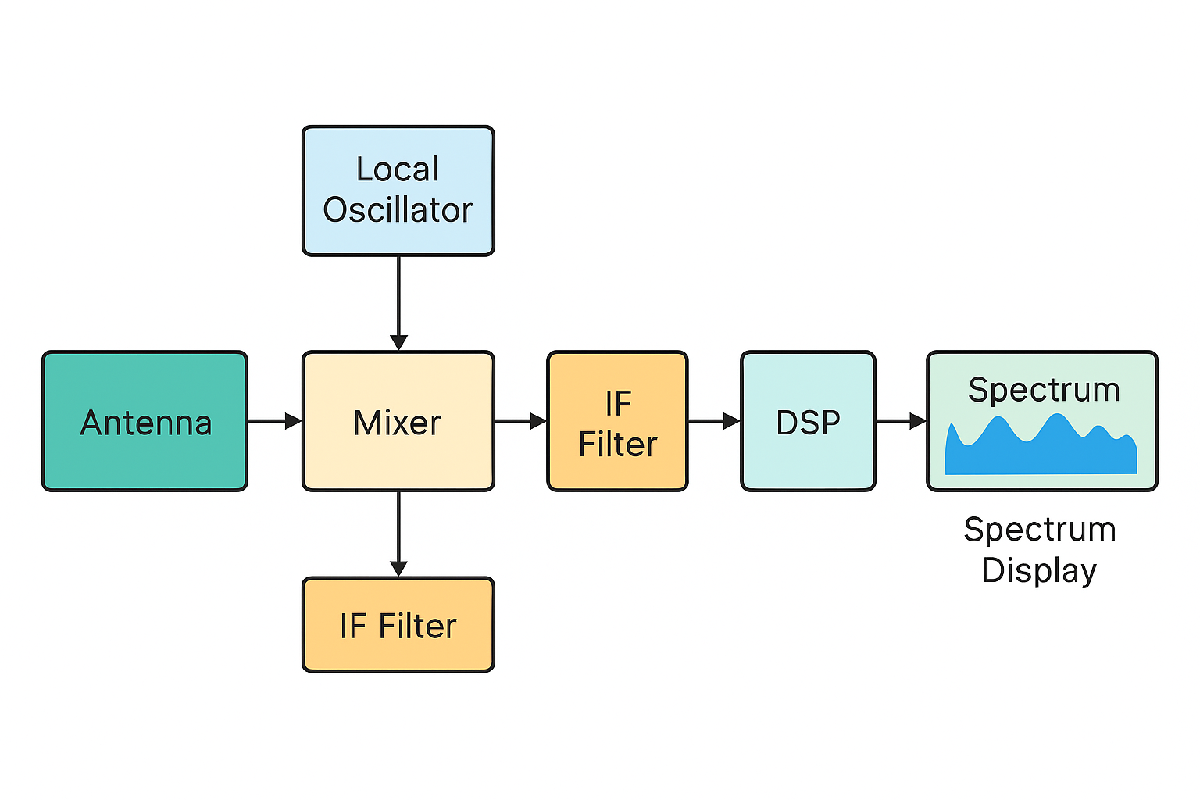
- An incoming radio frequency (RF) signal from the antenna arrives at the first stage.
- It's then fed into a mixer, which combines it with a signal from a local oscillator (the bit connected to your VFO knob). This clever process converts the signal down to a fixed, lower frequency known as the Intermediate Frequency or IF.
- It's at this fixed IF that the real magic of the superhet happens. The signal passes through a series of highly precise, physical hardware filters – often beautiful components made from quartz crystal. These filters have a fixed bandwidth and are designed to select the one signal you want to hear while rejecting the others nearby.
- Finally, the filtered signal goes to another hardware stage, the demodulator, which extracts the audio you hear from the speaker.
The superheterodyne is a brilliant piece of engineering, but its greatest strength is also its core limitation: its functions are locked into its hardware. Want a narrower filter for CW? You have to physically switch in a different crystal filter. Want to listen to a new digital mode? You'll likely need a new hardware board or an entirely new radio. It’s powerful, but it’s rigid.
The Birth of a New Idea: The SDR Concept
The idea of a radio where software could define its function didn't just appear in a hobbyist's shack. Its roots lie in military and government research labs back in the 1980s. The strategic goal was to create incredibly flexible, interoperable communication systems. Imagine a single radio that could be reconfigured in the field to talk to different allied forces using different standards, or adapt to new enemy frequencies, all without needing a complete hardware replacement.
This ambitious vision was championed in the early 1990s by a researcher named Joseph Mitola, who pioneered and popularised the term "Software Radio." He envisioned a truly reconfigurable platform, a kind of 'chassis' that could become any type of radio imaginable, just by loading different software.
The primary hurdle holding this vision back was technology. Early development was severely limited by two key factors:
- The Speed of Converters: An SDR needs to digitise a wide slice of the radio spectrum all at once. This requires an Analog-to-Digital Converter (ADC) with an incredibly high sampling rate and high precision. In the '80s and '90s, ADCs fast enough for this were astronomically expensive and power-hungry.
- Processing Power: Once you've digitised that huge chunk of spectrum, you have to process that vast amount of data in real-time. This is a task that requires immense computational horsepower, delivered by Digital Signal Processors (DSPs), Field-Programmable Gate Arrays (FPGAs), or incredibly fast CPUs – processing power that simply wasn't readily available or affordable.
For years, SDR remained a high-cost, military-grade technology. But as the 2000s rolled on, Moore's Law worked its magic. ADCs became faster and cheaper, and the processing power available in personal computers and dedicated chips skyrocketed. Suddenly, SDR began its transition from a secret-service technology to a viable commercial and, most excitingly, a hobbyist tool.
How a Modern SDR Works (and Why It's Magic)
A modern "direct-sampling" SDR takes a radically different and wonderfully elegant approach compared to the superhet. Instead of that long factory assembly line of hardware stages, imagine a single, incredibly fast digital camera taking billions of "pictures" of the entire RF spectrum every second.
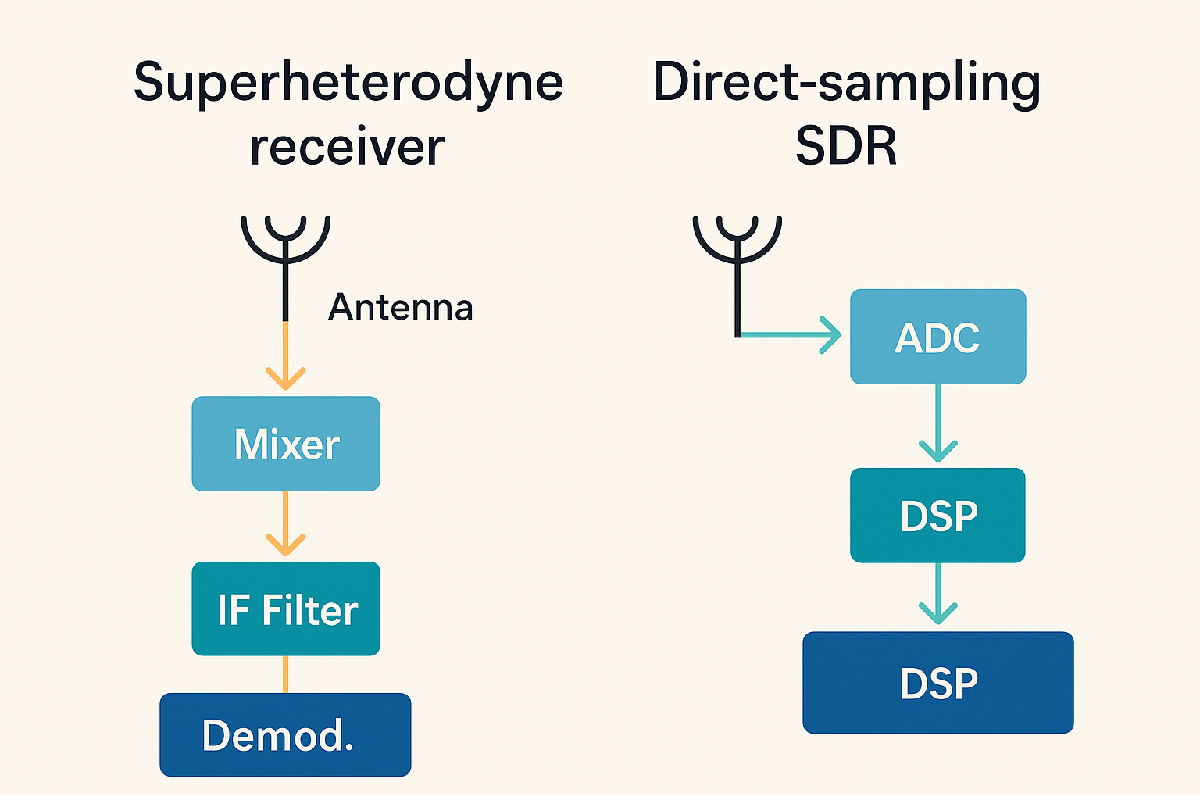
- The signal from the antenna passes through a minimal analog front-end, usually just some basic filtering and perhaps some amplification to get the signal level right.
- This raw, wideband RF signal is then fed directly into a high-speed ADC. This converter digitises a huge chunk of the spectrum at once – sometimes many megahertz wide.
- From that point on, everything is just data. A stream of numbers flows from the ADC to a computer or an onboard processor.
This is the paradigm shift. The critical radio functions are no longer performed by hardware components. Tuning, filtering, and demodulating are now just mathematical algorithms.
- Tuning to a specific frequency is simply a matter of mathematically selecting a slice of the digitised data.
- Filtering out adjacent signals is done by applying a mathematical filter to that data.
- Demodulating AM, FM, SSB, or any other mode is achieved by running the data through a specific software algorithm. The hardware simply captures the raw spectrum; the software does all the clever work. It’s an incredibly flexible and powerful architecture.
The Transformative Benefits of SDR
This shift from hardware to software provides several truly transformative benefits that have reshaped the radio experience.
- A New World of Flexibility
- The Waterfall Display: The Greatest User Experience Leap in Radio History
- See band openings as they happen: You can watch a whole band come to life as propagation improves, seeing signals appear where there was only noise moments before.
- Instantly find a clear frequency: There's no more "Is this frequency in use?" You can see at a glance where the empty spaces are.
- Diagnose interference: You can visually identify sources of noise and interference, seeing their spectral signature and making them easier to track down.
- Discover weak signals: Often, you can see the faint trace of a weak CW or digital signal on the waterfall long before you can hear it, allowing you to zero in on it and pull it out of the noise.
- Near-Perfect Performance
- Future-Proofing Your Station
This is the most obvious advantage. In a traditional radio, if you want a 500 Hz CW filter and a 2.7 kHz SSB filter, you need two separate, expensive, physical crystal filters. In an SDR, you simply tell the software what bandwidth you want. You can drag a filter's edges with your mouse, creating a filter of almost any bandwidth you desire, from a few hertz for weak-signal digital modes to many kilohertz for high-fidelity FM, all on the fly. You can switch instantly between AM, FM, SSB, CW, and complex digital modulation schemes like FT8, DMR, or D-STAR with a click of a mouse, because each mode is simply a different software algorithm running on the same hardware.
For me, and for many radio amateurs, this is arguably the single greatest benefit of SDR. For the first time, we can see the radio spectrum in real-time. The waterfall or panadapter display shows a live, scrolling graph of signals across a wide frequency range.
This visual interface is more than just eye-candy; it fundamentally changes how you operate. It allows you to:
It transforms tuning from a blind, auditory task into a rich, visual, and interactive experience. You're no longer just a listener; you're an explorer of the spectrum.
Because filters in an SDR are defined mathematically, they can achieve performance characteristics that are physically impossible to create with analog components. SDR allows for the creation of "brick-wall" filters with near-perfect shape factors and incredibly steep skirts. This results in superior rejection of strong, nearby interference, allowing you to hear weak stations that would be completely swamped on a traditional receiver. Furthermore, advanced algorithms for noise reduction (NR), automatic notch filtering (ANF), and weak-signal decoding can be implemented far more effectively and with much greater complexity in software than is possible with hardware.
By replacing numerous complex analog stages with software, the hardware design of an SDR can be simplified, often leading to lower costs. But the biggest advantage is upgradability. When a new digital mode is invented, you don't need to buy a new radio or send your existing one back for an expensive hardware modification. You just download and install a new piece of software or a firmware update. This prevents your expensive station equipment from becoming obsolete and ensures you can always stay on the cutting edge of the hobby.
The SDR Influence: The Rise of the Hybrid Radio
The impact of SDR extends far beyond the "pure" SDRs, like the popular SDRplay or Airspy receivers that require a computer to function. The technology has fundamentally changed the expectations and architecture of all modern receivers, leading to the development of sophisticated "hybrid" radios.
Most high-performance amateur radio transceivers on the market today from the big manufacturers are, in fact, hybrid SDRs. They cleverly employ a traditional superheterodyne front-end, often with excellent filtering, to convert the RF signal down to a single, clean Intermediate Frequency (IF). At that point, a dedicated, high-performance ADC digitises the IF signal. From there on, the rest of the receiver functions – the razor-sharp filtering, the noise reduction, the demodulation, and the generation of the spectrum display – are all handled by a powerful onboard Digital Signal Processor (DSP).
This IF-DSP approach offers what many consider to be the "best of both worlds":
- It retains the excellent front-end filtering and strong-signal handling characteristics of a high-quality superheterodyne design.
- It provides the user with all the key benefits of SDR, including those software-defined filters of variable bandwidths, advanced noise reduction, and, crucially, a built-in spectrum scope and waterfall display.
The features pioneered by SDR are now considered standard. A high-end transceiver without a real-time spectrum display is now almost unthinkable. The expectation of having multiple, user-definable filter widths and advanced digital noise reduction has forced all manufacturers to integrate sophisticated DSP, effectively bringing the benefits of SDR technology to the entire market, regardless of the underlying architecture.
Conclusion: A New Relationship with Radio
The evolution of Software Defined Radio, from a costly military concept to a technology that sits at the heart of most modern transceivers, is a remarkable story. It represents a fundamental shift in our relationship with radio. We've moved from simply "listening" to the spectrum to "seeing, analysing, and manipulating" it. The SDR turned radio from a purely auditory experience into a visual and deeply interactive one.
For me, the SDR isn't just a better receiver; it's a powerful instrument for exploring the invisible world around us. It brings a sense of wonder and discovery back to the hobby that is truly priceless. It has lowered the barrier to entry for many newcomers while providing powerful new tools for seasoned veterans. It is, without a doubt, one of the most significant revolutions in the history of radio.
What was your "SDR moment"? Do you remember the first time you saw a waterfall display light up with signals? Share your experiences and thoughts in the comments below!
For more information please visit our online store or alternatively contact us and well be happy to assist you!