
Loading...
0 view(s)
- Introduction
- Hook: Start with the idea of the missing link in early radio. "Heinrich Hertz had proven that invisible radio waves existed, but how could you reliably detect them? Early experiments were clumsy and unreliable. The world needed a 'detector,' a sensitive electric eye that could see these waves. Today, in our 'Pioneers of Radio' series, we meet the French physicist and physician Édouard Branly, the man who invented that crucial first eye: the coherer."
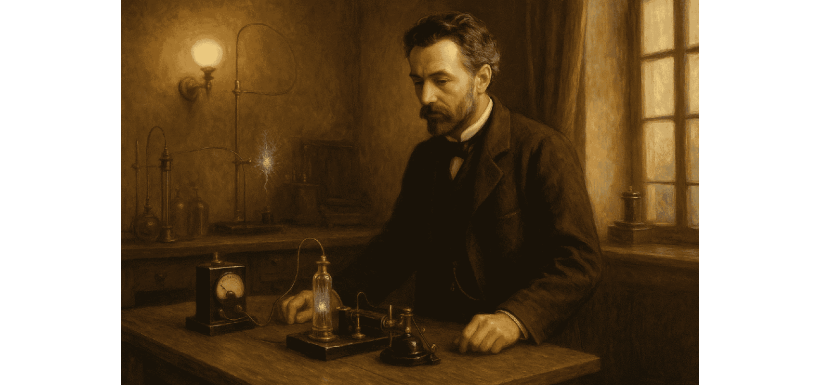
- Introduce Édouard Branly: Briefly mention his nationality (French), his dual professions (physicist and physician), and his key contribution (the invention of the "Branly coherer," the first practical radio wave detector).
- Series Context: Explain how Branly fits into the series. Emphasise that his invention was the essential component that enabled pioneers like Marconi to build the first successful long-distance wireless telegraphy systems.
- Thesis/Preview: The post will cover Branly's life, his research into electrical conductivity, the development of his coherer (building on earlier observations), its crucial role in early radio, and his somewhat controversial legacy in the "invention of radio" debate, especially in France.
- Early Life and a Dual Career: Medicine and Physics
- Birth and Background: Born in Amiens, France, in 1844. Briefly mention his upbringing and education.
- A Man of Two Sciences: This is a key part of his identity. Detail his impressive academic career, earning doctorates in both physical sciences and medicine.
- Professor at the Catholic University of Paris: Highlight his long and distinguished career as a professor of physics at the Catholic University of Paris. This was his base for all his major research.
- Early Research (Uncommon Detail): Mention his early medical research, for example, on the treatment of diseases using electrostatic methods. This shows his deep interest in applying electrical principles to different fields, even before his radio work. It gives a fuller picture of the man.
- The "Radio-Conductor": Inventing the Coherer
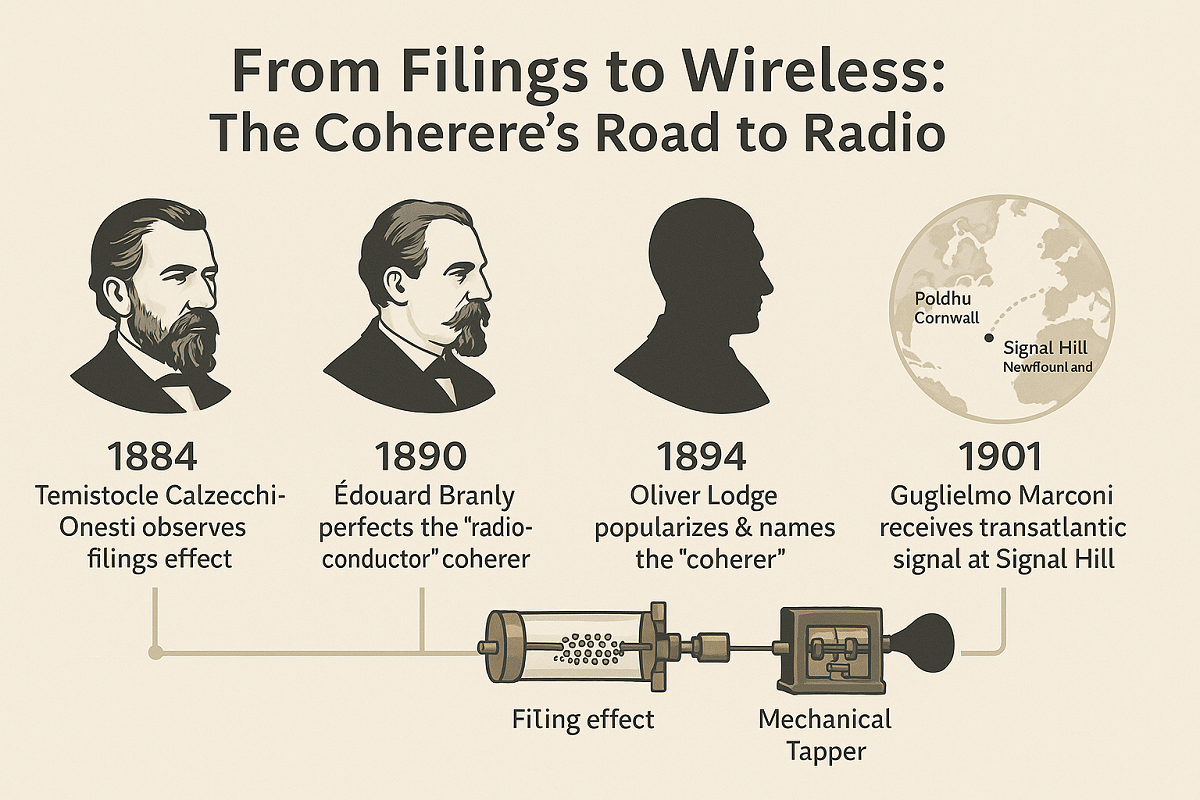
- Building on a Principle: Acknowledge the earlier observations by figures like Temistocle Calzecchi-Onesti, who noted that metal filings change their electrical resistance when a spark occurs nearby.
- Branly's Breakthrough (c. 1890): This is the core technical section.
- Describe how Branly systematically investigated this phenomenon. He wasn't just observing; he was refining and perfecting.
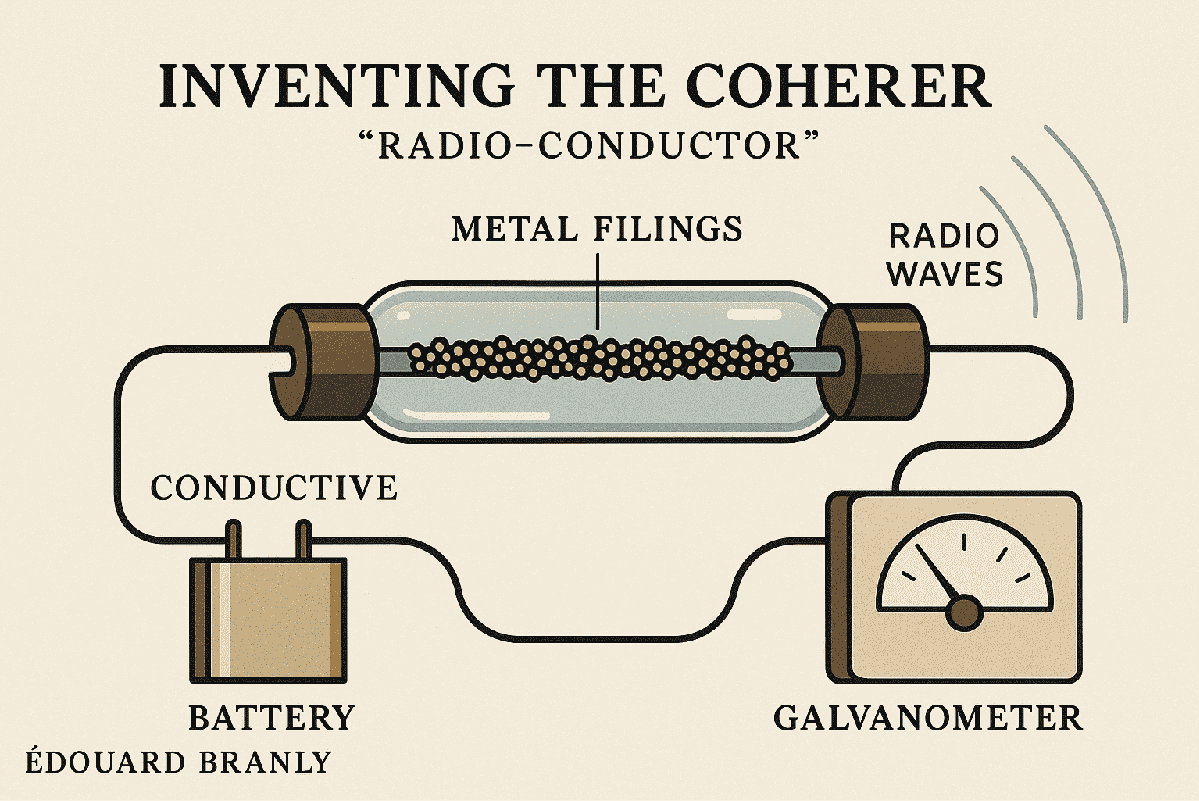
- Detail his device: a glass or ebonite tube containing metal filings (he experimented with many, finding silver and nickel worked best), packed between two electrodes.
- The Key Refinement: Explain what made his device superior. He created a much more sensitive and reliable detector than anyone before him. He was the one who conclusively demonstrated that it could detect Hertzian waves (radio waves) over a distance, not just the general electrical noise from a nearby spark.
- His Terminology: Mention that Branly didn't call it a "coherer." He called his device a "radio-conducteur" (radio-conductor). The name "coherer" was actually coined later by Oliver Lodge in England.
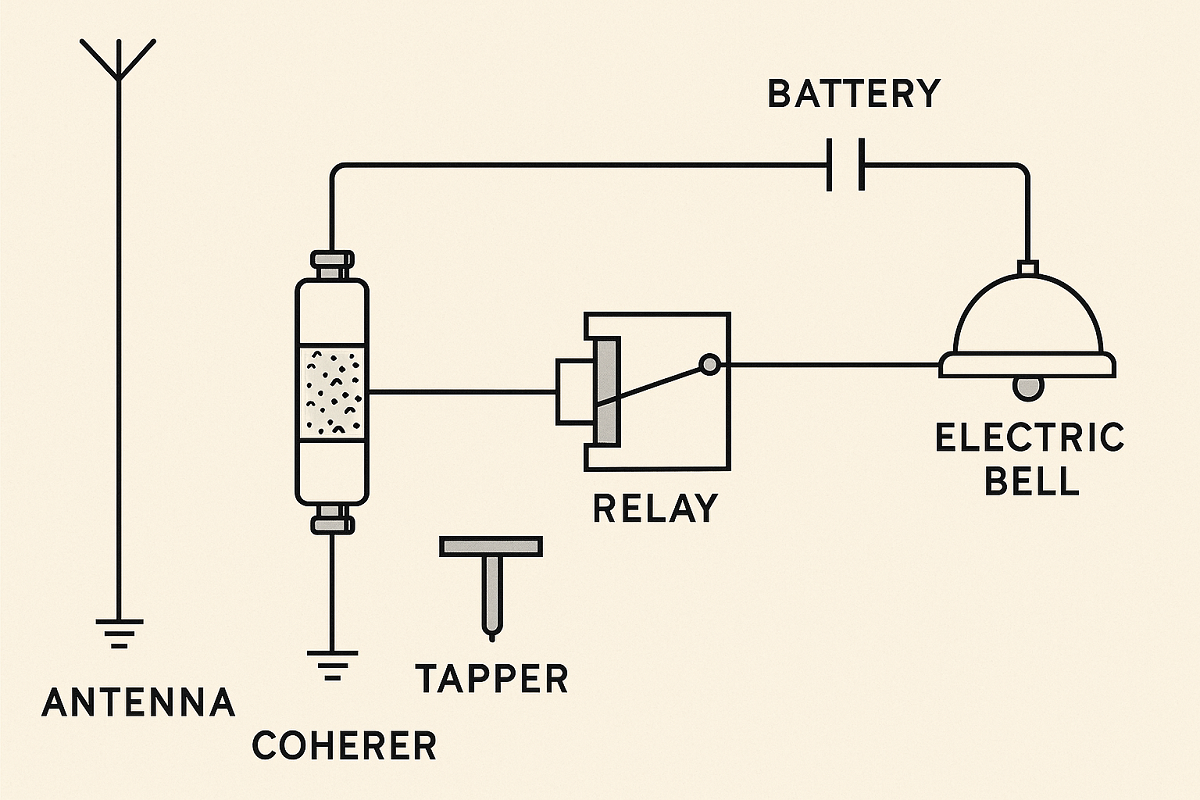
- How it Worked: Explain the principle clearly. The tube of filings normally has a very high electrical resistance. When a faint radio wave strikes it, the filings "cohere" or cling together, causing the resistance to drop dramatically. This drop can be detected by a galvanometer or used to close a circuit and ring a bell. The tube must then be tapped (de-cohered) to reset it.
- A Reluctant Pioneer? The Slow Spread of an Idea
- Publication and Initial Reception: Describe the publication of his work in 1890. Note that the French scientific community was impressed, but the full implications for wireless communication were not immediately grasped, even by Branly himself.
- Focus on Physics, Not Communication: Emphasise that Branly's primary interest was in studying the physics of electrical conductivity. He saw his device as a fascinating laboratory instrument, not necessarily as the key to a global communication system. He didn't actively pursue its commercial or practical application in telegraphy. I find this aspect really interesting – the pure scientist creates the tool, but it takes an inventor like Marconi to see its world-changing potential.
- Oliver Lodge's Role: Explain how the British physicist Oliver Lodge learned of Branly's work and demonstrated its effectiveness as a radio wave detector in his famous 1894 lectures. It was Lodge who really popularised the device in the English-speaking world and gave it the name "coherer."
- The Coherer in Action: The Heart of Marconi's First Radios
- The Missing Piece: Frame the coherer as the "missing piece of the puzzle" that allowed Marconi to turn radio from a laboratory curiosity into a practical technology.
- Marconi's Adoption: Describe how Marconi adopted and further refined Branly's coherer for his first wireless telegraphy systems. Marconi's genius was in combining the Hertzian transmitter, the Branly coherer detector, and the antenna/ground system into a complete, robust communication package.
- The "Tapper" Mechanism: Mention the automatic "tapper" (often a modified electric bell clapper) that was added to the receiver to de-cohere the filings after each signal was received, making it ready for the next one. This was a crucial addition for practical telegraphy.
- The First Generation: Emphasise that for a critical period, from the mid-1890s to the early 1900s, the coherer was the only practical detector available, and it was at the heart of every successful long-distance wireless receiver, including the one that received the first transatlantic signal.
- The French Controversy: Who Invented Radio?
- A National Hero in France: Explain that in France, Branly is often hailed as one of the true inventors of radio ("la TSF" - Télégraphie Sans Fil).
- The Debate: Discuss the basis of this claim. His supporters argued that by inventing the first practical device capable of detecting radio waves, he had made wireless telegraphy possible. Without his detector, Marconi's system would not have worked.
- Marconi's Counter-Argument: Present the other side: Marconi was the one who synthesized the components into a complete, working system and demonstrated its practical, long-range capabilities, driving its commercial development.
- A Nuanced View: Conclude that, like many great inventions, radio was the result of contributions from many individuals. Branly provided an indispensable component, while Marconi provided the system and the vision for its application.
- Synergies with Ham Radio: The First "Receiver"
- The First Detector: Connect Branly's work directly to the very first amateur radio experiments. The earliest hams would have built receivers using coherers based on his design. It was the original "front end."
- The Spirit of Improvement: Branly's work in taking a known phenomenon (the filings effect) and meticulously improving it into a reliable device is a core part of the ham spirit of experimentation and refinement.
- Historical Appreciation: Understanding the coherer gives hams a deep appreciation for how far receiver technology has come – from a device you had to physically tap to reset, to the incredibly sensitive SDRs of today.
- Later Life and Legacy
- Continued Research: Briefly mention his continued research in other fields, including medicine.
- Recognition and Honours in France: Detail the significant recognition he received in his home country, including being elected to the French Academy of Sciences and the Pontifical Academy of Sciences. A museum in Paris is dedicated to his work.
- Death: Note his death in Paris in 1940 at the age of 95.
- Final Legacy: Summarise his legacy as the inventor of the first practical radio detector, a foundational contribution that was absolutely essential for the birth of wireless communication.
- Conclusion
- Recap: Briefly summarize Branly's key achievement: turning a curious physical effect into the reliable coherer, the first device that could "see" radio waves.
- Concluding Thought: "Édouard Branly may not have sent the first message, but he forged the key that unlocked the door. His coherer was the sensitive nerve ending of early radio, the crucial component that allowed the pioneers who followed to finally hear the faint whispers of the wireless age. He is a testament to the fact that sometimes, the most important invention is not the final product, but the essential tool that makes it all possible."
- Call to action: Encourage readers to leave comments and share their thoughts.
For more information please visit our online store or alternatively contact us and our team will be happy to assist you!