

Great ideas often seem to blossom in different minds around the same time, like sparks catching fire independently across the globe. While Guglielmo Marconi was making waves in Western Europe with his wireless telegraphy experiments, halfway across the continent, a Russian physicist was conducting his own groundbreaking work with electromagnetic waves. Today in our "Pioneers of Radio" series, we turn our attention to Alexander Stepanovich Popov, a man revered in Russia and many other countries as the true inventor of radio. His story is one of independent discovery, practical application for naval communication, and a fascinating, enduring debate about who truly deserves the title of radio's ultimate pioneer.
Early Life and Naval Connections: From the Urals to Kronstadt
Alexander Popov was born in 1859 in a small village in the Ural Mountains region of Russia, the son of a local priest. Growing up far from the major scientific centres of Europe, his early life might seem an unlikely starting point for a radio pioneer. However, he showed a clear aptitude for science and mathematics, eventually making his way to St. Petersburg University, one of Russia's leading academic institutions.
After graduating with distinction in 1882, Popov didn't immediately pursue pure academic research. Instead, he took up a position that would prove crucial to his later work: he became an instructor and head of the physics laboratory at the Russian Navy's torpedo school in Kronstadt, a fortified island city near St. Petersburg that served as the base of the Baltic Fleet. This naval connection was significant. It provided him with access to resources, a practical context for his research (the Navy was keenly interested in improving communication), and likely instilled in him a focus on robust, reliable technology suitable for maritime use. I often find that these practical, real-world constraints can be powerful drivers of innovation.
Inspired by Hertz: Building a Receiver
Like physicists across the globe, Popov was electrified by the news of Heinrich Hertz's experiments in Germany, which, starting around 1887, definitively proved the existence of the electromagnetic waves predicted by James Clerk Maxwell. Hertz had not only shown that these waves existed but had also demonstrated how to generate and detect them in the laboratory.
Popov immediately recognised the significance of Hertz's work and set about replicating and extending the experiments. He became particularly interested in developing a more sensitive and reliable method for detecting these invisible waves. The detectors used by Hertz were relatively crude and not suitable for detecting weak signals over long distances.
Popov turned his attention to the coherer, a device whose resistance dramatically decreased when exposed to electromagnetic waves. The basic principle, as we discussed in the post about Calzecchi-Onesti, involved loose metal filings. Popov, likely building on the work of Édouard Branly in France, experimented with different coherer designs, aiming to improve their sensitivity and reliability.
Crucially, Popov made two significant additions to the basic coherer setup. First, he connected a long vertical wire – an antenna – to one side of the coherer. This dramatically increased the device's ability to intercept passing electromagnetic waves. Second, he added a ground connection to the other side of the coherer. These additions – the antenna and the ground – are fundamental components of almost every radio system built since. It seems obvious now, but figuring out the importance of a good aerial and earth connection was a major step forward back then.
The "Lightning Detector" Demonstration (May 7, 1895)
By 1895, Popov had assembled a complete, working receiver system. It consisted of:
- His improved coherer detector.
- The tall wire antenna and ground connection.
- A sensitive relay circuit, activated when the coherer's resistance dropped.
- An electric bell, triggered by the relay to provide an audible indication of a received signal.
- An automatic tapper mechanism (similar to Branly's) which struck the coherer tube after the bell rang, resetting it to its high-resistance state, ready to detect the next signal.
Popov initially conceived of this device not primarily as a communication receiver, but as a highly sensitive instrument for detecting atmospheric electrical disturbances – essentially, a sophisticated lightning detector. Given his location near the Gulf of Finland and his naval connections, detecting approaching storms would have been of significant practical interest.
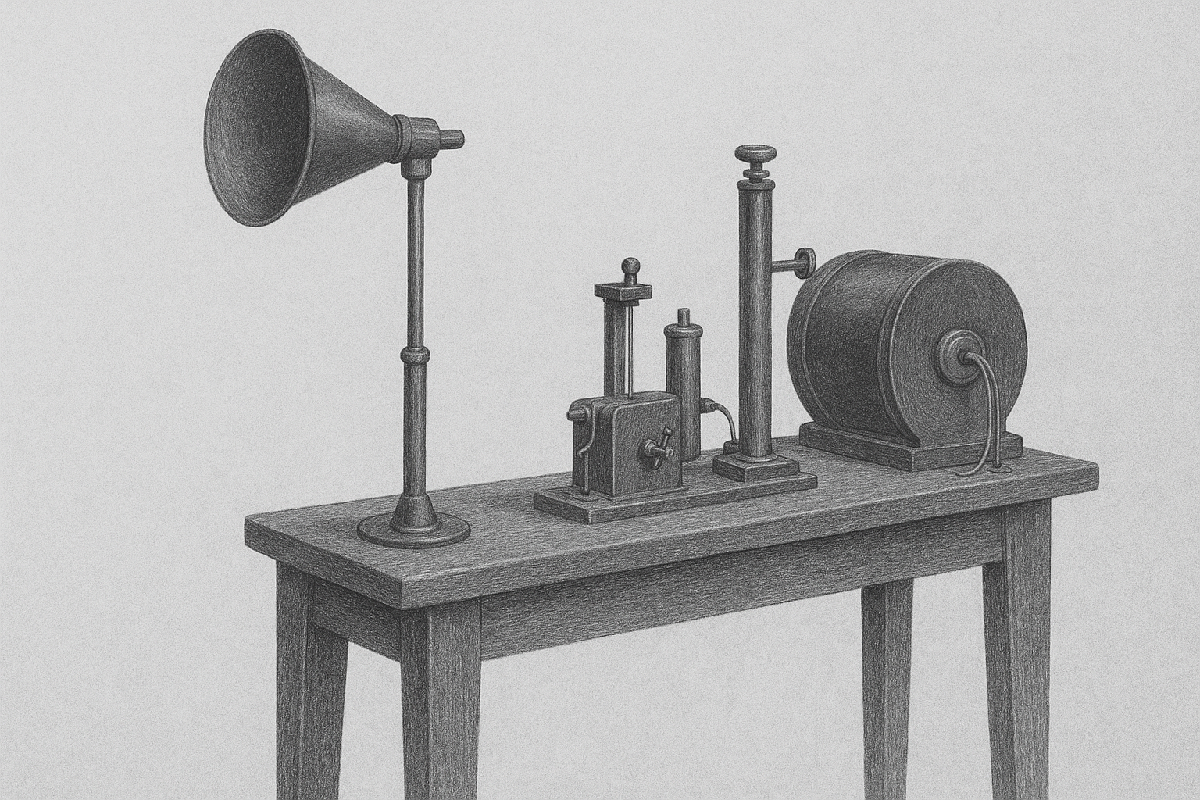
Image: Coherer Based Receiver
On May 7, 1895, Popov presented and demonstrated his apparatus at a meeting of the Russian Physical and Chemical Society in St. Petersburg. He showed how the device responded reliably to electrical sparks generated by a Hertzian oscillator located some distance away in the same building. The bell would ring each time the oscillator sparked, proving that his receiver could detect artificially generated electromagnetic waves.
This demonstration is considered a landmark event in the history of radio, particularly in Russia. It unequivocally showed a working radio receiver capable of detecting electromagnetic waves. For this reason, May 7th is celebrated annually as "Radio Day" in Russia and many other countries.
There are also claims, often cited but sometimes debated regarding the exact timing and circumstances, that during this or a subsequent demonstration in March 1896, Popov used his apparatus to receive a Morse code message – the words "Heinrich Hertz" – transmitted wirelessly over a distance of about 250 metres. Whether this specific Morse transmission occurred exactly as described is sometimes questioned by historians outside Russia, but the fundamental achievement of demonstrating a working receiver in May 1895 is well-established.
From Detection to Communication: The Navy Calls
It didn't take long for Popov, and indeed the Russian Navy, to realise that a device sensitive enough to detect distant lightning could also be used to detect artificial signals for communication. The potential for ship-to-ship and ship-to-shore wireless communication was immediately apparent, especially for naval operations.
Popov continued to refine his system, working on improving both the transmitter (using more powerful spark-gap oscillators) and the receiver's sensitivity and range. He conducted numerous experiments for the Russian Navy in the late 1890s, successfully demonstrating wireless communication over increasing distances across the Gulf of Finland.
His work culminated in a dramatic practical application during the winter of 1899-1900. The Russian battleship General-Admiral Apraksin ran aground on Hogland Island in the Gulf of Finland during heavy fog and ice. Establishing communication was critical for the rescue effort. Popov and his team were tasked with setting up a wireless link. They successfully established communication between Hogland Island and the mainland base at Kotka, Finland (then part of the Russian Empire), over a distance of nearly 30 miles (about 45 kilometres). This wireless link proved absolutely vital in coordinating the complex operation to free the battleship and, even more importantly, in relaying messages that led to the rescue of a group of Estonian fishermen stranded on a drifting ice floe. This incident provided undeniable proof of the immense practical value of radio communication, particularly in maritime emergencies. It must have been an incredibly proud moment for Popov, seeing his invention save lives.
Popov vs. Marconi: The Priority Debate
Now we come to the tricky part: the debate over who truly "invented" radio. As we've seen, both Popov and Marconi were working independently on similar technologies, based on Hertz's discoveries, during the same period in the mid-1890s.
The claim, particularly strong in Russia and former Soviet bloc countries, is that Popov invented radio before Marconi. This claim rests primarily on his successful demonstration of a working radio receiver on May 7, 1895, predating Marconi's first patent applications. The argument is that Popov demonstrated the fundamental principles and built the necessary apparatus first.
Image: Inductor Coil
Marconi's claim, and the view more commonly held internationally, is based on several factors. Marconi, from the outset, was focused on developing a complete, practical system for long-distance communication. He relentlessly improved both transmitters and receivers, conducted highly publicised demonstrations over ever-increasing distances, and, crucially, secured international patents for his system (starting in 1896 in Britain). Popov, on the other hand, initially focused more on the scientific demonstration and the specific application of lightning detection. He also didn't seek international patents for his early work, and his initial publications were primarily in Russian scientific journals, limiting their immediate visibility outside Russia.
It really boils down to how you define "invention." Was it the first person to demonstrate the reception of electromagnetic waves (Popov)? Or was it the first person to develop a practical, commercially viable system for wireless telegraphy and drive its global adoption (Marconi)?
The general historical consensus outside Russia acknowledges Popov's significant, independent contributions. He undoubtedly developed a working radio receiver and demonstrated wireless communication around the same time as, or even slightly before, Marconi's earliest successes. However, Marconi is typically credited with the invention of practical radio communication due to his focus on system development, long-distance transmission, commercialisation, and securing patents. It's perhaps fairest to see them as brilliant, parallel pioneers, each making crucial contributions in their own context.
Later Life and Legacy
Popov's work continued to be highly valued within Russia. He became a professor at the prestigious St. Petersburg Electrotechnical Institute in 1901 and was appointed its director in 1905. He continued his research and played a role in establishing radio communication within the Russian military and society.
Sadly, his life was cut short. He died suddenly from a brain haemorrhage in January 1906, at the age of just 46.
His legacy, particularly in Russia, is immense. He is revered as a national hero, the undisputed inventor of radio. Monuments have been erected in his honour, postage stamps bear his image, and May 7th remains the annual "Radio Day" celebration. Internationally, while the "inventor of radio" title is usually given to Marconi, Popov is widely recognised as a key pioneer, an independent inventor whose work significantly contributed to the dawn of the radio age.
Conclusion: Listening to Lightning, Hearing the Future
Alexander Popov's story is a fascinating chapter in the history of radio. Driven by scientific curiosity and the practical needs of the Russian Navy, he independently developed one of the world's first functional radio receivers. His famous 1895 demonstration, initially conceived as a way to detect lightning, proved the feasibility of receiving electromagnetic waves and opened the door to wireless communication. His subsequent work, particularly the dramatic rescue enabled by his wireless link, showcased the life-saving potential of this new technology.
While the debate over priority with Marconi may never be fully resolved to everyone's satisfaction, Popov's place as a crucial pioneer is undeniable. He was a brilliant physicist and engineer who, working largely in isolation from the developments in Western Europe, made fundamental contributions to the technology that would shrink the globe and change the world forever. He truly heard the future in the crackle of lightning.
What are your thoughts on Alexander Popov and the priority debate? How important is it to acknowledge parallel invention in the history of technology? Let me know in the comments below! And, as always, if you have suggestions for other "Pioneers of Radio" that you'd like to see featured, don't hesitate to share.
For more information please visit our online store or alternatively contact us and our team will be happy to assist you!