
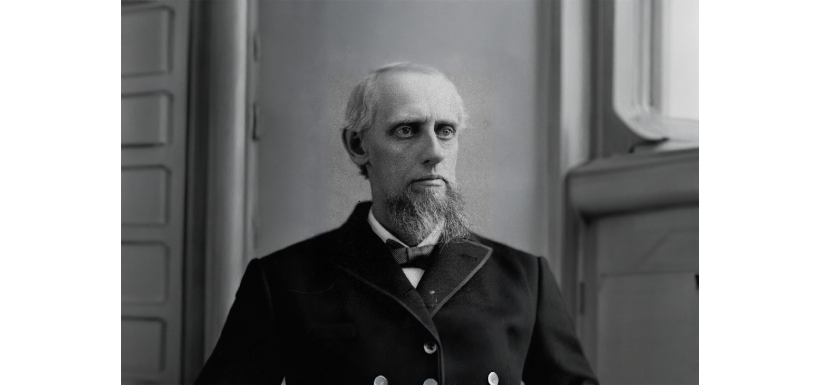
We often think of Guglielmo Marconi as the undisputed 'father of radio,' the man who first conquered the airwaves. But the history of wireless communication is actually far more complex, a tangled web of brilliant minds exploring different avenues, sometimes hitting dead ends, sometimes sparking revolutions. What if I told you there was an American professor who patented a wireless communication system years before Marconi's famous demonstrations? As we continue our "Pioneers of Radio" series, let's meet Amos Emerson Dolbear, a respected physicist and inventor whose story challenges the simple narrative and sheds light on the fascinating, sometimes confusing, early days of wireless technology. His tale involves ingenious inventions, frustrating patent battles, and a fundamental question: what exactly counts as radio?
Early Life & Academic Career at Tufts
Amos Dolbear was born in Norwich, Connecticut, in 1837. He came from humble beginnings but possessed a sharp intellect and a thirst for knowledge. He worked his way through Ohio Wesleyan University and later the University of Michigan, eventually earning multiple degrees. His academic journey led him to Tufts College, near Boston, Massachusetts, in 1874, where he would spend the majority of his long and distinguished career as a professor of physics and astronomy.
Professor Dolbear was, by all accounts, a highly respected figure in the academic world. He wasn't just teaching physics; he was actively contributing to it, known for his inventive mind and his practical approach to scientific problems. He wasn't just confined to the lecture hall; he was a tinkerer, an experimenter, a man driven to understand and manipulate the forces of nature.
Innovations in Telephony: Challenging Bell
Before Dolbear turned his full attention to wireless communication, he made significant contributions to the burgeoning field of telephony. Shortly after Alexander Graham Bell patented his revolutionary telephone in 1876, Dolbear was already developing improvements and alternative systems. It seems he wasn't one to shy away from tackling the big technological challenges of the day!
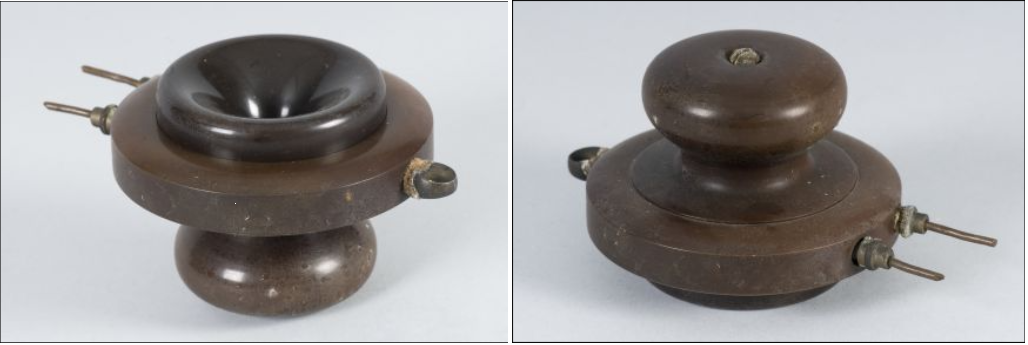
One of his most notable inventions was an electrostatic telephone receiver. Unlike Bell's receiver, which used electromagnetism to vibrate a diaphragm, Dolbear's device relied on changes in electrostatic attraction between two plates – a principle of capacitance. It was a fundamentally different approach, potentially simpler and avoiding the need for strong magnets. He also developed a magneto telephone system that cleverly generated its own electrical current when someone spoke into it, eliminating the need for cumbersome batteries.
Naturally, these innovations brought him into conflict with the powerful Bell Telephone Company. Patent disputes ensued, and although Dolbear ultimately lost the legal battles for priority over the basic telephone concept, his contributions were significant enough to be acknowledged. This early experience battling a corporate giant likely steeled him for his later, even more famous, dispute with Marconi. It certainly shows he had the courage of his convictions.
Wireless Before Radio Waves? Dolbear's System (1882/1886)
Now we get to the heart of Dolbear's connection to our "Pioneers of Radio" story. Years before Heinrich Hertz experimentally proved the existence of radio waves, and long before Marconi started sending signals across the English Channel, scientists were exploring various methods for wireless communication. They experimented with light beams, ground currents, and electrical induction.
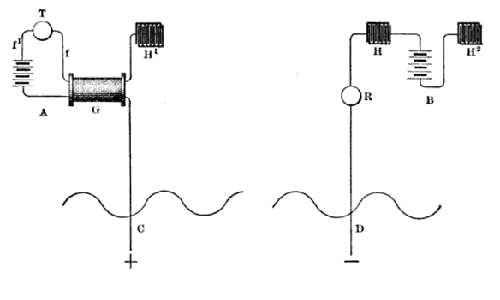
Image: Dolbear's wireless telephone circuit (1886)
In 1882, Dolbear developed and demonstrated his own system for wireless telegraphy, for which he received a US patent (No. 350,299) in 1886, titled "Mode of Electric Communication." Let's look at how it worked:
- Transmitter: Dolbear used an induction coil (similar to those used to generate sparks) to create high-voltage electrical pulses. This transmitter was connected to an elevated wire or metal plate (acting as an aerial) and also had a connection to the ground.
- Receiver: The receiver also had an elevated aerial and a ground connection. Crucially, the detector was Dolbear's own sensitive electrostatic telephone receiver.
He successfully demonstrated this system, transmitting Morse code signals over short distances – reports vary, but distances up to half a mile or perhaps a bit more seem plausible. He wasn't just sketching ideas; he built working apparatus that sent signals without wires.
But here's the absolutely critical point, the detail that makes Dolbear's story so interesting and complex: his system did not rely on Hertzian electromagnetic waves (radio waves) propagating through space. Dolbear himself believed, and subsequent analysis confirmed, that his system operated primarily through a combination of electrostatic induction (the effect an electric charge has on nearby objects without direct contact, effective only over very short distances) and ground conduction (electrical currents travelling through the earth).
Think of it like this: induction is like the static electricity that makes a balloon stick to the wall – it's a near-field effect. Ground conduction is like sending a signal through a giant, albeit inefficient, wire – the Earth itself. Neither of these is the same as generating a self-propagating electromagnetic wave that travels vast distances through space, which is the principle behind Marconi's radio. Dolbear had achieved wireless communication, yes, but was it radio? That became the million-dollar question.
The Marconi Dispute: A Question of Priority?
Fast forward to the late 1890s and early 1900s. Guglielmo Marconi bursts onto the scene, demonstrating increasingly impressive feats of long-distance wireless telegraphy using systems explicitly based on Hertz's discovery of electromagnetic waves. Marconi's success was undeniable and captured the world's imagination.
Naturally, this led earlier inventors like Dolbear to revisit their own work. Dolbear firmly believed that his 1886 patent gave him priority over Marconi. After all, hadn't he patented a system for wireless communication years earlier? He, and later his estate after his death in 1910, pursued legal challenges against the Marconi Wireless Telegraph Company of America.
The legal wrangling went on for decades, eventually reaching the US Supreme Court in the landmark case Marconi Wireless Telegraph Co. v. United States (decided in 1943, long after both Dolbear and Marconi were gone). This case also involved claims related to Nikola Tesla and John Stone Stone.
Regarding Dolbear's claim, the Supreme Court's decision was clear. While acknowledging Dolbear's ingenuity and his successful 1886 patent for a form of wireless communication, the court ruled that his system operated on fundamentally different physical principles – induction and conduction – than Marconi's system, which relied on the generation and detection of Hertzian waves. Therefore, Dolbear's patent did not anticipate Marconi's invention of radio communication as we understand it today. It was a crucial distinction based on the underlying physics.
This outcome really underscores the importance of not just inventing something, but also understanding how and why it works. Dolbear had built a wireless system, but it wasn't based on the principles that would ultimately enable long-range radio communication.
Other Inventions and Interests
It's worth remembering that Dolbear wasn't solely focused on wireless. He was a versatile inventor with broad interests. He worked on improvements to incandescent lighting systems, experimented with electrical measurement devices, and even developed a fascinating system for photographically recording sound – essentially an early precursor to optical sound on film. This breadth of work paints a picture of a truly inquisitive and inventive mind, constantly exploring the applications of physics and electricity.
Synergies with Ham Radio: Lessons from a Different Path
So, what can we, as radio enthusiasts, take away from Amos Dolbear's story?
- The Spirit of Experimentation: Dolbear embodies the classic ham spirit of tinkering, experimenting, and trying to make things work, even if the underlying theory isn't fully understood or the chosen path isn't the most efficient one.
- Antenna/Ground Concepts: It's interesting that his system, despite its different operating principle, still utilized elevated conductors (aerials) and ground connections. These concepts remain absolutely fundamental to practical radio communication today, regardless of the specific frequency or mode.
- Understanding Propagation: His story, and the subsequent legal clarification, is a great reminder of the importance of understanding how signals travel. Is it ground wave? Skywave? Induction? Knowing the difference is crucial for effective communication.
- History Matters: Dolbear's tale adds richness and complexity to the history of radio. It shows that the path to major technological breakthroughs is rarely straightforward and often involves multiple competing ideas and approaches.
Legacy: A Forgotten Pioneer?
Amos Dolbear passed away in 1910. How should we remember him? He was undoubtedly a respected professor and a genuine inventor with notable successes, especially in telephony. His wireless system was innovative for its time and demonstrated that communication without wires was possible before Hertz's discoveries were widely known or applied.
However, in the grand narrative of radio, he remains a somewhat peripheral figure. He's often overshadowed by Marconi, Hertz, and others whose work directly led to the radio technology we use today. This is largely because the physical principles he exploited (induction and conduction) were ultimately limited in range and application compared to Hertzian waves.
So, was he a forgotten pioneer? Perhaps. He was certainly a pioneer of early wireless communication, exploring one of the paths that branched off before the main road of radio was fully paved. His story is less about the triumph of invention and more about the fascinating process of scientific exploration, where different ideas are tested, and ultimately, some prove more fruitful than others.
Conclusion: The Twists and Turns of Innovation
Amos Dolbear's life and work offer a fascinating glimpse into the complex and often messy history of technological innovation. He was a brilliant inventor who achieved wireless communication years before Marconi, yet his system relied on different physics, ultimately limiting its potential. His subsequent patent battles highlight the crucial distinction between different forms of wireless transmission and the importance of understanding the underlying science. His story reminds us that the path to groundbreaking technology is rarely linear; it involves exploration, experimentation, dead ends, and sometimes, vigorous debate about who truly got there first and how. While not the father of radio as we know it, Amos Dolbear was undoubtedly an important figure in the early quest to conquer the challenge of communicating without wires.
What are your thoughts on Amos Dolbear? Do you think inventors whose methods didn't become mainstream deserve more recognition? Let me know in the comments below! And, as always, if you have suggestions for other "Pioneers of Radio" that you'd like to see featured, don't hesitate to share.
For more information please visit our online store or alternatively contact us and we'll be happy to assist you!