
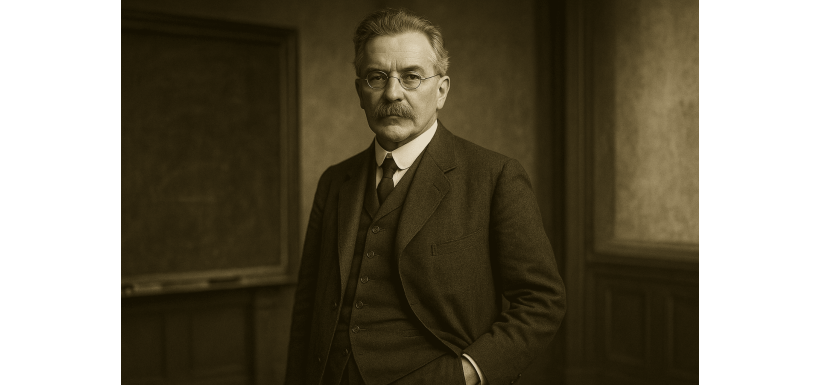
We often focus on the inventors who built the first transmitters and receivers, the practical geniuses who wrestled with wires, sparks, and vacuum tubes. And rightly so, their contributions were monumental. But what about the brilliant minds who delved into the deep mathematics of how those invisible radio waves actually travel? The ones who, armed with chalk and blackboard, figured out the fundamental physics that governed this new and mysterious phenomenon? Today in our 'Pioneers of Radio' series, we meet Arnold Sommerfeld, a true giant of theoretical physics whose work on wave propagation was absolutely crucial for understanding long-distance radio communication. He might not have built a radio set himself, but his insights helped make sense of how they worked across the globe.
Early Life and Rise as a Leading Physicist
Arnold Johannes Wilhelm Sommerfeld was born in Königsberg, Prussia (which is now Kaliningrad, Russia), in 1868. Königsberg was a historic centre of learning, and young Sommerfeld clearly thrived in this environment. He pursued his higher education at the University of Königsberg, focusing on mathematics and physics, subjects that would define his illustrious career.

His academic journey took him through some of the most prestigious institutions in Germany. After earning his doctorate, he spent time at the University of Göttingen, a veritable powerhouse of mathematics and physics in those days. Imagine the intellectual atmosphere there – it must have been incredibly stimulating! Eventually, he landed a professorship at the University of Munich, where he would spend the majority of his career, establishing one of the world's leading schools of theoretical physics.
Now, before we dive into his specific contributions to radio, it's important to understand that Sommerfeld was a towering figure in physics generally. He made profound contributions to atomic theory, developing the Sommerfeld model of the atom (an extension of Bohr's model that incorporated elliptical orbits and relativistic effects) and introducing the fine-structure constant, a fundamental physical constant that characterises the strength of electromagnetic interaction. He was also at the forefront of the development of quantum theory and made significant contributions to the understanding of special relativity. This wasn't just a "radio guy"; this was one of the leading theoretical physicists of the early 20th century. I always find it fascinating when these top-tier physicists, grappling with the deepest mysteries of the universe, also turn their formidable intellects to practical problems like radio wave propagation.
Tackling the Problem of Radio Wave Propagation
In the early 1900s, radio was rapidly evolving. Marconi had sensationally demonstrated transatlantic radio communication in 1901, sending signals across vast oceanic distances. This was a stunning practical achievement, but it posed a significant theoretical puzzle. How exactly did these radio waves manage to follow the curvature of the Earth over thousands of miles? Simple diffraction theory – the idea that waves bend around obstacles – wasn't enough to explain it. The Earth was a big obstacle!
This is where Arnold Sommerfeld made his groundbreaking contribution to radio science. In a seminal paper published in 1909, titled "On the Propagation of Waves in Wireless Telegraphy," he tackled this very problem with mathematical rigour.
His key insight was to treat the Earth not as a perfect insulator, nor as a perfect conductor, but as a finitely conducting sphere. This might sound like a subtle distinction, but it was crucial. The electrical conductivity of the Earth's surface (and seawater, which is even more conductive) plays a vital role in how radio waves propagate near it, especially at lower frequencies.
Sommerfeld's mathematical analysis was incredibly complex. He employed advanced techniques involving Bessel functions and complex integrals – definitely not back-of-the-envelope stuff! His work led to the concept of surface waves (sometimes referred to as Zenneck waves or Sommerfeld waves, though the exact terminology and dominance of these specific wave types have been subjects of long and complex debate among physicists and engineers). These are electromagnetic waves that can travel along the boundary between two different media, such as air and the conducting Earth. Crucially, these surface waves can, to some extent, follow the Earth's curvature, explaining how long-distance radio communication was possible, particularly for the longwave and medium wave frequencies used in early radio.
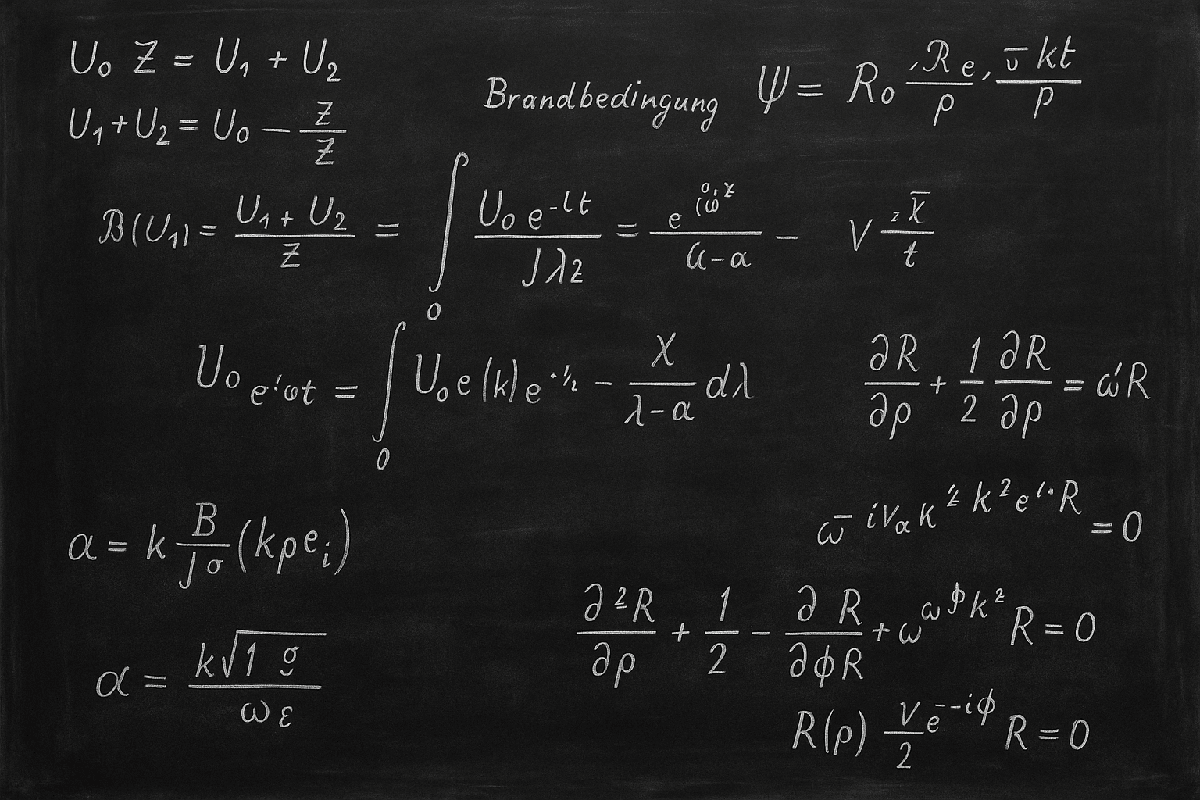
His work provided a much more complete theoretical understanding of ground wave propagation. This is the mode of propagation where radio waves travel along the surface of the Earth, and it's heavily influenced by the ground's conductivity.
Sommerfeld's theory allowed engineers to better predict signal strength, understand coverage areas, and design more efficient transmitting and receiving systems for these lower frequencies. It was a monumental piece of theoretical work that brought much-needed clarity to a puzzling phenomenon.
Diffraction and Antenna Theory
Sommerfeld's expertise in wave physics also extended to the theory of diffraction. He made significant contributions to understanding how waves, including radio waves, bend around obstacles. This is incredibly important in practical radio communication. Think about it – you can often receive a radio signal even if there's a hill or a building between you and the transmitter. That's diffraction at work. Sommerfeld's mathematical treatment of diffraction problems helped to explain these effects and predict signal behaviour in complex environments.
While perhaps not his primary focus, his deep understanding of how electromagnetic waves interact with conducting surfaces also had implications for antenna theory. The way an antenna radiates, and how its radiation pattern is affected by the presence of the ground, are all governed by the principles he explored. His work provided a more solid theoretical foundation for antenna design and analysis.
This theoretical work wasn't just an academic exercise. It had direct practical relevance for radio engineers who were trying to build reliable communication systems. Knowing how signals would propagate and diffract allowed for better planning of station locations, prediction of service areas, and the design of more efficient antennas.
A Legendary Teacher and Mentor
Beyond his own research contributions, Arnold Sommerfeld had an extraordinary and perhaps unparalleled legacy as a teacher and mentor. His Institute for Theoretical Physics at the University of Munich became a world-renowned centre, attracting and nurturing an incredible number of brilliant young minds.
He supervised an astonishing number of doctoral students who went on to become some ofthe most famous physicists of the 20th century and, remarkably, future Nobel laureates. The list of his students reads like a "who's who" of quantum mechanics and modern physics:
- Werner Heisenberg (Nobel Prize 1932, for the creation of quantum mechanics)
- Wolfgang Pauli (Nobel Prize 1945, for the discovery of the Exclusion Principle)
- Peter Debye (Nobel Prize 1936, for contributions to the understanding of molecular structure)
- Hans Bethe (Nobel Prize 1967, for contributions to the theory of nuclear reactions, especially energy production in stars)
And that's just a few of them! It's quite an astonishing record. He clearly had a gift for identifying talent and fostering it. His teaching style was renowned for its clarity, its mathematical rigour, and his ability to connect profound theoretical concepts with real-world physical problems. He wasn't just teaching equations; he was teaching students how to think like physicists.

His multi-volume textbook series, "Lectures on Theoretical Physics," became standard works in the field, used by generations of students. I can only imagine what it must have been like to be a student in his lectures – challenging, no doubt, but incredibly inspiring.
Synergies with Ham Radio: Understanding How Signals Travel
So, why should we, as radio amateurs, care about a high-flying theoretical physicist like Arnold Sommerfeld? Well, because his work directly impacts our understanding of how our signals get from A to B.
- Ground Wave Propagation: Sommerfeld's detailed analysis of ground wave propagation is directly relevant to hams operating on the lower HF bands, like 160 metres and 80 metres. On these bands, the ground wave is a significant mode of communication, especially for reliable regional contacts, day or night. Understanding how ground conductivity affects these signals helps us appreciate why some locations are better than others for low-band work.
- Antenna-Ground Interaction: His work on waves propagating over a conducting Earth underscores the critical importance of a good ground system, especially for vertical antennas. Every ham who has struggled with radials for their vertical knows this! Sommerfeld's theory provides the "why" behind that practical necessity.
- Diffraction and Obstacles: His work on diffraction helps us understand why we can sometimes make contacts even when there isn't a clear line of sight to the other station. Hills, buildings, and other obstacles don't always completely block our signals, thanks to the wave nature of radio and the phenomenon of diffraction that Sommerfeld helped to explain.
- The Value of Theory: Perhaps most importantly, Sommerfeld's story reminds us that even for a practical hobby like amateur radio, a grasp of the underlying theory can be incredibly valuable. It helps us understand why things work the way they do, leading to better station design, more effective operating practices, and a deeper appreciation for the magic of radio.
Later Life, Recognition, and Legacy
Arnold Sommerfeld remained an influential figure in physics throughout his long career. He received numerous prestigious awards and honours for his contributions, including the Max Planck Medal and the Lorentz Medal. Astonishingly, he was nominated for the Nobel Prize in Physics no fewer than 84 times between 1917 and 1951 – more than any other physicist – but, incredibly, he never actually won it. This is often cited as one of the great oversights in the history of the Nobel Prize. It certainly makes you think about the politics and peculiarities of such awards!
His specific legacy in radio science is secure: he provided the first rigorous and comprehensive mathematical theory for how radio waves propagate over the surface of a finitely conducting Earth. This was a monumental contribution that helped to transform radio from an empirical art, often relying on trial and error, into a more predictable and scientifically grounded engineering discipline.
Arnold Sommerfeld passed away in Munich in 1951, following injuries sustained in a traffic accident while out walking with his grandchildren. He left behind an immense body of work and an unparalleled legacy as a researcher and, perhaps even more importantly, as a teacher who shaped a generation of physicists.
Conclusion: The Intellectual Giant of Wave Propagation
Arnold Sommerfeld's story is a powerful illustration of how deep theoretical work, though often mathematically challenging and abstract, can be absolutely essential for technological progress. He was one of the intellectual giants who helped us truly understand the invisible waves that connect our world. He didn't build transmitters or receivers, but his profound insights into the physics of wave propagation provided the crucial understanding that enabled engineers to design and build more effective and reliable radio communication systems. He showed us the "how" and "why" behind long-distance radio, and for that, he truly deserves his place among the Pioneers of Radio.
What are your thoughts on the interplay between theoretical physics and practical radio engineering? Do you think figures like Sommerfeld get the recognition they deserve in the history of radio? Let me know in the comments below! And, as always, if you have suggestions for other "Pioneers of Radio" that you'd like to see featured, don't hesitate to share.
For more information please visit our online store or alternatively contact us and we'll be happy to assist you!