
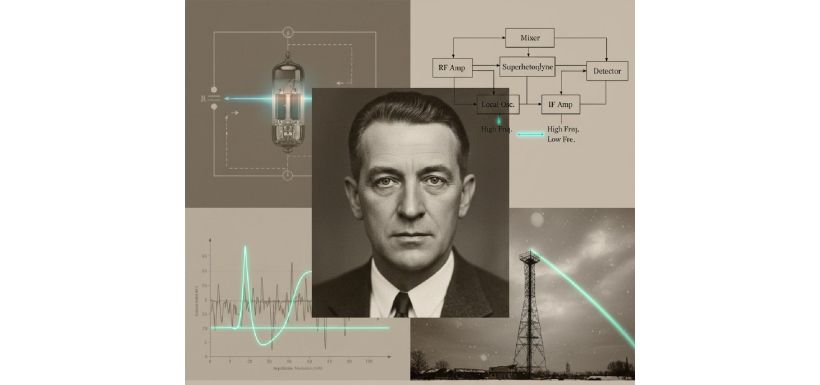
It is no exaggeration to say that almost every radio, television, or mobile phone you have ever used operates on principles invented by one man. He was a brilliant, driven, and uncompromising genius who saw the future of radio with a perfect, almost painful, clarity. He was also a man who spent his life in a brutal, heart breaking war to defend his ideas, only to be crushed by the very corporations that profited from them. Today, in our 'Pioneers of Radio' series, we meet the towering, tragic figure of Edwin Howard Armstrong.
He isn't just a pioneer on our list; he is arguably the most important inventor of all the core circuits that define modern radio. His story is one of breath taking invention, bitter legal battles, and a legacy that is, quite simply, the airwaves all around us.
The Young Inventor: A Passion for the Airwaves
Edwin Howard Armstrong was born in New York City in 1890. From a young age, he was a shy, quiet boy, but he possessed a fierce, obsessive fascination with the new magic of wireless, sparked by reading the stories of Marconi's triumphs. While other boys were playing sports, Armstrong was tinkering, learning Morse code, and stringing wires.
His singular determination was perfectly captured in what has to be one of my favourite anecdotes from radio history. As a teenager, he decided he wanted to build the tallest antenna possible. He convinced his father to let him erect a massive, 125-foot lattice antenna mast in their family's garden in Yonkers, New York. This wasn't some flimsy pole; it was a serious piece of engineering, towering over the neighbourhood. And young Armstrong, a shy boy in most respects, would fearlessly climb this terrifyingly high mast, even in high winds and bad weather, to work on his aerial. It's the perfect metaphor for his entire life: a man willing to go to dangerous heights, alone, in pursuit of a clearer signal.
He enrolled at Columbia University, where he studied electrical engineering under another of our pioneers, Michael Pupin. But Armstrong was not a typical student. He was known as brilliant but headstrong, often more interested in his own clandestine experiments in the university's laboratories than in the standard curriculum. He was fascinated by the Audion valve, the recent and poorly understood invention by Lee de Forest. Armstrong sensed that this simple, gas-filled bulb was the key to the future, and he was determined to figure out how it really worked.
Invention #1: Regeneration (1912) - The Magic Feedback Loop
While still an undergraduate at Columbia, tinkering late at night, Armstrong made his first monumental discovery. He was experimenting with an Audion circuit and had the revolutionary idea to feed a tiny portion of the signal from the output (the plate) back into the input (the grid). The result was staggering. The tube's amplification didn't just increase; it skyrocketed, by factors of thousands.
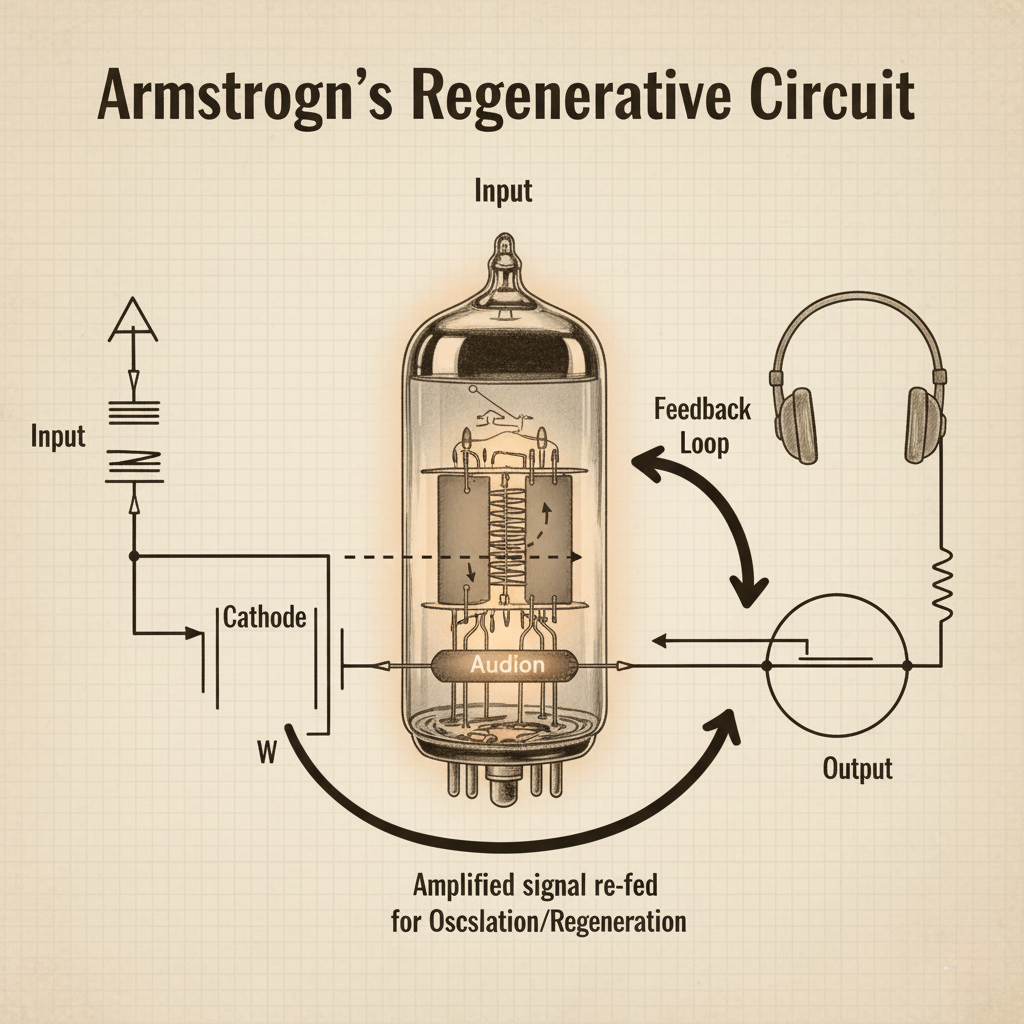
It's like pushing someone on a swing. A single, weak push (the original signal) won't get them very high. But if you apply tiny, perfectly-timed pushes (the feedback) just as the swing comes back, their altitude soars. Armstrong's regenerative circuit did exactly that for radio signals.
But he didn't stop there. He pushed the feedback further and further, until the circuit "spilled over" and began to oscillate, producing its own pure, stable, continuous wave (CW).
This single discovery had a two-fold, revolutionary importance:
- The Regenerative Receiver: It created an incredibly sensitive receiver from a single, simple valve. This was the "Regen" receiver that made long-distance shortwave listening a reality for hams and hobbyists for decades.
- The CW Transmitter: It was the first simple, all-electronic method to create a stable CW signal. This made the massive, building-sized alternators of Ernst Alexanderson obsolete almost overnight and was the key to modern, reliable transmitters.
Armstrong, brimming with excitement, demonstrated his discovery to his colleagues. And then the darkness began. Lee de Forest, who we've already covered, saw Armstrong's invention and promptly, and baselessly, sued him, claiming he had discovered regeneration first. This kicked off the first of Armstrong's devastating, multi-decade patent wars.
Invention #2: The Superheterodyne (1918) - The World's Standard Receiver
When the United States entered the First World War, Armstrong joined the Army Signal Corps as a Major and was sent to Paris. His task: to find a way to intercept faint, high-frequency German radio signals that were beyond the range of any existing equipment.
The problem was that the valves of the day were simply too unstable to reliably amplify these very high-frequency (short-wave) signals. The regeneration circuit was too sensitive and difficult to control at those frequencies.
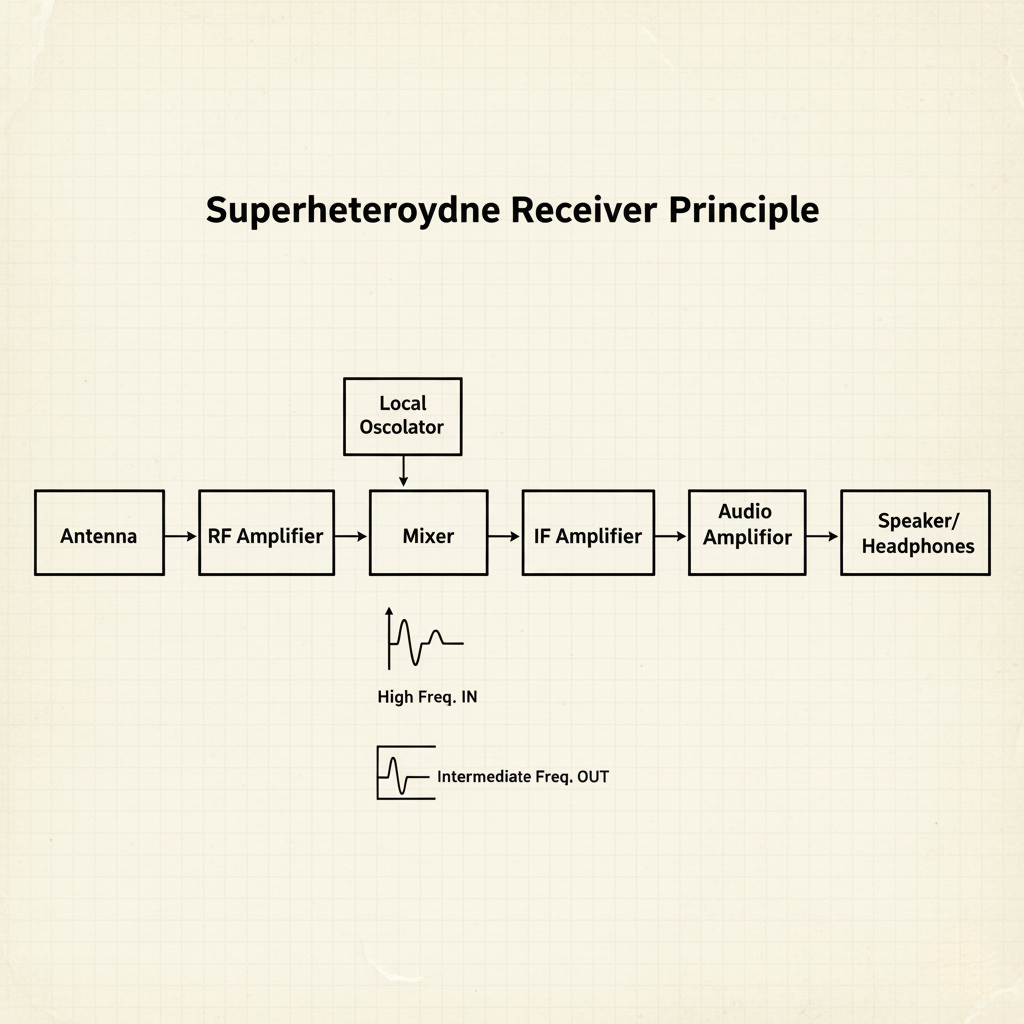
In a dugout in France, Armstrong had his second stroke of pure genius. Instead of trying to tame the wildly difficult high-frequency signal, why not change it? He devised the superheterodyne circuit.
The principle is brilliant. I like to think of it as a clever 'gearbox' for radio frequencies.
- A local oscillator in the receiver generates its own, stable signal.
- This signal is "mixed" with the faint, high-frequency signal coming in from the antenna.
- This mixing process creates a new, fixed, and much lower frequency signal, called the "intermediate frequency" (IF).
It doesn't matter if you're tuned to 14 MHz or 7 MHz; the signal always gets converted down to the same, easy-to-manage IF (say, 455 kHz). All the main amplification is then done at this single, stable frequency.

The impact was revolutionary. The "superhet" allowed for incredibly high, stable amplification and razor-sharp selectivity (filtering). It is the fundamental design of almost every radio, television, radar, and satellite receiver built ever since. Every HF transceiver in every ham shack today is a direct descendant of the circuit he dreamed up in a wartime dugout.
The Legal Wars and a Hollow Victory
While Armstrong was becoming the most important inventor of his age, his legal battles were grinding on. The fight with de Forest over the regenerative circuit, a fight he had already won in the lower courts, was appealed again and again. In 1934, in a decision that is still considered baffling and technically incorrect by engineers and historians, the U.S. Supreme Court ruled in favour of Lee de Forest.
The decision was a devastating blow to Armstrong. It wasn't just about the money (though he lost a fortune); it was about his scientific honour, his life's work. The court had, in his view, given his invention to a man who didn't even understand how it worked. He became more embittered, isolated, and profoundly distrustful of the corporate and legal world. "I have found that the inventor's greatest problem is not in the invention," he once said, "but in the defence of the invention." I can almost hear the exhaustion and frustration in those words.
Invention #3: Wide-Band FM (1933) - The Static-Free Revolution
Despite his legal battles, Armstrong's mind never stopped. By the late 1920s, he had become obsessed with solving radio's last great problem: static. AM radio, the standard system used by RCA's new NBC network, was plagued by static from thunderstorms, electrical equipment, and even the receiver's own tubes.
Armstrong set out to create a truly static-free, high-fidelity radio system. After years of meticulous, secret experimentation, he had another breakthrough. He realised that all static was Amplitude Modulated (AM) – it caused a change in the power, or amplitude, of the radio wave. So, he devised a system that ignored amplitude entirely. His system modulated the frequency of the wave: Frequency Modulation (FM).
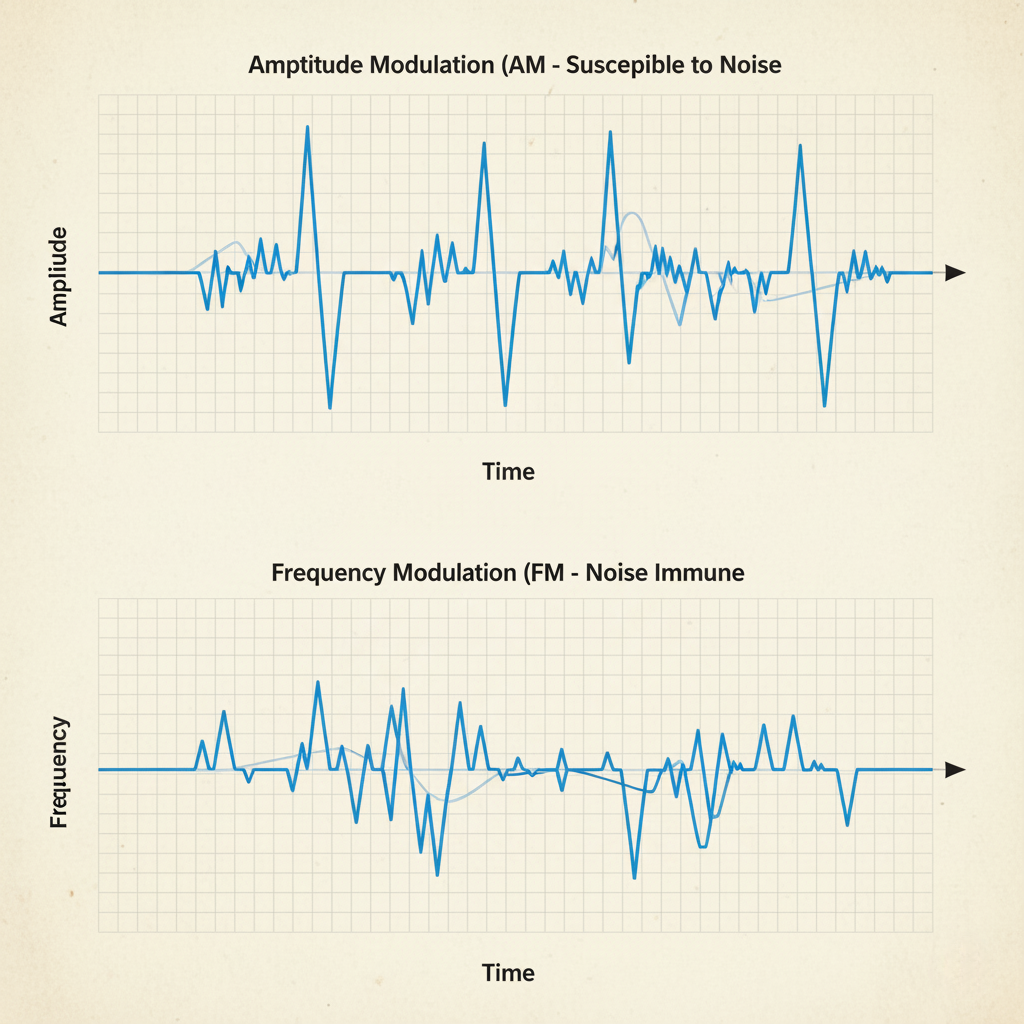
His crucial discovery was that by using a wide frequency swing (Wide-Band FM), he could make the signal vastly more immune to noise. The FM receiver, by only listening for changes in frequency, could simply ignore the crackles and pops of AM static.
In 1935, he gave a legendary demonstration. In a smoke-filled room at the Institute of Radio Engineers, he played a jazz record over a conventional, high-power AM link. The music was hopelessly buried in artificial static. He then switched to his FM link. The music came through with a clarity and dynamic range that no one had ever heard from a radio before – it was completely, utterly silent. He then switched the static generator on... and nothing happened. The music continued, crystal-clear. The engineers in the room were reportedly dumbfounded. It was, by all accounts, a magic trick.
The Long, Final Battle and Tragic End
Armstrong presented his invention to his old friend and head of RCA, David Sarnoff. But Sarnoff, who had built his entire empire on AM radio and was now pouring millions into the new field of television, saw FM not as an opportunity, but as a threat. It would make his entire AM network, and every AM radio RCA sold, obsolete.
What followed was one of the most tragic and shameful chapters in the history of technology. RCA, led by Sarnoff, suppressed the invention. They claimed it wasn't practical. When Armstrong, betrayed and furious, decided to build his own FM ecosystem, RCA used its immense power to fight him at every turn. Armstrong, using his own fortune, built the first FM broadcast station, W2XMN, in Alpine, New Jersey. He began licensing his technology to smaller manufacturers.
As FM's success became undeniable, RCA allegedly used its lobbyists to have the FCC move the entire FM band from its original 42-50 MHz allocation up to 88-108 MHz – instantly making all of Armstrong's transmitters and the 500,000 FM radios the public had bought completely useless. Simultaneously, RCA began manufacturing its own "new" FM sets, based on Armstrong's patents, and refused to pay him royalties, claiming their circuits were different.
Drained of his fortune by decades of legal battles and the cost of single-handedly building the FM network, Armstrong filed a massive infringement suit against RCA. The suit dragged on for years, with RCA's vast legal team using every delay tactic in the book to bleed him dry.
On the last night of January 1954, Edwin Howard Armstrong, his health failing, his fortune gone, and believing he was a failure, wrote a final, heartbreaking note to his wife. He then put on his coat and hat and walked out of the window of his 13th-floor New York apartment.
It was a truly devastating end to one of history's most brilliant inventive careers. In a bitter postscript, his widow, Marion, took up the legal fight. Years later, she eventually won. RCA, and all the other major manufacturers, were forced to settle, finally vindicating his patents. But it was far too late for the man himself.
Synergies with Ham Radio: The Armstrong Legacy
For us in the amateur radio community, Armstrong's legacy is simply... everything.
- The "Regen" Receiver: This was the first simple, high-performance receiver that countless early hams built to explore the shortwaves.
- The Superheterodyne: This is the modern ham radio receiver. Every HF transceiver, every VHF handheld, every SDR that uses an IF, operates on the "superhet" principle he invented in that dugout.
- FM (Frequency Modulation): The entire world of VHF/UHF amateur radio – repeaters, simplex, mobile operation, and even digital modes built on top of it – is built on the static-free FM invention he fought and died for.
He embodied the highest ideals of the amateur spirit: relentless, hands-on experimentation, a deep understanding of circuits, and a courageous, uncompromising refusal to accept that something was "impossible."
Conclusion: The Genius Who Invented Modern Radio
Edwin Howard Armstrong's genius gave us modern radio. The regenerative circuit, the superheterodyne, and wide-band FM are not just contributions; they are the pillars of the entire field. His life is a powerful, and painful, reminder that a brilliant invention is only the first step in a long, hard battle against corporate interests and human greed. He won the technical war, creating a string of inventions that were undeniably superior. But he lost the personal one, crushed by the very industry he had done so much to create. He left behind a world forever changed by his mind, a world that crackles with static-free FM and connects across oceans using the circuits he perfected.
What are your thoughts on Edwin Howard Armstrong's legacy? Do you think he's the single most important inventor in radio history? Let me know in the comments below! And, as always, if you have suggestions for other "Pioneers of Radio" that you'd like to see featured, don't hesitate to share.
For more information please visit our online store or alternatively contact us and our team will be happy to assist you!