

Long before fibre optics and laser communication became staples of our modern world, imagine speaking into a device and having your voice travel silently, invisibly, on a beam of light to a receiver miles away. It sounds like something straight out of the pages of H.G. Wells or Jules Verne, doesn't it? But this wasn't science fiction; this was the reality of incredible experiments conducted at the turn of the 20th century by Ernst Ruhmer, a German physicist who explored the very frontiers of wireless communication. As we continue our "Pioneers of Radio" series, we'll meet a man who championed an alternative path to wireless. While radio waves ultimately won the day for mass communication, Ruhmer's prescient work on optical communication was a stunning achievement that offered a prophetic glimpse into the future.
Early Life and Scientific Beginnings
Ernst Walter Ruhmer was born in Berlin, Germany, in 1878. From a young age, he was captivated by the physical sciences. He pursued his education in mathematics and natural sciences in his home city, quickly developing a fascination with the great technological challenges of his era. He was particularly drawn to physics, with a keen interest in acoustics, optics, and the rapidly emerging field of electrical engineering. The central problem that seemed to capture his imagination was the transmission of sound over long distances – a challenge that would lead him down some truly innovative and unconventional paths.
The Photophone Revisited: Speaking on a Light Beam
The idea of transmitting sound on a beam of light wasn't entirely new. The brilliant Alexander Graham Bell and his assistant Charles Sumner Tainter had first demonstrated a device they called the "photophone" back in 1880. Bell was, in fact, prouder of this invention than his telephone! His system used a flexible mirror to modulate a beam of sunlight; as someone spoke, the mirror would vibrate, causing the reflected light beam to flicker. A receiver with a selenium cell would then convert these light flickers back into sound. It was ingenious, but it had severe limitations. It relied on bright sunlight and had a very limited effective range.
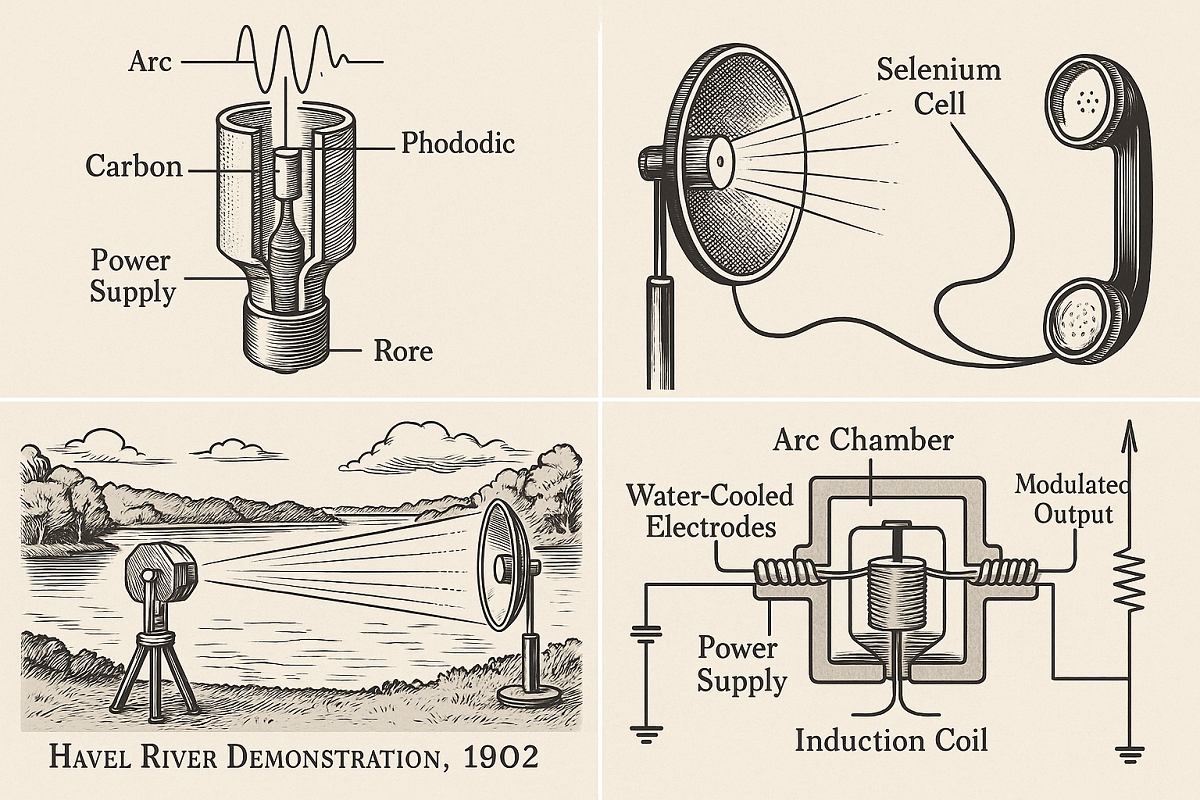
This is where Ernst Ruhmer picked up the baton and made a revolutionary leap forward. He revisited Bell's concept but re-engineered it with more powerful and practical components. His key innovation was the transmitter, which did away with fragile vibrating mirrors and unreliable sunlight. Ruhmer used a powerful carbon arc lamp as his light source.
His system was based on a principle he perfected, which became known as the "speaking arc." The idea was brilliantly clever. The audio signal from a microphone was superimposed onto the direct current (DC) power supply feeding the carbon arc lamp. This caused the intensity of the arc's brilliant light to fluctuate in direct correspondence with the sound waves of the speaker's voice. The arc lamp itself became the light-based modulator, its brightness varying in perfect sync with the speech. It was a far more robust and powerful method of modulating a light beam than Bell's original design.
For the receiver, Ruhmer used a large parabolic mirror to collect as much of the distant, flickering light as possible. This mirror focused the light onto a highly sensitive selenium cell. As we've seen with other pioneers, selenium has the fascinating property of changing its electrical resistance based on the amount of light hitting it. The rapidly changing light intensity from Ruhmer's speaking arc caused the selenium cell's resistance to vary, which in turn modulated an electrical current. This recreated electrical signal was then fed to a standard telephone receiver, and the speaker's voice could be heard, clear as a bell.
The significance of Ruhmer's system cannot be overstated. By using a powerful, self-contained arc lamp, he created a photophone system that was far more powerful and reliable than Bell's, capable of operating over much, much greater distances.
Record-Breaking Demonstrations and Naval Interest
Armed with his powerful new photophone, Ruhmer set about demonstrating its capabilities in a series of increasingly ambitious public trials between 1901 and 1904. He started with successful transmissions over shorter distances, sending his voice across the Havel river and Lake Wannsee near Berlin. These initial successes, over a few kilometres, were already impressive and generated considerable excitement.
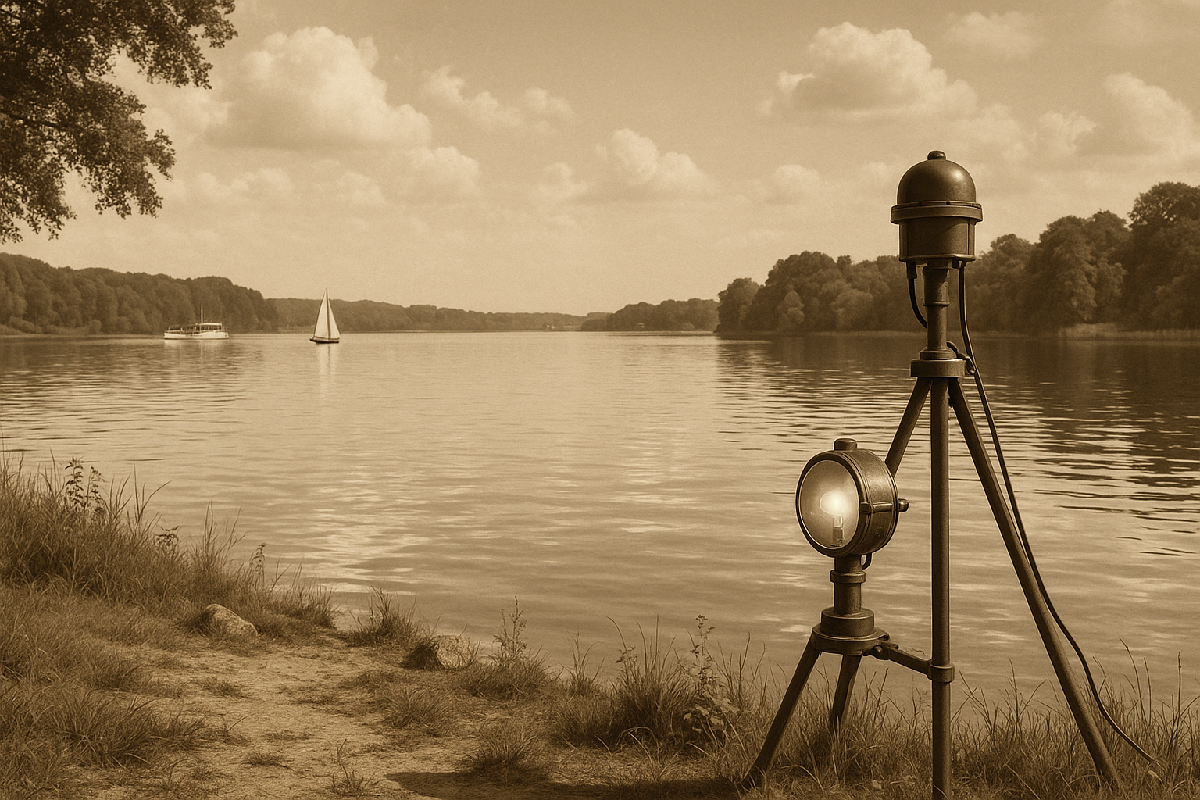
But he kept pushing the limits. He refined his apparatus, improving the power of his arc lamp and the sensitivity of his selenium receiver. His experiments culminated in a record-breaking transmission over a distance of 15 kilometres (nearly 10 miles) between an observatory in Berlin and a station on a hill at Nauen. This was an incredible achievement for optical communication at the turn of the 20th century, proving that his system was more than just a laboratory curiosity.
This success attracted the serious attention of the German Navy. They immediately saw the potential of Ruhmer's photophone for secure, jam-proof ship-to-ship communication. Unlike radio waves, which broadcast in all directions and could be easily intercepted, a focused beam of light was highly directional and private. The Navy sponsored further trials, and Ruhmer's system was successfully tested between naval vessels.
So why didn't we all end up with photophones instead of radios? Despite its successes, the technology had some fundamental practical limitations that ultimately prevented its widespread adoption:
- Line of Sight: It required a clear, uninterrupted line of sight between the transmitter and receiver. It couldn't see through buildings, over hills, or around the curvature of the Earth.
- Weather Dependent: This was its biggest Achilles' heel. Fog, rain, snow, and even thick atmospheric haze could easily scatter or block the light beam, rendering the system useless.
- Daylight vs. Night: While it could work during the day, it performed best at night when the modulated beam from the arc lamp was easier for the receiver to distinguish from ambient light.
Ultimately, Ruhmer's photophone was a technology that was simply ahead of its time. The principles were sound, but it lacked a sufficiently powerful, reliable, and coherent light source – something like the laser, which wouldn't be invented for another 60 years.
Work with Radio Waves: The Arc Transmitter
What makes Ruhmer's story even more interesting is that he had a foot in both camps. He wasn't just an optics guy; he was also deeply involved in the mainstream development of radio. He understood that light and radio were just different parts of the same electromagnetic spectrum.
He conducted extensive work with the Poulsen arc transmitter. This device, invented by Valdemar Poulsen, was the dominant technology for generating continuous wave (CW) radio signals before powerful vacuum tube oscillators became available. Unlike the noisy spark-gap transmitters, the arc transmitter could produce a pure, stable carrier wave, which was essential for transmitting clear audio.
Ruhmer used the arc transmitter to conduct his own experiments in wireless telephony using radio waves. He was one of the early pioneers, alongside figures like Poulsen himself and Lee de Forest, working to transmit voice and music via radio. His expertise with the "speaking arc" in his photophone was directly transferable. The principle of modulating a power source to vary an output – whether that output was a beam of light or a radio wave – was fundamentally the same.
Synergies with Ham Radio: The Spirit of Exploration
Ernst Ruhmer's work embodies the very best of the experimental spirit that drives amateur radio.
- Exploring Different "Bands": His work on both light waves (the highest frequency "band" of all!) and radio waves mirrors the ham's curiosity to explore the entire electromagnetic spectrum. Hams today experiment with everything from VLF signals that travel through the earth to microwave and even light-beam communication.
- Line-of-Sight Communication: His photophone experiments are a fascinating historical precursor to all the modern line-of-sight communication modes used by hams on VHF, UHF, and microwave bands. Every time a ham points a beam antenna for a line-of-sight contact or experiments with laser communication, they are following in Ruhmer's footsteps.
- A "What If?" Technology: His story presents a wonderful "what if?" for radio enthusiasts to ponder. What if the laser had been invented in 1900? Would optical communication have become the dominant technology, with radio relegated to a secondary role for non-line-of-sight applications? It's a fun thought experiment that highlights how technological paths are chosen.
Legacy: A Visionary Ahead of His Time
Tragically, Ernst Ruhmer's brilliant and promising career was cut short. He passed away in 1913 at the very young age of 35. One can only wonder what other incredible inventions he might have produced had he lived longer.
His legacy is primarily that of a key pioneer of free-space optical communication. He took Alexander Graham Bell's initial concept and, through his own ingenuity with the speaking arc, transformed it into a robust, practical, long-distance system.
His work is often treated as a footnote in the history of communication because radio waves, which could travel beyond the horizon and weren't stopped by a bit of fog, ultimately proved to be a more versatile and practical medium for general communication. But to dismiss his work as a mere curiosity would be a great mistake. The principles he demonstrated with his photophone are the direct ancestors of modern technologies like fibre optic communication and the laser-based data links used for inter-satellite communication. He was planting seeds that would take half a century to fully blossom.
Conclusion: Speaking on a Beam of Light
Ernst Ruhmer's story is a captivating tale of a brilliant mind exploring the very limits of wireless communication. While radio waves ultimately won the day, his success in sending human voices on beams of light across miles of open air was a stunning achievement and a prophetic glimpse into the future of optical communications. He reminds us that the path of innovation is not always a straight line, and sometimes the most fascinating journeys, and the most prescient visions, are the ones found on the roads less travelled. He proved that it was possible to speak on a beam of light, and in doing so, he secured his place as one of the most imaginative Pioneers of Radio.
What are your thoughts on Ernst Ruhmer's work? Do you think optical communication could have become more dominant if the technology had been more advanced? Let me know in the comments below! And, as always, if you have suggestions for other "Pioneers of Radio" that you'd like to see featured, don't hesitate to share.
For more information please visit our online store or alternatively contact us and our team will be happy to assist you.