
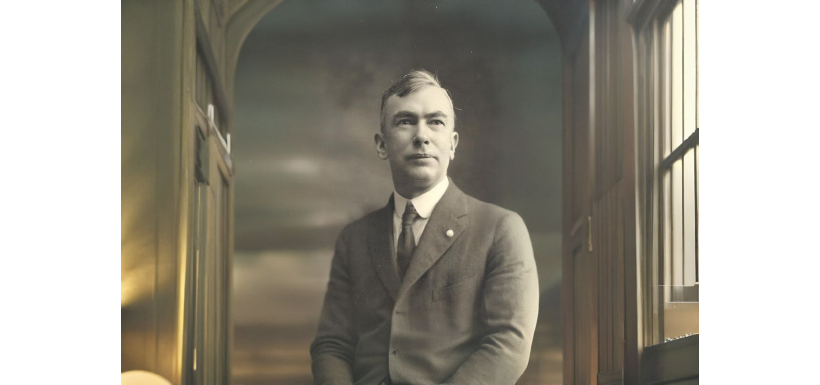
Imagine a world where the only way to get news or entertainment was through newspapers or live performances. No instant updates, no music on demand, no voices from across the globe reaching you in your own home. Then, imagine the wonder of hearing those voices and music suddenly emerge from a box in your living room, seemingly out of thin air. This was the magic of early radio broadcasting, a revolution that transformed society in ways few could have imagined. And while names like Marconi are synonymous with the invention of wireless communication, one man, Frank Conrad, played a pivotal, yet often overlooked, role in turning radio into the mass medium we know and love. As we continue our "Pioneers of Radio" series, we'll meet the unassuming engineer from Pittsburgh who, almost by accident, sparked the broadcasting boom.
Early Life and a Self-Taught Engineer
Frank Conrad was born in Pittsburgh, Pennsylvania, in 1874, a city that was then a booming centre of industry and innovation. Unlike some of the other pioneers we've covered, Conrad wasn't a formally trained academic. In fact, he left school after the seventh grade, a testament to his self-driven nature and practical aptitude. He was, in many ways, a self-taught engineer, learning by doing, tinkering, and experimenting. I find that incredibly inspiring; it shows that a passion for knowledge and a hands-on approach can be just as valuable as formal qualifications.
At the age of just 16, Conrad began working for Westinghouse Electric & Manufacturing Company, a major industrial firm in Pittsburgh. He started as a bench-hand, but his natural talent for mechanics and electricity quickly became apparent. He worked on a variety of projects, gaining experience in diverse areas of electrical engineering. He even contributed to the development of an improved streetcar motor, demonstrating his early inventive capabilities.
Even early in his career, Conrad had a fascination with accurate timekeeping. He developed a clock that was synchronized with the Arlington time signals, a precursor to his later involvement with radio time broadcasts. It's a seemingly small detail, but it reveals his early interest in precision and the use of technology for practical applications.
The Road to KDKA: From Time Signals to Broadcasting
Westinghouse, like other major electrical companies at the time, was involved in wireless technology, primarily for point-to-point communication, like ship-to-shore telegraphy. But Conrad's path towards broadcasting began, not with a grand vision, but with a personal hobby.
In 1916, Conrad built his own amateur radio station, with the call sign 8XK, at his home in Wilkinsburg, a suburb of Pittsburgh. His "studio," if you could call it that, was initially his garage. He began experimenting with transmitting time signals, building on his earlier interest in accurate timekeeping. This might seem a bit niche, but it was a valuable service for jewellers and others who needed precise time synchronization.
But then, something unexpected happened. Other amateur radio operators started tuning in to Conrad's transmissions, not just for the time signals, but for something else entirely: music. Conrad, perhaps to entertain himself or to test his equipment, had started playing phonograph records over the air. And people loved it.
He began receiving requests for specific songs and even started announcing a schedule for his "wireless telephone concerts," as he called them. He'd announce, "I will play such-and-such a record at 7:30 tonight," and hams within range would tune in to listen. It was informal, spontaneous, and utterly revolutionary. He was, without really intending to, becoming a broadcaster.

The turning point came with an advertisement in the Pittsburgh Sun newspaper. The Joseph Horne Company, a local department store, advertised radio receivers that could pick up Conrad's "wireless concerts". This ad is now considered a pivotal moment in the history of broadcasting. It demonstrated that there was a public demand for broadcast content, that people were willing to buy receivers specifically to listen to entertainment programmes transmitted over the air. I often wonder if the folks at Horne's realized the significance of what they were doing. They were, in effect, helping to launch a whole new industry.
This caught the attention of Harry P. Davis, a vice president at Westinghouse. Davis, unlike some executives who might have dismissed it as a passing fad, saw the potential. He recognized that radio could be more than just a point-to-point communication tool; it could be a medium for reaching a mass audience. And he knew that Frank Conrad, with his experimental station and his growing following, was the key to making it happen.
KDKA: The Birth of Commercial Radio Broadcasting
Westinghouse, under Davis's direction and with Conrad's technical expertise, decided to build a dedicated broadcasting station. The goal was not just to experiment, but to establish a regular, scheduled service that would provide news, music, and other entertainment to the public. And so, station KDKA was born.
On November 2, 1920, KDKA made its historic first broadcast, transmitting the returns of the Harding-Cox presidential election. Now, there's some debate about whether KDKA was absolutely the first broadcasting station. There were other experimental stations on the air before then. But KDKA is widely recognized as the first commercially licensed broadcasting station with a regular schedule of programmes, and it was certainly the most influential pioneer. That broadcast on election night 1920 was a watershed moment. It wasn't just about reporting the results; it was about demonstrating the power of radio to connect people to events in real-time, to create a shared experience across distances.
The early KDKA setup was fairly rudimentary. The transmitter was located in a makeshift shack on the roof of a Westinghouse building in East Pittsburgh. The "studio" was little more than a draped-off area with a microphone and a phonograph. But from these humble beginnings, a revolution was launched.
In the months and years that followed, KDKA's programming expanded to include music, sports, news, and religious services. The station became a model for others across the country, and the "radio craze" of the 1920s was in full swing. People were clamouring for receivers, and new stations were popping up everywhere. The airwaves, once the domain of experimenters and telegraph operators, were now filled with the sounds of a new era.
Frank Conrad, of course, remained a central figure at KDKA and Westinghouse. He continued to oversee the technical aspects of broadcasting, constantly working to improve the quality and reach of the station's signal. He became Assistant Chief Engineer, a testament to his indispensable role in the company's radio operations.
Beyond KDKA: Further Contributions and Legacy
Conrad's contributions extended beyond KDKA. He was a pioneer in the development of shortwave radio, conducting experiments that demonstrated the ability of shortwave signals to travel vast distances by reflecting off the ionosphere. This opened up the possibility of international broadcasting and further expanded radio's global reach. He was an avid experimenter, and held over 200 patents.
He received the prestigious Edison Medal in 1930, from the American Institute of Electrical Engineers (forerunner of the IEEE). He was also recognised with awards from the IRE. He would eventually retire in 1940. He died the following year. He’s often referred to as the “father of radio broadcasting”, although as we’ve seen, this claim can be disputed.
Conclusion: The Accidental Broadcaster
Frank Conrad's story is a fascinating example of how technological innovation can sometimes happen in unexpected ways. He wasn't initially trying to create a broadcasting empire; he was a curious engineer, experimenting with wireless technology and responding to the requests of his fellow radio enthusiasts. But in doing so, he stumbled upon a powerful new medium, one that would transform the way people received information and entertainment. He was, in a sense, an accidental broadcaster, a tinkerer who inadvertently helped launch a revolution.
So, the next time you turn on the radio, remember Frank Conrad, the unassuming engineer from Pittsburgh who, with his homemade station and his passion for wireless, helped to usher in the age of broadcasting. His story is a reminder that innovation can come from anywhere, and that sometimes, the most transformative technologies emerge from the simplest of beginnings.
What are your thoughts on Frank Conrad and the birth of radio broadcasting? Do you think he deserves more recognition for his contributions? Let me know in the comments below! And, as always, if you have suggestions for other "Pioneers of Radio" that you'd like to see featured, don't hesitate to share.
For more information please visit our online store or alternatively contact us and our team will be happy to assist you!