
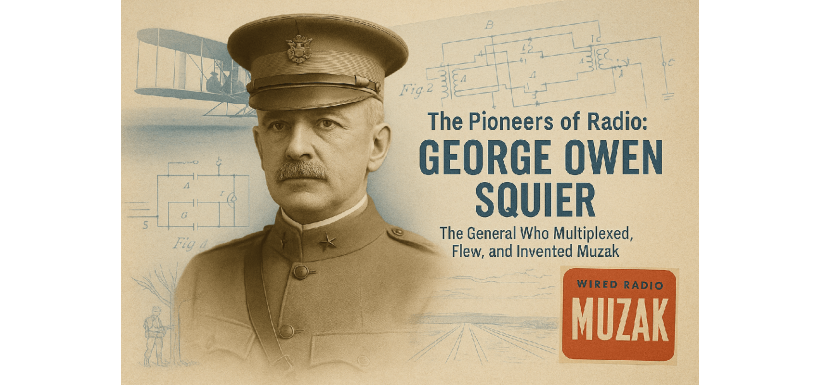
Imagine a decorated US Army General, a West Point graduate and Chief Signal Officer during the First World War, who not only revolutionised battlefield communication and helped birth the US Air Force but also invented the system that would become Muzak – yes, the very same "elevator music" that’s either soothed or mildly irritated generations! It sounds like a character from a rather eccentric novel, doesn't it? But Major General George Owen Squier was very real, and a true, if wonderfully unconventional, Pioneer of Radio. As we continue our "Pioneers of Radio" series, we'll unpack the multifaceted career of this remarkable individual, a man whose intellect and drive led him down some truly fascinating and diverse technological paths.
Early Life, Military Precision, and a Scientific Mind
George Owen Squier was born in Dryden, Michigan, in 1865. From early on, it seems he was destined for a life that blended discipline with a keen scientific curiosity. He graduated from the United States Military Academy at West Point in 1887, a place renowned for instilling precision and a rigorous approach to problem-solving. After his initial service in the artillery, he was drawn to the technical challenges of the U.S. Army Signal Corps.
But Squier wasn't your average army officer. In an era when advanced academic degrees were rare for military men, he pursued and obtained a Ph.D. in physics and electrical engineering from the prestigious Johns Hopkins University in 1893. This made him the first U.S. Army officer to earn such a doctorate. Can you imagine the dedication that took, balancing military duties with doctoral research? His studies likely focused on areas directly applicable to improving military capabilities, such as ballistics and the cutting edge of electrical communication. Even this early dedication to advanced study set him apart.
His inventive streak was apparent from early on. Before his most famous contributions, he co-developed "The Polarizing Photo-Chronograph" in 1896 with Professor Albert Cushing Crehore. This ingenious device was designed to measure the velocity of artillery shells, both inside the cannon barrel and just after they exited.
It was a blend of optics, electronics, and precision mechanics – a clear foreshadowing of the innovative thinking that would define his career. He wasn't just following orders; he was looking for ways to apply science to solve real-world military problems.
Revolutionising Wired Communication: Multiplexing and "Wired Wireless"
One of the biggest headaches for military (and civilian) communication in the late 19th and early 20th centuries was the limitation of telegraph and telephone lines. Typically, it was a case of "one wire, one message." If you wanted to send multiple telegraph messages or have several telephone conversations simultaneously, you needed multiple physical wires, which was expensive, cumbersome, and often impractical, especially in a battlefield scenario.
Squier, with his deep understanding of electrical principles, tackled this problem head-on. He famously wrote, "If one wire could be made to do the work of many wires, the main difficulty in field communications for war purposes would be solved.” And solve it he did. Around 1910, he developed and demonstrated telephone carrier multiplexing.
His ingenious idea, which he termed "wired wireless," involved using the principles of radio frequency transmission over existing wires. Essentially, he figured out how to send multiple telephone or telegraph signals over a single pair of wires by modulating each signal onto a different high-frequency "carrier wave." At the receiving end, filters would separate these carrier frequencies, allowing the individual messages to be demodulated. Think of it like having several different radio stations broadcasting simultaneously, but instead of travelling through the air, their signals are neatly channelled down a single wire, each on its own distinct frequency. It was revolutionary.
This multiplexing technique dramatically increased the capacity of existing communication infrastructure. Sources suggest it could increase the capacity of a standard telephone wire by as much as 400 percent, and a telegraph wire by an incredible 1,000 percent! It was a massive leap forward, a genuine game-changer for both military and commercial communications. AT&T, the telephone giant, quickly recognised the importance of Squier's work.
Interestingly, Squier's key patents for "Multiplex Telephony and Telegraphy," granted in 1911, were "dedicated to the public" due to his status as a government officer making inventions during his service. This meant that companies could, in theory, use his methods without paying him royalties, a fascinating and rather selfless aspect of his contribution, though it also led to some complex interactions with commercial entities like AT&T who were also developing similar systems.
Taking to the Skies: A Pioneer of U.S. Military Aviation
As if revolutionising wired communications wasn't enough, George Owen Squier also played an absolutely pivotal, and often underappreciated, role in the birth of the United States Air Force. His foresight and advocacy for military aviation were extraordinary for the time.
While serving as Executive Officer to the Chief Signal Officer in Washington D.C., Squier was instrumental in the establishment of the Aeronautical Division, U.S. Signal Corps, on August 1, 1907. He literally wrote the memorandum that created this first organisational ancestor of the USAF. At the time, aviation was still very much in its infancy, viewed by many as a novelty rather than a serious military tool.
Squier, however, saw its potential. He was deeply involved with the Wright Brothers. He drafted the first specifications for a military aircraft to be purchased by the U.S. Army, a machine that would, of course, be supplied by Orville and Wilbur. And then, on September 12, 1908, Squier made history by becoming the first military passenger in an airplane, taking a flight with Orville Wright. Can you imagine the courage and the sheer thrill of that? To be one of the very first to experience heavier-than-air flight, knowing it could change warfare forever. He was then directly responsible for the Army's first purchase of an airplane from the Wrights in 1909.
His commitment to aviation didn't stop there. From May 1916 to February 1917, he served as Chief of the Aviation Section, U.S. Signal Corps. During this period, he was responsible for acquiring the land and establishing Langley Field in Virginia. He named it after Samuel Pierpont Langley, another aviation pioneer. Langley Field became, and in many ways still is, a principal research facility for military and civilian aviation, a lasting testament to Squier's vision.
Unconventional Antennas: "Talking Through the Trees"
Squier was clearly a man who didn't shy away from unconventional ideas. One of the most wonderfully quirky examples of this was his research into using living trees as radio antennas. Yes, you read that right – actual trees!
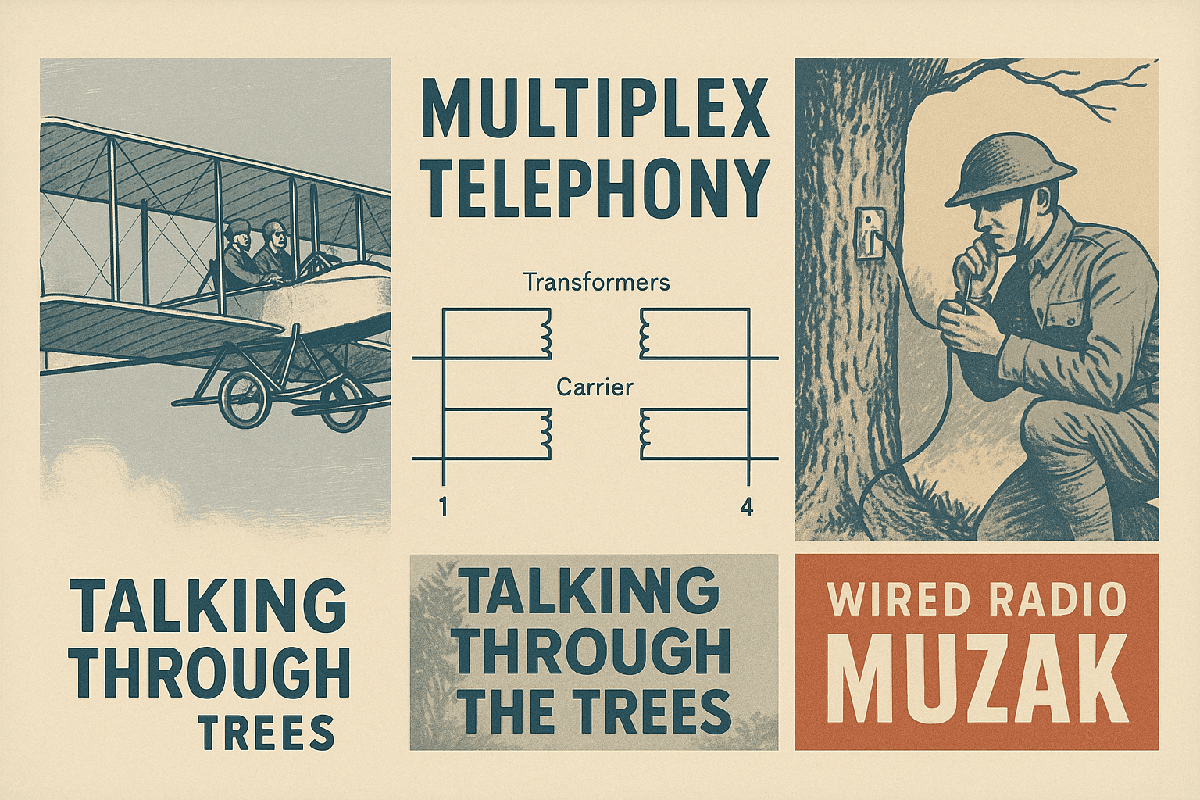
Around 1904, and reported more widely in publications like Scientific American in 1919, Squier discovered that trees could be surprisingly effective for both receiving and transmitting radio signals. His method was remarkably simple: drive a nail or metal spike into a tree trunk at a suitable height, and connect a wire from that nail to your radio apparatus. The tree itself, with its sap and extensive root system acting as a ground, became part of the antenna system. He called this "floragraphy" or, more evocatively, "talking through the trees."
He reported successful experiments to the War Department, highlighting the potential military applications. Imagine soldiers in a forested battlefield, far from base, needing to communicate. Instead of lugging around cumbersome antenna masts, they could simply tap into the nearest suitable tree! It's a brilliant example of innovative thinking and making use of the natural environment. While it didn't become a mainstream antenna solution (for obvious reasons of practicality and consistency compared to engineered antennas), it demonstrated Squier's willingness to experiment and explore every possibility. It really captures that early pioneering spirit of radio, that feeling that anything was possible.
The Surprising Birth of Background Music: Muzak
Just when you think George Owen Squier's career couldn't get any more diverse, we arrive at perhaps his most widely known, if often anonymously experienced, invention: Muzak.
Building on his "wired wireless" multiplexing concept, Squier realised that existing electrical power lines or telephone wires could be used to distribute not just telegraph and telephone signals, but also news broadcasts and, crucially, music directly into homes and businesses. This would bypass the need for then-expensive and often poor-quality radio receivers. He called this service "Wired Radio."
After retiring from the military with the rank of Major General in 1922, Squier dedicated himself to this new venture, founding Wired Radio, Inc. He envisioned a subscription service, delivering high-quality audio content directly to subscribers. The name for this service needed to be catchy. Inspired by the success of the brand name "Kodak," Squier cleverly combined "Music" with "Kodak" to coin the term "Muzak" in 1934.
Initially, the idea was to pipe music into homes. However, by the time Muzak was fully developed, broadcast radio had become much more established and offered free entertainment. So, Squier's company pivoted, focusing on providing background music to commercial establishments – hotels, restaurants, department stores, and, yes, elevators. Muzak became synonymous with "elevator music" or "piped music," designed to create a specific atmosphere or even, according to some theories, influence worker productivity or shopper behaviour. It's a rather unexpected cultural legacy for a high-ranking military officer and signals pioneer!
Chief Signal Officer, WWI, and Later Career
Squier's military career culminated during the First World War. Promoted to Major General, he served as the Chief Signal Officer of the U.S. Army from February 1917 until his retirement. This was an immense responsibility, placing him in charge of all Army communications – telegraph, telephone, and the rapidly developing field of radio – as well as the burgeoning Army aviation service.
During the war, he oversaw the massive expansion of the Signal Corps, the establishment of vital training programmes, and the deployment of new communication technologies to the front lines. He was instrumental in setting up two crucial Army research laboratories: Fort Monmouth in New Jersey for radio research and development, and, as mentioned earlier, Langley Field for aviation. These institutions became centres of excellence and played a vital role in advancing military technology for decades to come.
His leadership during this critical period was recognised with the Distinguished Service Medal. After retiring from the Army in 1922, his primary focus shifted to his commercial venture, Muzak. George Owen Squier passed away in 1934.
Synergies with Radio & Ham Radio
While Squier's "wired wireless" isn't radio in the traditional sense of Hertzian waves propagating through free space, his work has significant synergies with radio and amateur radio:
- Multiplexing's Legacy: The fundamental principles of using carrier frequencies to send multiple signals over a shared medium, which Squier pioneered for wires, are directly analogous to how the radio spectrum is divided and used. Modern digital modes used by hams often employ sophisticated multiplexing techniques (like Frequency Division Multiplexing or Time Division Multiplexing).
- Antenna Experimentation: Squier's bold experiments with tree antennas absolutely embody the ham spirit of "what if?" and "let's try it!" Hams are renowned for their innovative and sometimes unconventional antenna designs, often making use of whatever materials are at hand.
- Signal Corps Influence: As Chief Signal Officer, Squier's leadership in adopting and developing radio within the military had a profound impact. The Signal Corps trained thousands of radio operators and technicians, many of whom would have gone on to become amateur radio enthusiasts, bringing their skills and passion to the hobby. The military's investment in radio research also spurred broader technological advancements that benefited the entire field.
Legacy & Recognition: More Than Just Muzak
George Owen Squier was a man of extraordinary vision and diverse talents. His contributions spanned multiplex telephony, the very foundations of the U.S. Air Force, unconventional antenna research, and the creation of a cultural phenomenon in Muzak.
He received numerous awards and honours throughout his life, including the Distinguished Service Medal, the John Scott Medal, the Elliott Cresson Medal, and the Franklin Medal. He was elected to the prestigious National Academy of Sciences in 1919. In 1943, a U.S. Navy troopship, the USS General G. O. Squier (AP-130), was named in his honour, the lead ship of its class.
Yet, despite these accolades and his profound impact, Squier is perhaps not as much of a household name as some of his contemporaries. Perhaps it's because his contributions were so varied, or because Muzak, while commercially successful, carried a somewhat kitsch connotation that overshadowed his more serious scientific and military achievements.
Conclusion: The Army's Unconventional Communications Genius
Major General George Owen Squier was a true polymath in uniform, a remarkable individual whose intellect and relentless drive left an indelible mark on communications, aviation, and even the soundtrack of our daily lives. From making one wire do the work of many, to taking the first military flight, to envisioning music delivered like a utility, his career was a testament to innovative thinking and the practical application of science. He reminds us that innovation can wear many hats, and sometimes the most fascinating pioneers are those who refuse to be confined to a single field, constantly exploring, experimenting, and pushing the boundaries of what's possible. He was, without a doubt, one of the U.S. Army's most unconventional and impactful communications geniuses.
What are your thoughts on George Owen Squier's incredibly diverse career? Do you think his contributions, particularly to early aviation and multiplexing, get the recognition they deserve? Let me know in the comments below! And, as always, if you have suggestions for other Pioneers of Radio" that you'd like to see featured, don't hesitate to share.
For more information please visit our online store or alternatively contact us and we'll be happy to assist you!