
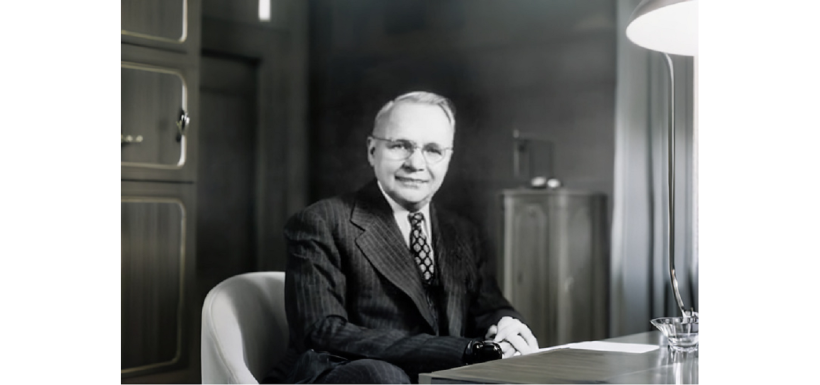
Ever listened to a CD, streamed music online, or admired a crisp digital photograph? We live in a world saturated with digital media, where sounds and images are routinely converted into streams of ones and zeros. But have you ever stopped to wonder how that conversion actually happens? How can a continuous sound wave, like the music from a guitar, or a continuous range of colours and light, like a sunset, be accurately represented by discrete digital data? The answer lies in a fundamental principle called sampling, and one of the key figures who unlocked its secrets was a Swedish-American physicist and engineer named Harry Nyquist. As we continue our "Pioneers of Radio" series, we'll meet the man who laid the mathematical foundations for the digital revolution, a quiet giant whose work at Bell Labs continues to shape the way we experience the world. His name might not be instantly recognizable, but his contribution is woven into the fabric of modern communication.
Early Life and Education: From Sweden to America
Harry Nyquist's story begins in Nilsby, Sweden, where he was born in 1889. The details of his early childhood are somewhat sparse, but we know that at the age of 18, in 1907, he emigrated to the United States. This transatlantic journey marked a turning point in his life, setting him on a path that would lead to groundbreaking contributions in the field of communication theory. He wasn't coming to America to seek fame or fortune in Hollywood, like some of our other pioneers. He came seeking knowledge.
He enrolled at the University of North Dakota, where he earned both bachelor's and master's degrees in electrical engineering. Clearly, he had a knack for the subject. He then went on to earn a Ph.D. in physics from Yale University in 1917. Now, a Ph.D. from Yale in 1917? That's no small feat. It speaks volumes about Nyquist's intellectual capabilities and his dedication to understanding the fundamental principles of the physical world. I can only imagine the long hours he must have spent poring over textbooks and conducting experiments.
Bell Labs and the Dawn of Information Theory
After completing his doctorate, Nyquist joined the Department of Development and Research of the American Telephone and Telegraph Company (AT&T) in 1917. This was a pivotal moment, not just for Nyquist, but for the future of communication technology. AT&T, and its research arm, Bell Telephone Laboratories (Bell Labs), would become a crucible of innovation, attracting some of the brightest minds in the world.
In the early 20th century, one of the major challenges facing the telecommunications industry was improving the speed and efficiency of telegraph transmission. Telegraphy, the sending of text messages over long distances using wires, was the primary means of rapid communication at the time. But existing telegraph systems were limited by factors like bandwidth and noise. How could more information be transmitted over a given channel in a given amount of time?
This was the problem that Nyquist tackled in his early work at AT&T. In 1924, he published a seminal paper titled "Certain Factors Affecting Telegraph Speed." This paper, while focused on telegraphy, laid some of the groundwork for his later, more famous work on sampling. He analyzed the relationship between the bandwidth of a communication channel (the range of frequencies it can carry) and the maximum speed at which information can be transmitted without distortion.
Nyquist followed this with a second, pivotal paper in 1928: "Certain Topics in Telegraph Transmission Theory". This publication is generally considered a masterpiece, a concise and yet amazingly complete summary of the state of the art.
The Nyquist-Shannon Sampling Theorem: A Cornerstone of Digital Communication
Now, we get to the heart of Nyquist's legacy: the Nyquist-Shannon sampling theorem. This theorem, often simply called the Nyquist theorem, is so fundamental to digital communication that it's hard to overstate its importance. It's one of those concepts that seems deceptively simple, but its implications are profound.
Here's the problem in a nutshell: The world around us is mostly analog. Sound waves, light waves, radio waves – these are all continuous signals, meaning they vary smoothly over time. But computers and digital devices operate on discrete data, on ones and zeros. So, how do you convert a continuous analog signal into a discrete digital representation without losing essential information?
The answer, according to the Nyquist-Shannon sampling theorem, is to sample the analog signal at regular intervals. Think of it like taking snapshots of a moving object. If you take snapshots frequently enough, you can create a sequence of images that accurately captures the motion. But if you take snapshots too infrequently, you'll miss important details, and the motion will appear jerky or distorted.
The sampling theorem provides the precise rule for how frequently you need to sample:
The sampling rate (fs) must be at least twice the highest frequency component (fmax) of the signal.
Or, expressed as a formula:
fs ≥ 2fmax
Where,
- fs is the Sample Rate
This minimum sampling rate, 2fmax, is called the Nyquist rate.
So, what happens if you sample below the Nyquist rate? You get something called aliasing. This is where the high-frequency components of the signal get "folded back" into the lower frequencies, creating distortion and artifacts. A classic example of aliasing is the wagon-wheel effect in old Westerns. If the camera's frame rate (its sampling rate) is too low compared to the rotation speed of the wagon wheel, the wheel can appear to be rotating backward or at the wrong speed. It's a visual illusion caused by under sampling.
Now, it's important to acknowledge that while Nyquist laid the groundwork for the sampling theorem in his 1928 paper, it was Claude Shannon, another giant of information theory (and a future subject in this series, no doubt!), who provided a more complete mathematical proof and generalized the concept in his landmark 1948 paper, "A Mathematical Theory of Communication". That's why we often refer to it as the Nyquist-Shannon sampling theorem, giving credit to both of these brilliant minds. I find it quite fitting that it's a collaborative name, as so much of scientific progress is built on the work of many individuals.
The practical implications of the sampling theorem are enormous. It's the reason why audio CDs have a sampling rate of 44.1 kHz. The human ear can typically hear frequencies up to about 20 kHz, so a sampling rate of slightly more than twice that ensures that all audible frequencies are accurately captured. It's also why digital images have a certain resolution (measured in pixels), and why digital video has a certain frame rate. In all these cases, the sampling theorem guides engineers in choosing the appropriate sampling parameters to ensure faithful reproduction of the original analog signal.
Beyond Sampling: Nyquist's Other Contributions
While the sampling theorem is arguably Nyquist's most famous achievement, he made other significant contributions to communication theory and engineering. He was a prolific inventor, holding over 130 US patents.
One area where he made important contributions was the study of thermal noise in electrical circuits. Thermal noise, also known as Johnson-Nyquist noise, is a fundamental type of noise caused by the random motion of electrons in a conductor. Nyquist derived a formula for calculating the noise power generated by a resistor, a result that's essential for designing low-noise amplifiers and other sensitive electronic circuits. Imagine trying to pick up a faint radio signal from a distant galaxy. You need to minimize the noise generated by your own equipment, and Nyquist's work helps engineers do just that.
Nyquist also developed the Nyquist stability criterion, a powerful tool used in control theory and feedback systems. This criterion provides a graphical method for determining whether a system, such as an amplifier or a control system, will be stable or unstable. It's a fundamental concept in engineering design, helping to ensure that systems operate reliably and don't oscillate out of control. I have to admit, stability criteria aren't exactly my strong suit, but I appreciate their importance!
Legacy and the Digital Revolution
Harry Nyquist retired from Bell Labs in 1954, but his work continued to have a profound impact on the world. He received numerous awards and honours, including the IRE Medal of Honor in 1960 "for fundamental contributions to a quantitative understanding of thermal noise, data transmission and negative feedback." He also received the Stuart Ballantine Medal from the Franklin Institute.
The Nyquist-Shannon sampling theorem, in particular, became a cornerstone of the digital revolution. It's the theoretical foundation upon which much of digital audio, digital video, digital imaging, and digital communication is built. Without it, we wouldn't have CDs, MP3s, digital cameras, mobile phones, or the internet as we know it. It's quite humbling to think that so much of our modern digital world rests on the insights of this one man, working at Bell Labs in the early 20th century.
Conclusion: The Foundation of the Digital Age
Harry Nyquist's story is a testament to the power of theoretical work in driving technological progress. He wasn't a flashy inventor who created iconic gadgets. He was a physicist and engineer who delved deep into the fundamental principles of communication, and his insights paved the way for the digital revolution. He was a quiet giant, a pioneer whose work might not be immediately obvious to the average person, but whose impact is undeniable. He laid the mathematical groundwork for so much of what we take for granted today. So, the next time you listen to a digital song, watch a streaming video, or make a phone call, remember Harry Nyquist, the master of sampling, the man who helped turn the analog world into the digital one we inhabit today.
For more information please visit our online store or alternatively contact us and our team will be happy to assist you.
What are your thoughts on Harry Nyquist and the sampling theorem? Do you have any experience with digital signal processing or other fields where his work is relevant? Let me know in the comments below! And, as always, if you have suggestions for other "Pioneers of Radio" that you'd like to see featured, don't hesitate to share.