
When you think of Hedy Lamarr, chances are you picture a glamorous film star, a silver-screen siren from Hollywood's golden age. But did you know she also co-invented a technology that's crucial to modern wireless communication? That's right, the same woman who graced the silver screen with her beauty and talent also possessed a brilliant mind for engineering. As we continue our "Pioneers of Radio" series, we'll delve into the extraordinary story of Hedy Lamarr, an Austrian-American actress who proved that there's more to her than just a pretty face. We'll uncover how her ingenious invention, conceived during the dark days of World War II, laid the groundwork for technologies like Wi-Fi and Bluetooth that we all rely on today.
From Vienna to Hollywood: A Star is Born
Hedy Lamarr's journey began not in Hollywood but in Vienna, Austria. Born Hedwig Eva Maria Kiesler in 1914, to a bank director and a concert pianist. She was a bright spark from the start, fascinated by both the performing arts and the workings of the world around her. She reportedly excelled in her science classes, and had a habit of taking apart and reassembling her music box, much to the amusement of her parents.
Her acting career took off in Europe while she was still in her teens. She appeared in several films, including the 1933 film "Ecstasy," which, shall we say, raised a few eyebrows at the time due to its rather racy content. It wasn't long before she caught the eye of Hollywood, but her personal life took a dramatic turn before she made the leap across the Atlantic.

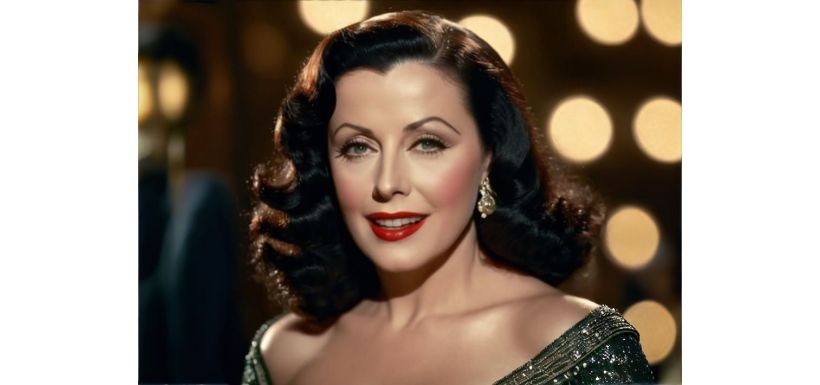
Image - portrait of Hedy Lamarr
In 1933, she married Friedrich Mandl, a wealthy Austrian arms manufacturer. It was not a happy union. Mandl was controlling and possessive, attempting to restrict Lamarr's career and, somewhat ironically, trying to buy up every copy of "Ecstasy" in existence. He was also, unfortunately for him, supplying arms to the Nazi regime. But amidst this stifling environment, Lamarr's intellect was sparked. She often accompanied Mandl to business meetings, where she listened intently to discussions about military technology, including the challenges of radio-controlled weaponry. This knowledge, gleaned in the most unlikely of circumstances, would later prove invaluable.
In a daring escape, Lamarr fled her oppressive marriage, reportedly disguising herself as her own maid. She eventually made her way to London, where a chance encounter with Louis B. Mayer, the head of MGM studios, changed her life once again. He offered her a contract, and soon, under the stage name Hedy Lamarr, she was dazzling audiences on the silver screen. She became an icon of Hollywood glamour, known for her exotic beauty and captivating performances in films like "Algiers" (1938), "Boom Town" (1940), "White Cargo" (1942), and "Samson and Delilah" (1949).
An Unlikely Inventor: The Secret Communication System
But amidst the glitz and glamour of Hollywood, Lamarr harboured a secret passion: invention. The outbreak of World War II ignited in her a fierce desire to contribute to the Allied war effort. Drawing on what she'd learned during her marriage to Mandl, she became particularly concerned about the vulnerability of radio-controlled torpedoes. The existing systems used a single frequency, making them easy for the enemy to jam, rendering the torpedoes useless.
At a dinner party, she met George Antheil, a self-proclaimed "bad boy of music," known for his avant-garde compositions, including the infamous "Ballet Mécanique," which was scored for multiple player pianos. It was an unlikely pairing – a Hollywood star and an experimental composer – but they shared a common interest in pushing boundaries. Antheil, it turned out, had been experimenting with synchronizing musical instruments using radio signals, a concept that resonated with Lamarr's concerns about torpedo guidance.
Together, they came up with a brilliant idea: frequency-hopping. Imagine a pianist rapidly jumping between different keys on a piano. That's essentially what their invention did with radio signals. They envisioned a system where the transmitter and receiver would hop between different frequencies in a synchronized pattern, making it incredibly difficult for the enemy to jam the signal or intercept the communication. They took their inspiration from player pianos, which used perforated paper rolls to control multiple notes. Lamarr and Antheil proposed using a similar mechanism, with 88 frequencies (the number of keys on a piano), to control the frequency hopping.
They developed their idea, calling it a "Secret Communication System," and in 1942, they were granted a patent (US Patent No. 2,292,387). But their invention was met with scepticism from the US Navy. Lamarr would later suggest the Navy found their idea too cumbersome, struggling to imagine such a mechanism being small enough to fit within a torpedo. Instead, she was encouraged to use her celebrity status to sell war bonds, which she did, raising millions by touring the country and promoting the war effort. "Evidently," she might have quipped, "when faced with a complex engineering solution from a Hollywood star and an avant-garde composer, the Navy's response was, 'Thanks, but no thanks. Maybe stick to selling war bonds.' It just goes to show, even geniuses get brushed off sometimes."
Rediscovery and Recognition: From Patent to Wi-Fi
Lamarr and Antheil's invention, while ahead of its time, was initially shelved. However, the principles behind frequency-hopping eventually found their way into military applications during the Cold War. In the late 1950s and early 1960s, engineers at companies like Sylvania Electronic Systems Division developed electronic frequency-hopping systems, acknowledging the conceptual debt to Lamarr and Antheil's patent. Their system would be fitted to ships sent to blockade Cuba in 1962, long after the patent had expired.
But the real revolution came with the advent of digital communication. Frequency-hopping, along with other spread spectrum techniques, proved to be a game-changer in wireless technology. It's used in secure military communications, of course, but it's also a fundamental part of everyday technologies like Wi-Fi and Bluetooth. I remember the first time I used a Bluetooth headset, thinking it felt like magic, this seamless wireless connection.
Little did I know, I had a Hollywood star to thank, in part, for that bit of technological wizardry.
It wasn't until the late 1990s that Lamarr and Antheil finally received proper recognition for their groundbreaking work. In 1997, they were honoured with the Electronic Frontier Foundation (EFF) Pioneer Award. And in 2014, they were posthumously inducted into the National Inventors Hall of Fame. As Anthony Loder, Lamarr's son, put it, "While my mother was known as a movie star, her greatest role was that of an inventor. She spent countless hours working to improve the world, and in doing so, she made an indelible mark on history."
More Than a Pretty Face: A Lasting Impact
Hedy Lamarr was far more than just a glamorous Hollywood star. She was a brilliant, creative individual with a genuine passion for invention. Her story is particularly inspiring because she defied the expectations of her time, refusing to be defined solely by her looks. It is a shame that she had to face significant challenges in being taken seriously as an inventor, simply because she was a woman famous for her beauty.
Her collaboration with George Antheil, an equally unconventional figure, is a testament to the power of interdisciplinary thinking. Who would have thought that an actress and an avant-garde composer would come up with an invention that would revolutionise wireless communication?
Conclusion
Hedy Lamarr's story is a powerful reminder that innovation can spring from the most unexpected places. She showed that glamour and intelligence can go hand in hand, and that a beautiful mind can be even more captivating than a beautiful face. Her invention of frequency-hopping, though initially overlooked, ultimately had a profound impact on the development of secure communication and laid the groundwork for technologies we now take for granted. So, the next time you connect to Wi-Fi or use your Bluetooth headphones, spare a thought for Hedy Lamarr, the Hollywood star who was also a secret radio pioneer. Her tale is a compelling one, and one that deserves to be told.
For more information please visit our online store or alternatively contact us, our team will be happy to assist you!
What are your thoughts on Hedy Lamarr and her remarkable contribution to technology? Are there other unsung heroes or unlikely inventors you think deserve a place in the spotlight? Let me know in the comments below!