
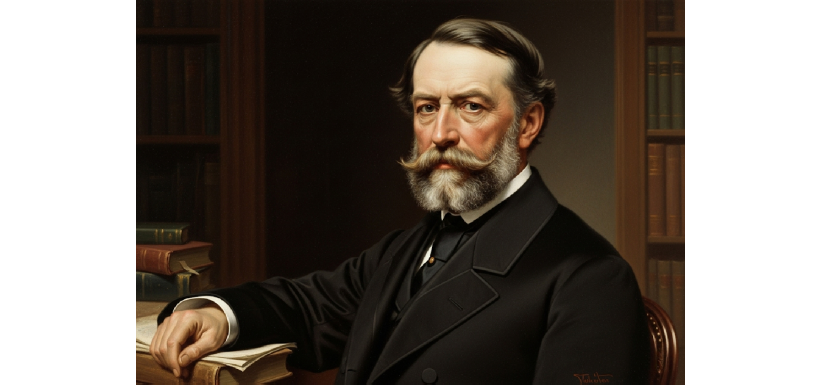
In the grand story of radio, we often leap to the inventors who first sent a signal or the engineers who perfected the receiver. But the journey of electronics began much earlier, not with a complex circuit, but with a mysterious, beautiful glow in a simple glass tube. Long before the first radio signal ever crackled into existence, scientists in darkened laboratories across Europe were exploring the strange and mesmerising effects of passing electricity through vacuums. One of the very first to truly document and investigate these mysterious emanations was Julius Plücker, a German mathematician and physicist. As we continue our "Pioneers of Radio" series, we’ll meet a man whose work on what would become known as 'cathode rays' was a fundamental first step towards the discovery of the electron and, ultimately, the invention of the vacuum tube itself.
A Mathematician First: Geometry and Plücker Coordinates
Julius Plücker was born in Elberfeld, Germany, in 1801. He wasn't initially destined to be an experimental physicist; his first love and primary career was mathematics. He studied at a number of prestigious German and French universities, establishing himself as a brilliant mathematician with a gift for geometry.
He eventually became a professor of mathematics at the University of Bonn, where he made profound contributions to the fields of analytic and projective geometry. He developed a concept known as "Plücker coordinates," a way of representing lines in 3D space using a set of numbers. Now, I won't pretend to be a mathematician, and the details are fantastically complex, but this work was so foundational that it's still used today in fields like computer graphics, robotics, and theoretical physics. This is important because it establishes Plücker not just as a tinkerer, but as a top-tier scientist with a mind capable of deep, abstract thought before he ever turned his full attention to the laboratory bench. It shows the incredible intellectual depth he would later bring to his experiments.
The Pivot to Physics: Investigating Magnetism
Around 1847, after a long and distinguished career in mathematics, Plücker made a significant pivot and turned his focus to experimental physics. It’s a fascinating career change. What prompts a celebrated mathematician to dive into the hands-on world of the laboratory? It was likely the incredible buzz of discovery in the air at the time, particularly from figures like Michael Faraday in London, whose work on electricity and magnetism was captivating the scientific world.
Plücker quickly proved he was just as skilled an experimentalist as he was a theorist. He conducted important research into the magnetic properties of gases and crystals. He discovered that the magnetic properties of certain crystals were not uniform; they would align themselves differently in a magnetic field depending on the orientation of their crystalline axes. This phenomenon, known as magnetic anisotropy, was a significant contribution to the understanding of magnetism. This work wasn't just a side project; it cemented his reputation as a skilled and respected experimental physicist and set the stage for his most famous discovery.
The Mysterious Glow: Experiments with Geissler Tubes
The real breakthrough, and the reason Plücker is so crucial to our story, came in 1858. By this time, a fellow German, the skilled glassblower and instrument maker Heinrich Geissler, had perfected a device that would become essential for physics research: the Geissler tube. It was a high-quality sealed glass tube with electrodes at either end, from which most of the air had been pumped out to create a partial vacuum.
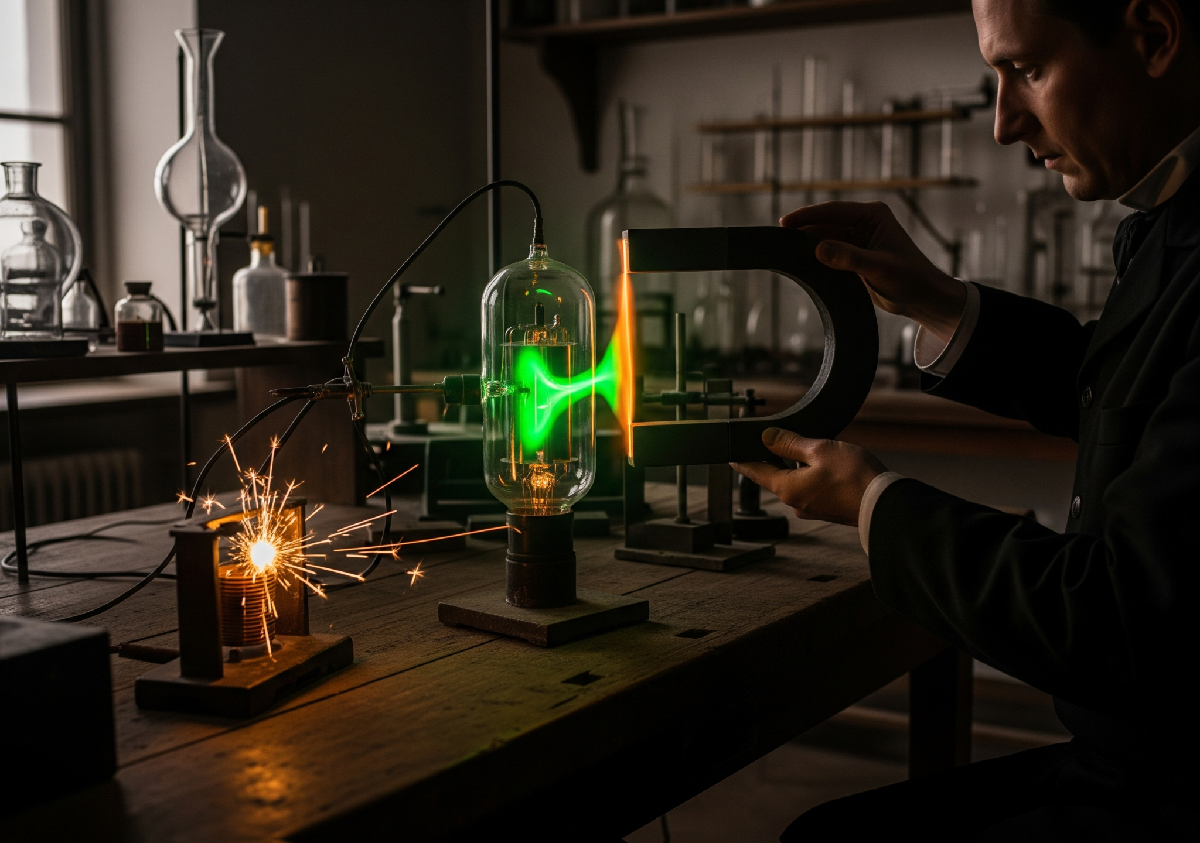
Plücker, using these new tubes, began to investigate the effects of passing a high voltage from an induction coil through the low-pressure gas inside. And what he saw was extraordinary. He noticed that a strange, greenish fluorescent glow appeared on the glass wall of the tube. Crucially, this glow was always opposite the negative electrode, the cathode.
This was more than just a pretty light show. Plücker, the meticulous scientist, began to experiment. He found that if he placed a small object inside the tube, it would cast a sharp shadow within the glow. This was a vital clue. It proved that whatever was causing the glow was travelling in straight lines from the cathode across the tube. It wasn't just the gas itself that was glowing randomly; it was being struck by invisible rays.
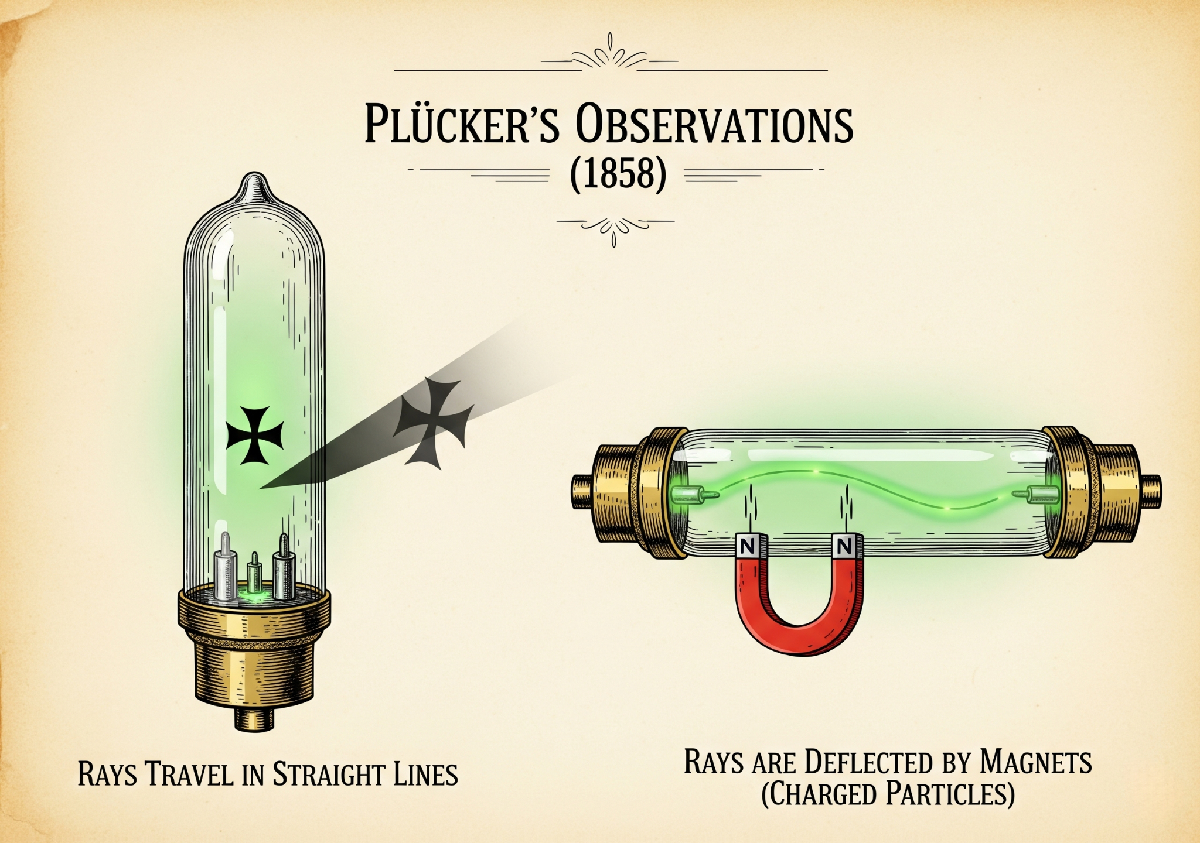
But his most important discovery was yet to come. He brought a magnet close to the outside of the tube and observed that the position of the green glow on the glass moved. The magnet could bend the path of these invisible rays! This was a monumental finding. It proved that the rays were not a form of light, like ultraviolet rays, because light is not deflected by a magnetic field in this way. This meant that the "rays" had to be composed of electrically charged particles. He had discovered cathode rays, the very first glimpse of the electron in action. The term itself would be coined later, but Plücker was the first to see and describe their fundamental properties.
The Bridge to Modern Electronics: Influence and Legacy
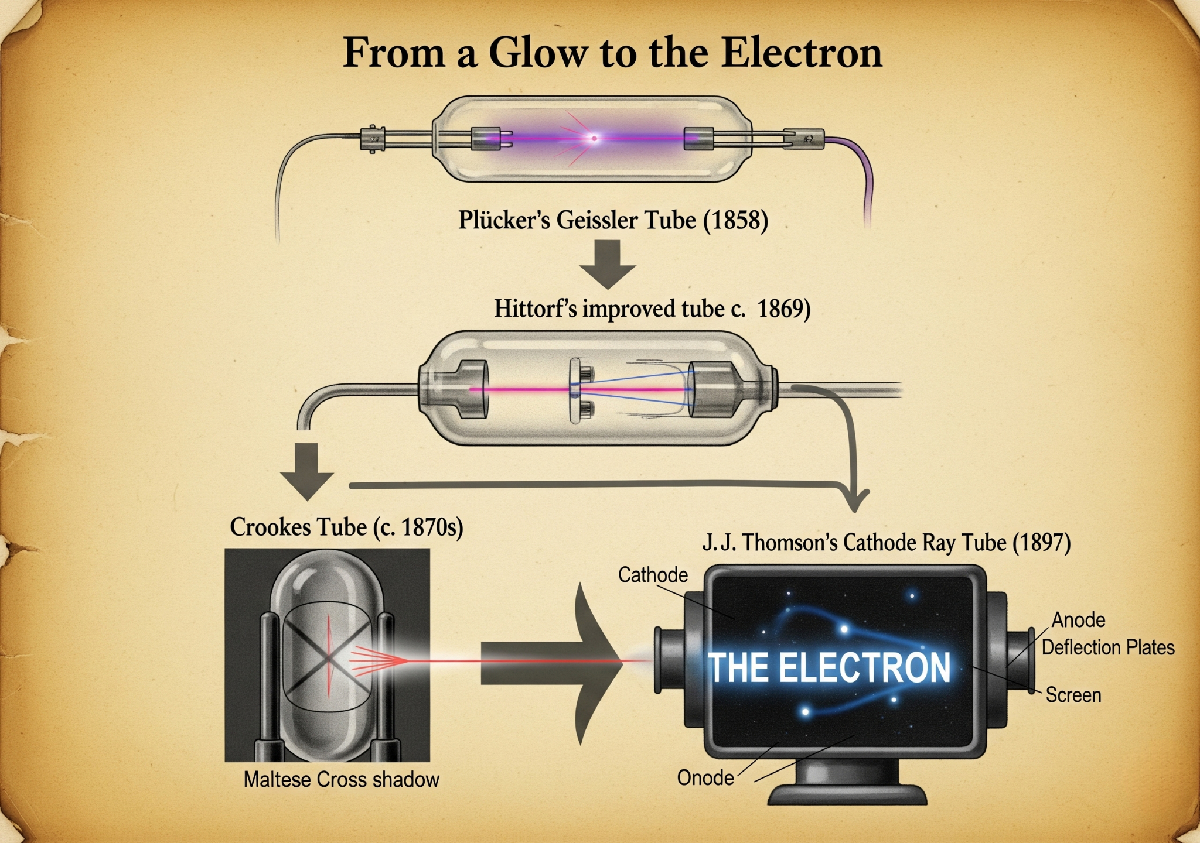
Plücker's discovery was the first domino to fall in a chain of events that would lead directly to the electronic age. His work was picked up and built upon by a succession of brilliant physicists:
- Johann Hittorf, one of Plücker's own students, continued the experiments and was the first to measure some of the properties of these strange rays.
- The English physicist William Crookes developed a much-improved vacuum tube, the "Crookes tube," where he meticulously studied the properties of cathode rays, famously calling them "radiant matter" or a "fourth state of matter."
- And finally, it was in a modified Crookes tube that J.J. Thomson, in 1897, conducted his famous experiments that definitively proved that cathode rays were streams of a new fundamental particle, a particle with a negative charge and a tiny mass. He had discovered the electron.
The lineage is direct and undeniable. The simple Geissler tube that Plücker used in his darkened Bonn laboratory is the great-grandfather of every single vacuum tube, or valve, ever made. The Fleming diode, de Forest's Audion triode – the very valve that made radio amplification and broadcasting possible – are all direct descendants of Plücker's experimental apparatus. The fundamental principle of generating and controlling a stream of electrons in a vacuum, which Plücker first witnessed as a mysterious green glow, is the basis of every radio valve ever built.
Synergies with Ham Radio: The Birth of the Valve
For any radio amateur, especially those of us with a fondness for the warm glow of vintage gear or the raw power of a valve amplifier, Julius Plücker's story is the origin story.
- The Ancestor of All Electronics: Plücker's tube is the "great-grandfather" of all the valves that powered the golden age of radio. Every triode, tetrode, and pentode in every classic receiver and transmitter owes its existence to these early experiments.
- The Cathode Ray Tube (CRT): The connection is even more direct when you think of the oscilloscope, an essential piece of test gear for any serious ham. The glowing spot that traces waveforms on an oscilloscope screen is the exact same phenomenon Plücker first observed on the wall of his Geissler tube – it's a controlled beam of cathode rays striking a fluorescent surface.
- Understanding the Electron: His discovery that the rays were charged particles was the first step towards understanding the electron, the fundamental particle whose flow and control is the very definition of electronics and our entire hobby.
Later Life and Conclusion
In his final years, Julius Plücker returned to his first love, mathematics, making further important contributions to the field of geometry. He passed away in Bonn in 1868, decades before Marconi or de Forest would apply the consequences of his discovery to create the technologies that would change the world. He never got to see the full, world-altering impact of that faint green glow.
Julius Plücker wasn't looking for radio; he was a pure scientist exploring the fundamental nature of electricity and matter. Yet, in observing that mesmerising light on the wall of a glass tube, he unknowingly opened the door to the 20th century. He gave us the first glimpse of the cathode ray, the stream of electrons that would become the lifeblood of radio, television, and all of modern electronics. His story is a beautiful reminder that sometimes the most practical revolutions begin with the most profound and curiosity-driven science.
What are your thoughts on Julius Plücker and the importance of fundamental physics in driving technology? Let me know in the comments below! And, as always, if you have suggestions for other "Pioneers of Radio" that you'd like to see featured, don't hesitate to share.
For more information please visit our online store or alternatively contact us and we'll be happy to assist you!