
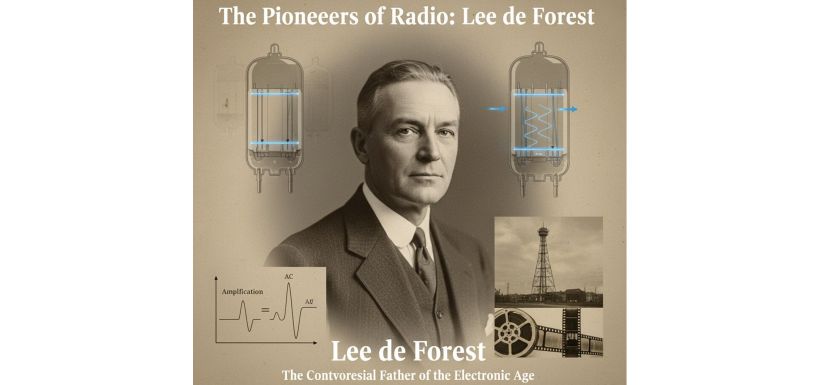
Lee de Forest famously and repeatedly called himself the "Father of Radio" and even the "Grandfather of Television." They were bold, grandiose claims from a man whose entire life was a whirlwind of brilliant invention, disastrous business ventures, and relentless, bitter legal battles. His was a personality that often rubbed people the wrong way. And yet, looking back, it's hard to argue with his core assertion. Because while his life was fraught with controversy, there's no denying the monumental, earth-shattering impact of his greatest invention: the Audion, or triode valve. This unassuming little glass bulb, by introducing the world to electronic amplification, didn't just transform radio; it literally birthed the entire electronic age.
Early Life and Ambition: A Drive to Invent
Lee de Forest was born in Council Bluffs, Iowa, in 1873. He was the son of a Congregational minister who, it's said, hoped his bright young son would follow him into the clergy. But young Lee had other ideas. From his earliest days, he was captivated by science and invention, a passion that put him in direct conflict with his father's pious expectations. This early tension seems to have forged a relentless, almost combative drive in him – a need to prove himself and his ideas to the world.
His exceptional intellect and mechanical aptitude won out, and he made his way to Yale University's Sheffield Scientific School, a top-tier institution. He was a classic tinkerer, reportedly a bit of a loner, who was infamous for blowing the university's fuses with his high-voltage experiments. He was completely consumed by the new science of electricity. In 1899, he earned his Ph.D., and his dissertation title tells you everything you need to know about his focus: "Reflection of Hertzian Waves from the Ends of Parallel Wires." He was, from the very beginning, a wireless man.
After graduating, de Forest was a man possessed by a single ambition: to succeed in wireless telegraphy and, specifically, to rival Marconi. He worked for a time, but his independent and (let's be honest) difficult personality wasn't suited to being an employee. He quickly struck out on his own, starting a series of wireless companies: the De Forest Wireless Telegraph Company, the American De Forest Wireless Telegraph Company... The names changed, but the story was often the same: brilliant technical ideas followed by disastrous financial management, questionable stock-promotion schemes, and eventual collapse. He was constantly inventing, constantly seeking investment, and constantly, it seemed, on the brink of both glory and ruin.
The Audion: The Spark of the Electronic Age
In the early 1900s, radio detection was a crude business. As we've seen, pioneers were using crystal detectors or coherers. Then, in 1904, Sir Ambrose Fleming invented the "Fleming Valve" – the diode. It was a brilliant rectifier, a one-way street for current that could detect a radio signal. But it couldn't strengthen it. The signal out was weaker than the signal in. Radio was still waiting for its big leap.
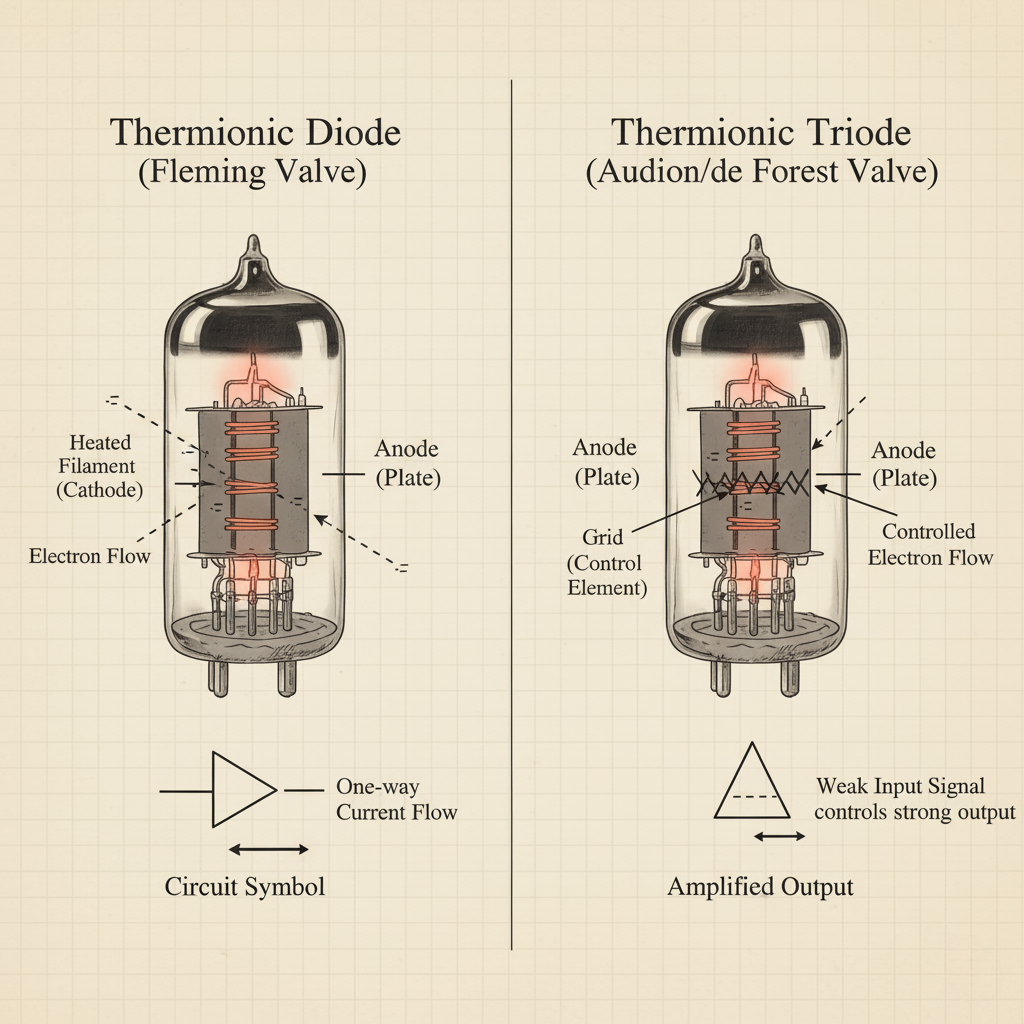
In 1906, Lee de Forest provided it. Building directly on Fleming's diode, he had a stroke of genius. He took a standard diode with its two elements – the heated filament (cathode) and the metal plate (anode) – and inserted a third element between them: a small, zig-zagging wire he called the "grid." He called his new invention the Audion.
This simple addition changed everything. Here’s how it worked:
- The heated filament emitted a steady stream of electrons.
- The positively charged plate attracted this stream of electrons, creating a current.
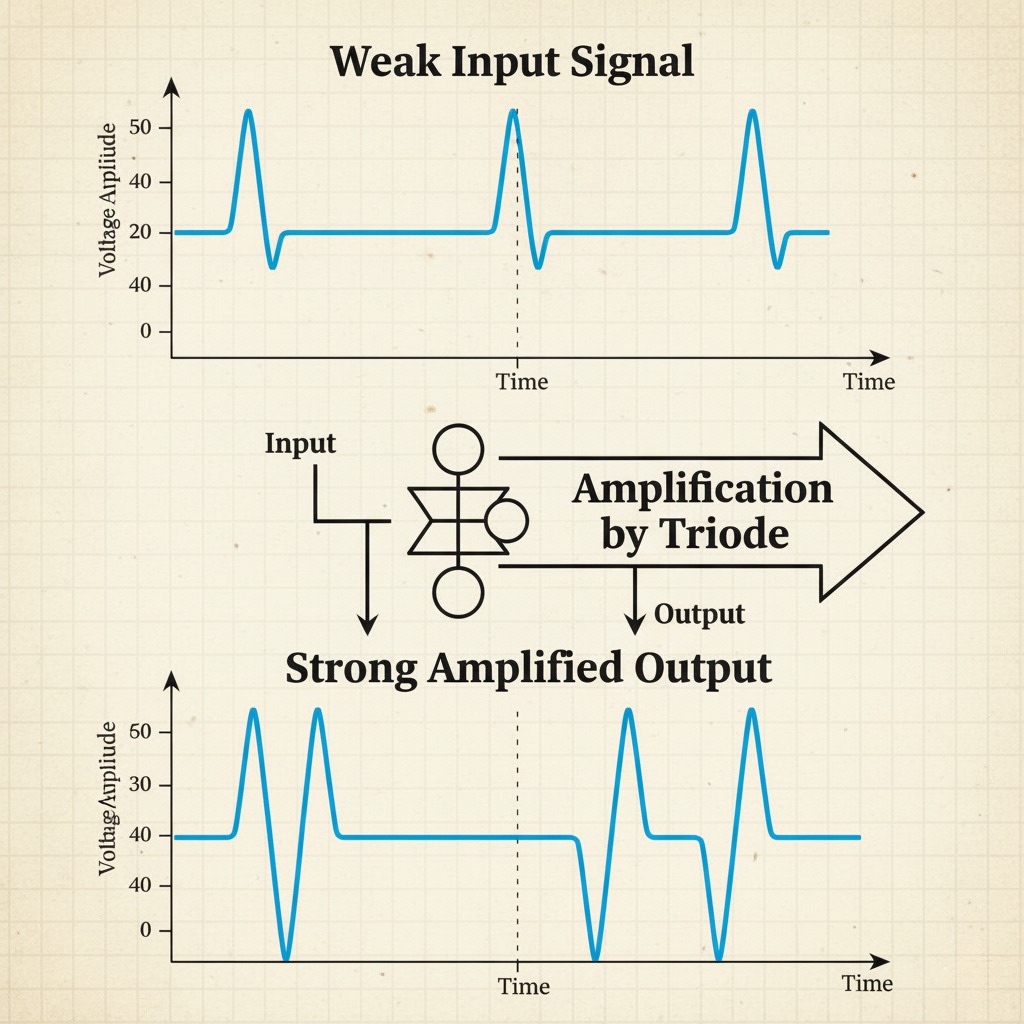
- The grid sat right in the middle of this stream. By applying a very small, weak voltage to this grid (like the faint signal from an antenna), de Forest could control the entire, much larger flow of electrons moving to the plate. A tiny positive charge on the grid would increase the flow; a tiny negative charge would repel and decrease the flow.
Think of it like this: the electron stream is a powerful gush of water from a tap. Fleming's diode was just a one-way valve. De Forest's grid was like a delicate handle on that tap. With just a tiny, effortless twist of the wrist, he could control the full, powerful blast of water. This is amplification. The weak signal on the grid was reproduced as a much, much stronger signal at the plate. The Audion was the first practical electronic amplifier.
Interestingly, de Forest himself didn't fully understand why it worked. He famously believed that the trace amounts of gas left in his early, imperfectly-evacuated tubes were essential to its operation. He was later proven wrong – a high vacuum was actually the key to stable amplification – but it didn't matter. He had patented the device in 1906, and the electronic age had begun.
The Patent Wars and Legal Battles
The invention of the Audion, and the subsequent discovery of what it could really do, kicked off one of the most bitter and protracted legal wars in the history of technology.
A young engineer named Edwin Howard Armstrong (another giant on our list) discovered that if you took an Audion and fed a portion of its amplified output signal back into its input (a process called regeneration), you could dramatically increase the amplification a thousand times over. Tweak it a bit more, and the tube would break into stable oscillation, becoming a miniature radio transmitter.
De Forest, upon learning of this, claimed he had discovered it first. This ignited a decades-long legal battle between de Forest and Armstrong over the patent for the regenerative circuit. It was a vicious, draining fight that went all the way to the Supreme Court. In a decision that is still considered infamous by engineers and historians, the court, in a complex and (many say) technically flawed ruling, ultimately awarded the patent to de Forest.
This was just one of many legal battles. He fought with Fleming over the original valve. He was constantly in and out of court. He was even indicted for mail fraud in 1912 for using the mail to sell stock in his company, with prosecutors famously arguing to the jury that the Audion was a "worthless" device and that sending a human voice across the Atlantic (as de Forest claimed was possible) was a "wild, absurd" dream. He was eventually acquitted, but his reputation for financial chaos was sealed.
Other Pioneering Ventures: Beyond Radio Detection
Despite his legal and financial troubles, de Forest's inventive spirit was irrepressible.
Early Broadcasting: He truly was a "Father of Radio" in the sense of broadcasting. He was one of the first to see the Audion not just as a telegraphy device, but as a "wireless telephone." He was a born showman. In 1910, in a world-first, he broadcast the live performance of opera singer Enrico Caruso from the Metropolitan Opera in New York. Later, from his laboratory, he began regular broadcasts of news and music, playing gramophone records to a tiny but growing audience of wireless hobbyists. These were critical, formative steps in moving radio from mere dots and dashes to a mass entertainment medium.
Sound-on-Film: As if that wasn't enough, in the early 1920s, he developed a system for optically recording sound directly onto motion picture film. He called it "Phonofilm". This was one of the first viable "sound-on-film" technologies, a direct precursor to the "talkies" that would revolutionise Hollywood. As with many of his ventures, his system was soon superseded by others, but he had once again proven to be a pioneer, pointing the way to a new industry.
Synergies with Ham Radio: The Amplifying Heart
For radio amateurs, Lee de Forest's contribution is simply everything. The Audion, and its triode descendants, are the single most important invention in the history of electronics.
- Amplification: Every radio, every transmitter, every receiver relies on this principle. Before de Forest, signals were faint and unamplified. After de Forest, they could be made as loud as desired.
- Oscillators: The Audion's ability to oscillate (thanks to regeneration) provided the key to the Continuous Wave (CW) transmitter. This replaced the noisy, inefficient spark-gap transmitters and made modern, stable voice and Morse code transmission possible.
- Regenerative Receivers: The "Regen" receiver, based on a single oscillating Audion, was the workhorse of early ham radio. It was simple to build and incredibly sensitive, allowing hams to hear signals from around the world.
- The "Voice" of Radio: De Forest's passion for broadcasting voice and music is the very essence of what many hams do today. He was the one who truly pushed radio beyond simple telegraphy.
Legacy: A Complicated Figure
Lee de Forest lived a long and tumultuous life, dying in 1961. He received many awards in his later years, including the IEEE Edison Medal. His legacy, however, remains as complex as the man himself.
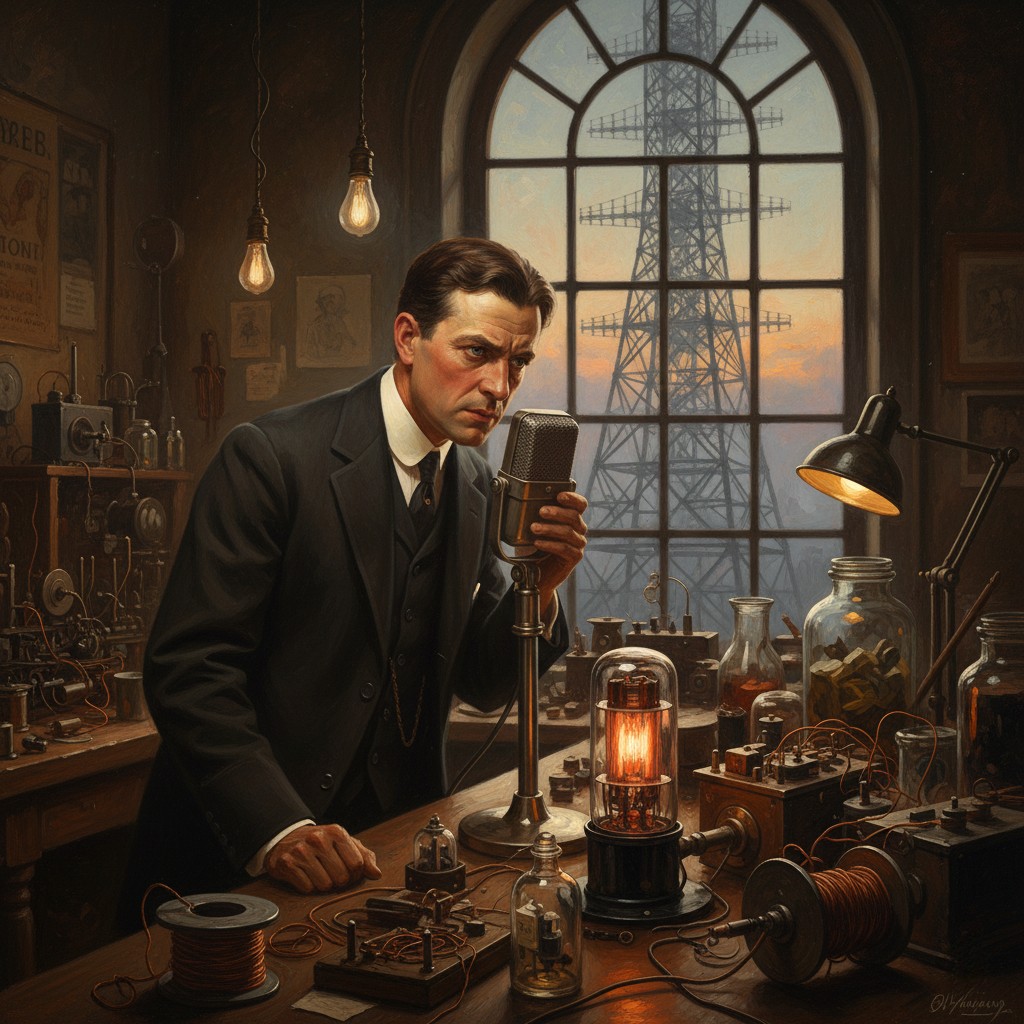
He was a brilliant, intuitive inventor, a genuine visionary who saw the future of broadcasting and sound-on-film. But he was also a terrible businessman, a litigious and often abrasive man, and a relentless self-promoter who wasn't always scrupulous about giving credit to others.
He craved the title "Father of Radio", and in many ways, he earned it. While Fleming invented the valve, de Forest gave it the "magic" of amplification. While others like Armstrong truly perfected the circuits, de Forest had provided the essential tool.
Conclusion: The Flawed Genius of the Electronic Age
Lee de Forest's story is a reminder that even the most significant technological breakthroughs can be accompanied by complex human dramas. He was a flawed hero, a brilliant inventor whose contributions were undeniable, but whose character was far from perfect. The Audion tube, his most famous creation, revolutionized radio and ushered in the age of electronics, but his legacy remains a tangled web of innovation, controversy, and ultimately, a significant contribution to the world we live in today. His story serves as a cautionary tale about the importance of collaboration, intellectual honesty, and the dangers of unchecked ambition in the pursuit of scientific progress. It's a story of brilliant invention, bitter rivalry, and the messy, complicated reality of technological progress.
What are your thoughts on Lee de Forest and his complex legacy? Do you think his contributions outweigh the controversies surrounding him? Let me know in the comments below! And, as always, if you have suggestions for other "Pioneers of Radio" that you'd like to see featured, don't hesitate to share.
For more information please visit our online store or alternatively contact us and our team will be happy to assist you!