

Ever had a microphone get too close to a speaker at an event and create that deafening, high-pitched feedback squeal? That ear-splitting howl is a classic example of uncontrolled oscillation. In the early 1920s, as the radio craze swept across the nation, millions of new radio sets suffered from a very similar problem internally. They would howl, whistle, and squeal uncontrollably, making them incredibly difficult and frustrating to tune. Today in our 'Pioneers of Radio' series, we meet the man who silenced the squeal: Professor Louis Alan Hazeltine, the inventor of the elegant and ingenious Neutrodyne circuit. His story is a perfect example of how a brilliant circuit design can be just as revolutionary as a brand-new component, solving a critical engineering problem and paving the way for the golden age of broadcasting.
The Professor from Stevens Institute
Louis Alan Hazeltine was born in Morristown, New Jersey, in 1886. Unlike many of the pioneers we've covered who moved between companies and countries, Hazeltine's story is one of remarkable dedication to a single institution: the Stevens Institute of Technology in Hoboken, New Jersey. His connection to the university was lifelong. He entered as a student, graduating in 1906 with a degree in Mechanical Engineering, and then simply stayed on. He rose through the academic ranks, eventually becoming a professor and the head of the Electrical Engineering department in 1917.
This academic environment shaped his approach to invention. He wasn't just an empirical tinkerer; he was a professor with a deep and rigorous understanding of the underlying physics and mathematics. He was deeply interested in solving real-world engineering challenges, not just dwelling in abstract theory. This combination of academic rigour and a practical mindset made him uniquely equipped to tackle one of the most vexing problems in early radio design.
The Squealing Radio Problem: Instability in the TRF Receiver
The early 1920s was the era of the radio boom. For the first time, families were bringing wireless sets into their homes. A popular and relatively simple design for these early receivers was the Tuned Radio Frequency (TRF) set. A TRF receiver works by taking the weak signal from the antenna and amplifying it at its original radio frequency through several stages before detecting the audio. It’s a straightforward concept.
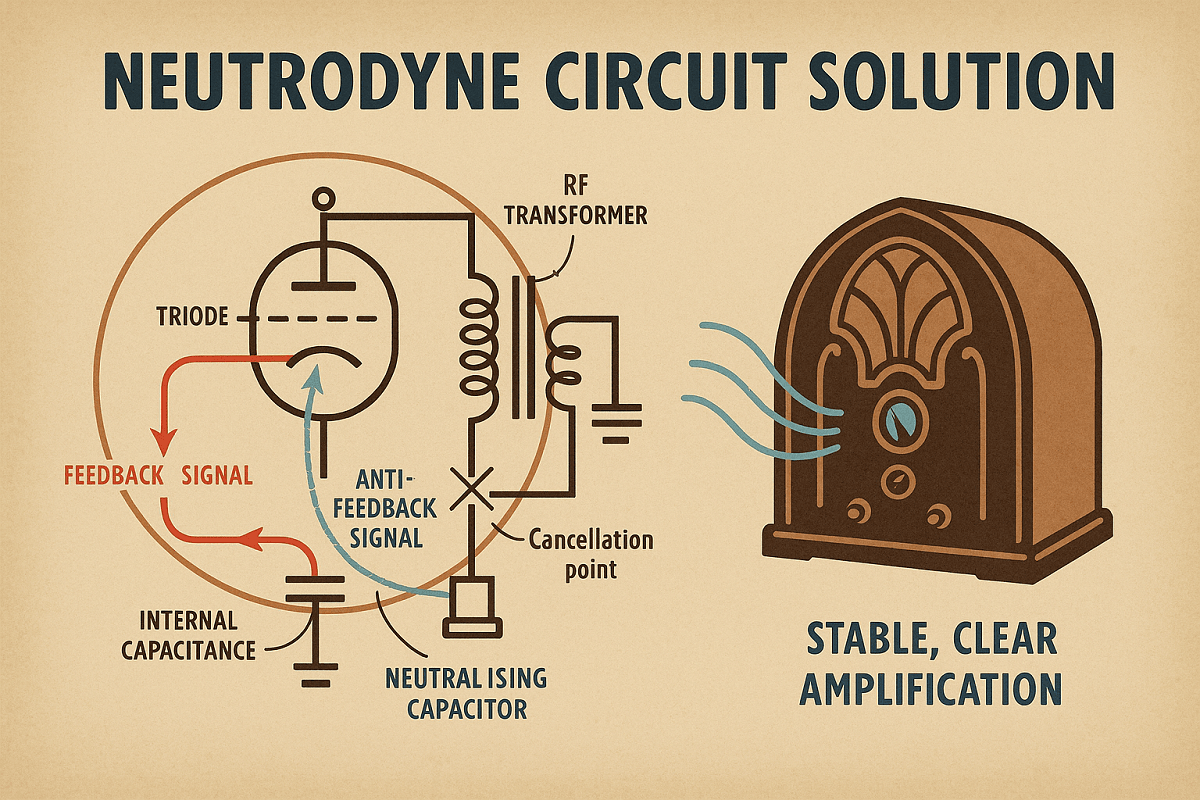
The problem, however, lay with the heart of the amplifier: the triode vacuum valve. As we've discussed with other pioneers, the triode was a revolutionary device that made amplification possible. But it had a fundamental flaw. Inside the valve, there's a natural, unavoidable capacitance between its internal elements, specifically between the anode (the plate) and the control grid.
This internal capacitance, a phenomenon thoroughly explained by the Miller effect, created a feedback path. A portion of the amplified signal from the output (the anode) would leak back to the input (the grid). At low frequencies, this wasn't a huge issue. But at the higher radio frequencies used for broadcasting, this feedback was often in-phase with the input signal. This created a condition of positive feedback, causing the amplifier to become unstable and oscillate uncontrollably.
For the user, this meant their expensive new radio would suddenly erupt into loud howls and squeals as they tried to tune it or adjust the volume. It was incredibly frustrating. To combat this, manufacturers had to resort to all sorts of tricks to limit the amplification of their sets, which meant the radios weren't very sensitive and couldn't pick up weak, distant stations. It was a major roadblock for the industry, a compromise that satisfied no one. A sensitive radio was an unstable one, and a stable radio was a deaf one.
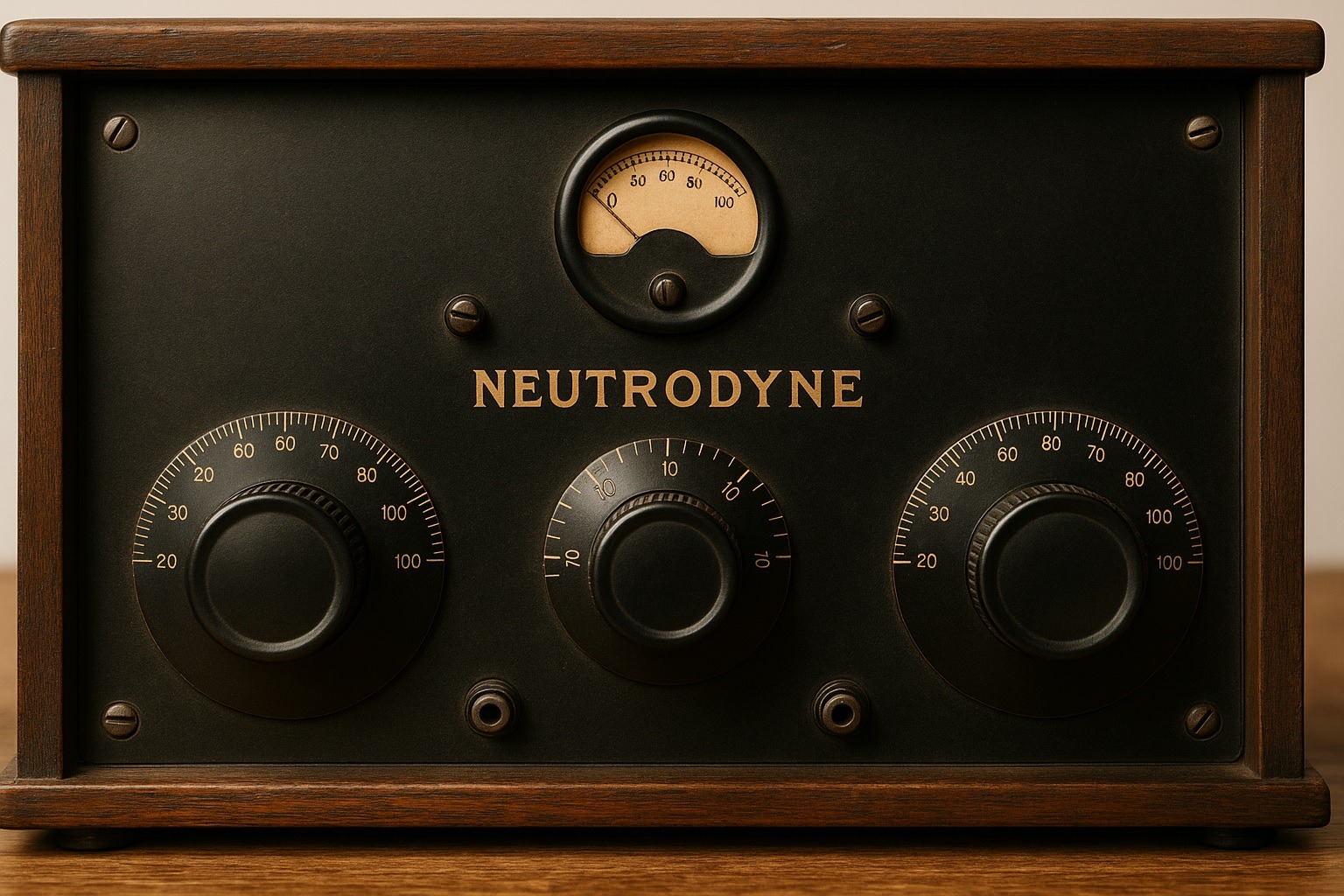
The Neutrodyne Solution: An Elegant Balancing Act
This is where Professor Hazeltine's genius came to the fore. He didn't invent a new type of valve to solve the problem (as Walter Schottky did in Germany with the tetrode). Instead, he devised a clever circuit that could tame the existing, unruly triode. His solution was the Neutrodyne circuit. The name itself is wonderfully descriptive, coming from the words "neutral" (as in neutralising) and "dyne" (a unit of force). The circuit applied a counteracting force to cancel out the unwanted feedback.
The principle of neutralisation was elegant and incredibly effective. Hazeltine's insight was that if you could feed a small amount of energy back from the output to the input that was perfectly equal in amplitude but opposite in phase to the unwanted internal feedback, the two signals would cancel each other out.
Think of it like noise-cancelling headphones. The headphones have a microphone that listens to the ambient noise around you. The circuitry then generates an 'anti-noise' sound wave that's a perfect mirror image – 180 degrees out of phase – with the real noise. When these two waves combine at your ear, they cancel each other out, and you're left with silence. Hazeltine's Neutrodyne circuit did precisely the same thing for the internal feedback 'noise' in the triode. He added a special neutralising capacitor to the circuit, carefully connected to feed back that 'anti-feedback' signal. This cancelled out the Miller capacitance, creating a stable, well-behaved, high-gain RF amplifier. The squeal was silenced.
As a fascinating extra detail, Hazeltine's design was meticulous. To minimise other sources of stray capacitance and magnetic coupling between the different amplifier stages, he specified that the cylindrical tuning coils for each stage should be mounted at a specific angle relative to each other – around 54.7 degrees. This angled arrangement of coils became a distinctive visual feature of many Neutrodyne radios. I love details like that; it shows a level of thought that went beyond just the circuit diagram into the physical layout of the device.
The result was transformative. The Neutrodyne circuit allowed manufacturers to build TRF receivers with multiple stages of high-gain RF amplification without the risk of oscillation. This meant that, for the first time, a mass-produced radio could be both highly sensitive (able to pick up weak, distant stations) and perfectly stable and easy to operate.
The Radio Boom: Commercial Success and the Patent Pool
The timing of Hazeltine's invention could not have been better. The 1920s radio market was dominated by the corporate giant RCA, which held a powerful pool of patents, including Edwin Armstrong's superheterodyne circuit. Smaller, independent radio manufacturers were finding it incredibly difficult to compete. They needed a high-performance circuit that didn't infringe on RCA's patents.
Hazeltine patented his Neutrodyne circuit in 1923, and it was exactly what the independent manufacturers were looking for. Instead of trying to manufacture radios himself, he founded the Hazeltine Corporation to license his patent. He formed a patent pool of his own, licensing the design to a group of over 20 independent radio manufacturers.
What followed was the Neutrodyne craze. For several years in the mid-1920s, Neutrodyne radios absolutely dominated the market. They were the first truly high-performance, easy-to-use broadcast receivers that the average family could afford. They offered sensitivity and selectivity that was, at the time, comparable to the much more complex and expensive superheterodyne sets. It was a huge commercial victory for the independent manufacturers, and it established the Hazeltine Corporation as a major force in the radio industry.
It's also important to mention his collaboration with his brilliant former student, Harold Alden Wheeler. Wheeler made significant contributions at the Hazeltine labs, particularly in developing practical Automatic Volume Control (AVC) circuits, which were often incorporated into later Neutrodyne designs to keep the volume level steady as the listener tuned between strong and weak stations.
Synergies with Ham Radio: The Art of Neutralisation
For any radio amateur who has ever built or worked on a valve-based power amplifier, Louis Hazeltine's work is instantly familiar. The principle of neutralisation is a fundamental technique that hams have been using for decades. The goal is exactly the same: to cancel out the internal grid-plate capacitance of a triode valve to prevent self-oscillation in a high-gain RF amplifier.
When you're building a linear amplifier for your station, one of the final, critical steps is "neutralising the final." This involves carefully adjusting a small capacitor to feed back a signal of the opposite phase to achieve perfect stability. This is pure Hazeltine! His work provided the foundational theory and the practical circuit design for a technique that is still essential in RF engineering today. His story is a celebration of circuit-level innovation, which is at the very heart of the ham radio "home-brew" tradition. It’s a perfect example of how a clever arrangement of components can solve a fundamental problem, without needing to invent a whole new device.
Later Life and Lasting Legacy
The success of the Neutrodyne circuit secured the future of the Hazeltine Corporation. Even after the superheterodyne receiver eventually became the dominant design (partly because it was easier to align in mass production), the company continued to thrive on its strong patent portfolio and its expertise in RF engineering.
The company became a major defence contractor, developing critical technologies for the military. One of its most significant contributions was the IFF (Identification Friend or Foe) transponder system, which was widely used by Allied aircraft and ships during the Second World War to prevent friendly fire incidents.
Louis Hazeltine himself continued to innovate, later contributing to the development of the NTSC colour television system used in the United States. And through it all, he remained a dedicated educator, continuing to teach and mentor students at the Stevens Institute of- Technology for his entire career. He passed away in 1962.
Conclusion: The Professor Who Silenced the Squeal
Louis Alan Hazeltine was the professor who solved one of early radio's most annoying and limiting problems. With an elegant circuit and a deep understanding of physics, he tamed the unruly triode, silencing the squeals and howls that plagued early receivers. The Neutrodyne circuit was a breakthrough that enabled the mass production of sensitive, stable, and user-friendly radios, truly paving the way for the golden age of broadcasting. His story is a perfect example of how a clever circuit design can be just as revolutionary as a brand-new component. He didn't just invent a product; he provided a solution that empowered an entire industry.
What are your thoughts on Louis Alan Hazeltine? Have you ever had to neutralise an amplifier or battled with RF feedback in one of your projects? Share your experiences in the comments below! And, as always, if you have suggestions for other "Pioneers of Radio" that you'd like to see featured, don't hesitate to share.
For more information please visit our online store or alternatively contact us our team will be happy to assist you.