
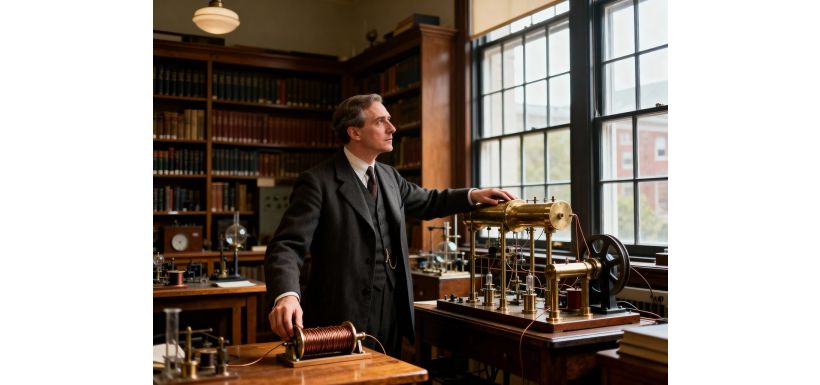
Imagine arriving in America as a penniless teenage immigrant, with just five cents in your pocket and unable to speak a word of English. Now imagine, decades later, being one of the world's most celebrated physicists, a Pulitzer Prize winner, and the man whose invention made long-distance telephone calls possible. Today, in our 'Pioneers of Radio' series, we meet Michael Idvorsky Pupin, a Serbian-American genius whose life story is as electrifying as his inventions. While his most famous patent revolutionised wired communication, his deep understanding of electrical resonance provided the essential theoretical and practical knowledge that was directly applicable to the critical challenge of tuning wireless radio circuits.

From Immigrant to Inventor: A Remarkable Journey
Michael Pupin's story is the stuff of legend, a true "rags-to-riches" tale that embodies the very essence of the American dream. He was born in 1858 in Idvor, a small, rural village in the Austro-Hungarian Empire (now part of Serbia). His early life was simple; he was a shepherd boy, but one with an insatiable curiosity about the world around him. He learned about the natural world not from textbooks, but from direct observation, a skill that would later serve him well as an experimental physicist.
In 1874, at the age of just 15, he made the momentous decision to immigrate to the United States. His journey was a testament to his determination. He arrived in New York City with no money, no connections, and no knowledge of the English language. I can only imagine the sheer grit and courage it must have taken for a teenager to embark on such a journey. He spent his early years in America working manual labour jobs to survive – from a farmhand in Delaware to a factory worker in New York City. But he never lost sight of his goal: to get an education. He attended night school at Cooper Union to learn English and the sciences, all while working during the day.
His hard work paid off. In 1879, he was admitted to Columbia University, where he excelled, graduating with honours in 1883. His academic prowess earned him a scholarship to study at Cambridge University in England, followed by postgraduate studies in Berlin under the great Hermann von Helmholtz, where he earned his Ph.D. in 1889. This period in Europe established his credentials as a top-tier physicist, placing him at the forefront of research into electromagnetism.
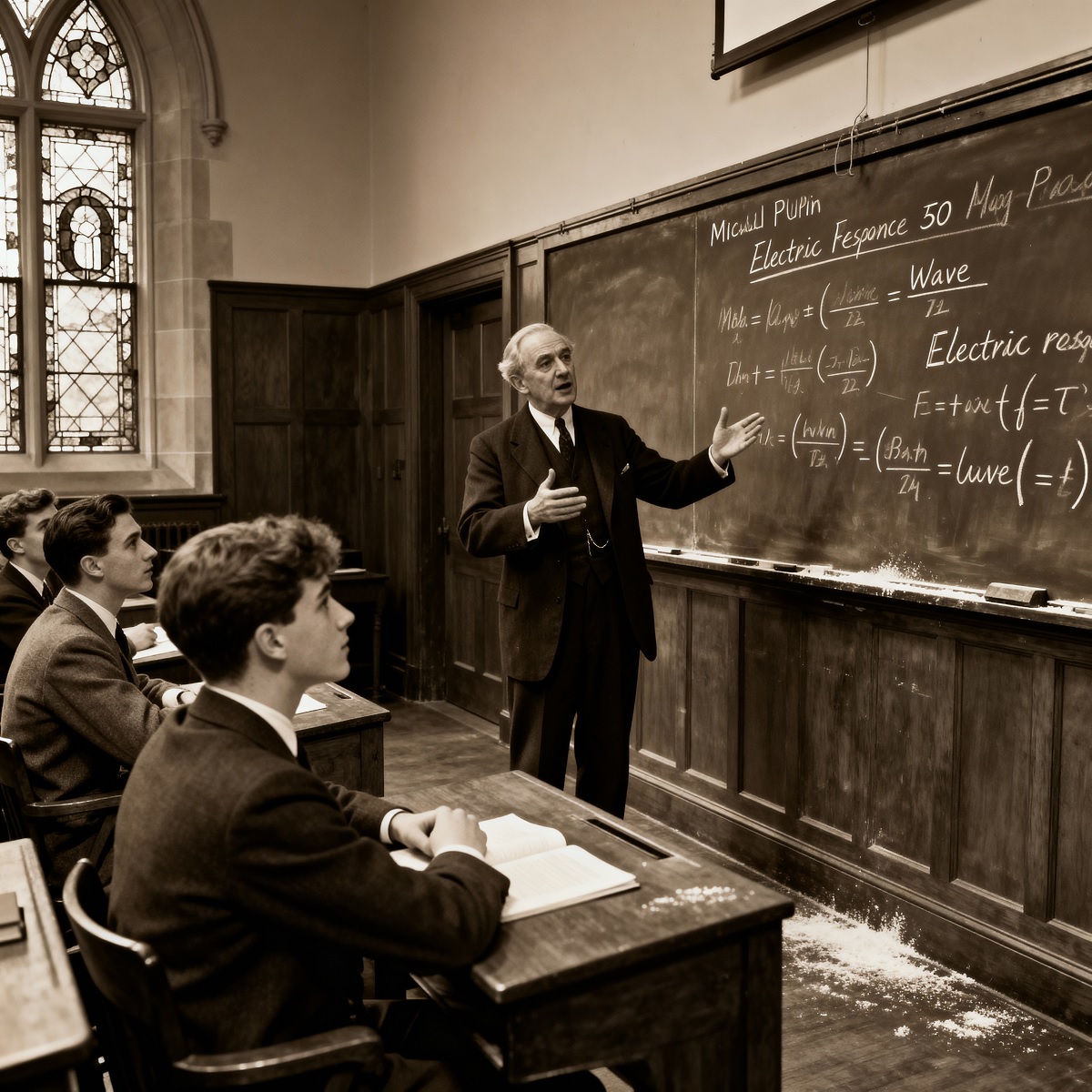
In a remarkable full circle, Pupin returned to Columbia University as a professor of mathematical physics. The penniless immigrant who had once struggled to learn English was now a respected academic at one of America's most prestigious institutions. His life story is, in my opinion, just as impressive and inspiring as any of his groundbreaking inventions.
Solving the Long-Distance Problem: The Pupin Coil
In the late 19th century, the telephone was revolutionising communication, but it had a serious limitation: distance. Over long copper wires, the voice signal would become weak and badly distorted, making a call from New York to Chicago a garbled mess. Coast-to-coast calls were simply impossible. The culprit was the inherent capacitance of the long wires, which acted like a capacitor, smearing the signal and filtering out the higher frequencies that make speech intelligible.
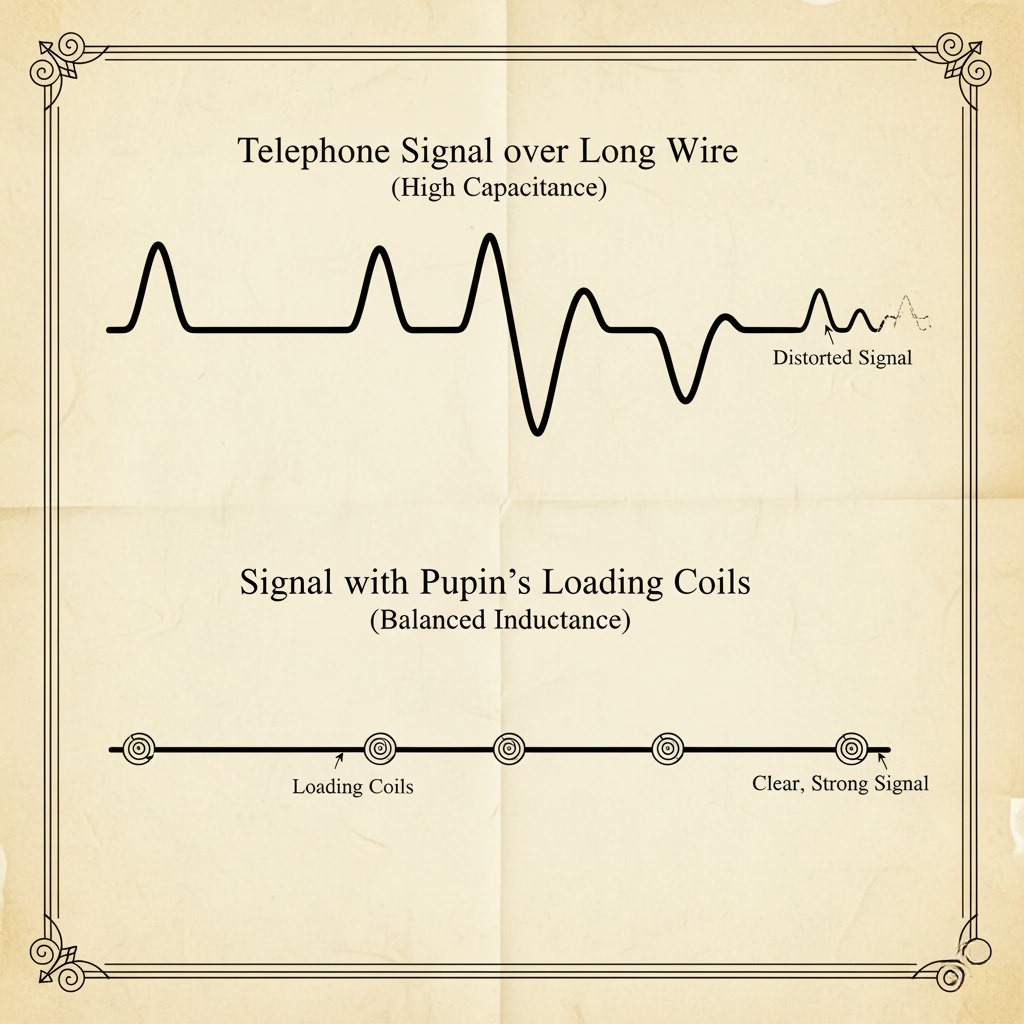
The brilliant but eccentric Oliver Heaviside had theoretically predicted that adding inductance at regular intervals along the line could counteract this capacitance and preserve the signal's integrity. However, Heaviside's proposal was mathematically complex and not easily translated into a practical, engineered solution.
This is where Michael Pupin's genius for both mathematics and practical application came to the fore. In 1899, after years of research, he developed an elegant and practical solution. He invented what became known as "loading coils" – precisely calculated inductors (coils of wire) placed at specific, mathematically determined intervals along the telephone line.
Think of it like a long, floppy rope. If you try to send a sharp wave down it, the wave quickly fizzles out. But if you attach small, carefully spaced weights along the rope, the wave can travel much further without losing its shape. Pupin's coils were the electrical 'weights' for the 'rope' of the telephone line.
The impact of his invention, which became known as "Pupinization", was nothing short of transformative. When AT&T acquired the rights to his patent, it enabled them to build a truly national telephone network. Long-distance and even transcontinental telephone calls became clear and practical, revolutionising business, news, and personal communication. Pupin's invention had, quite literally, shrunk the world.
A Glimpse Inside: Pioneering X-Ray Imaging
As if revolutionising telephony wasn't enough, Pupin also made a crucial, though less famous, contribution to the field of medical imaging. Just weeks after Wilhelm Röntgen announced his discovery of X-rays in late 1895, Pupin began his own experiments at Columbia University.
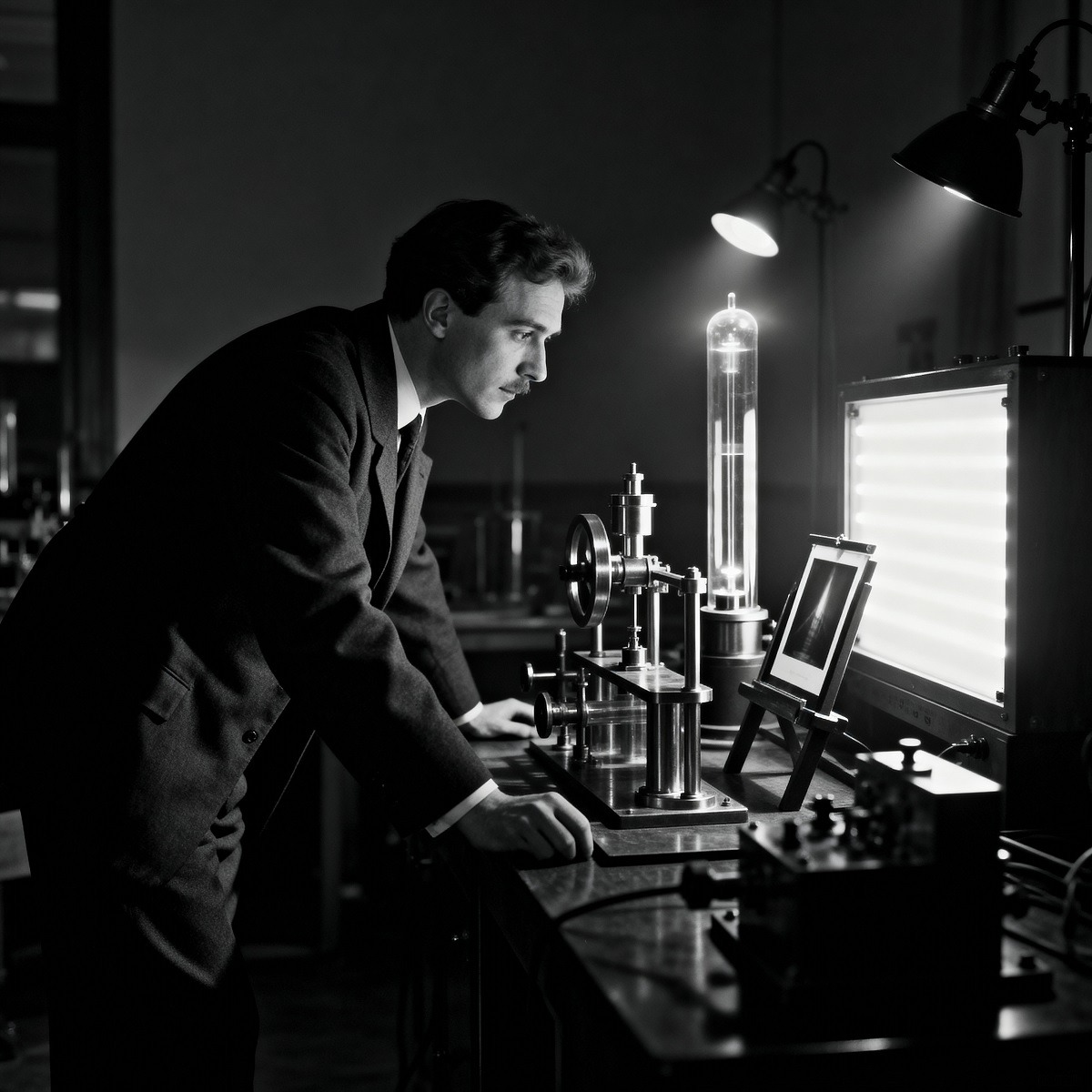
The early process of taking an X-ray photograph was incredibly slow, often requiring exposure times of an hour or more. This was not only impractical but also dangerous for the patient. Pupin had a brilliant idea. He realised that placing a fluorescent screen next to the photographic plate would dramatically shorten the required exposure time. The X-rays would cause the screen to glow, and this visible light, in addition to the X-rays themselves, would help expose the photographic plate much faster.
His method reduced exposure times from over an hour to just a few minutes, making medical X-rays a practical diagnostic tool for the first time. In February 1896, he is credited with taking the first X-ray image in America (of a patient's hand riddled with shotgun pellets), which was then used to guide a successful surgical operation. It was a remarkable achievement that demonstrated his versatility as an inventor and his ability to quickly grasp and improve upon new scientific discoveries.
Other Contributions and Wartime Service
Pupin was a prolific inventor, holding around 34 patents. His work wasn't confined to the laboratory either. During the First World War, he applied his deep knowledge of electrical resonance to develop methods for detecting submarines, a vital contribution to the war effort.
He was also a prominent and respected leader in the Serbian immigrant community in the United States, acting as a diplomat and a passionate advocate for his homeland, particularly during the post-war negotiations that led to the formation of Yugoslavia.
Synergies with Ham Radio: The Master of Tuning
So, what does a pioneer of wired telephony have to do with ham radio? Everything! The very same principles of inductance, capacitance, and resonance that Pupin mastered for telephone lines are the absolute foundation of radio tuning.
- The Tuned Circuit:
- Influence on Armstrong:
- The "Coil" Connection:
Every tuned circuit (LC circuit) in a radio transmitter or receiver, used to select a specific frequency and filter out others, is a direct application of the physics that Pupin worked with. His loading coils were a practical demonstration of controlling electrical resonance on a massive scale.
As a professor at Columbia, one of his students was the brilliant Edwin Howard Armstrong. There is no doubt that Pupin's expertise in resonance and electrical circuits profoundly influenced the young Armstrong, who would go on to invent the regenerative circuit and the superheterodyne receiver – two of the most important inventions in radio history.
Hams are famous for winding their own coils (inductors) for antennas, filters, and tuners Pupin's most famous invention was a coil, making him a kindred spirit to every radio amateur who has ever wrapped wire around a former. His work showed how a simple coil of wire, when properly understood and applied, could change the world.
Legacy: From Immigrant to Inventor
Michael Pupin received numerous accolades throughout his life, including the prestigious IEEE Edison Medal. But perhaps his most remarkable achievement, outside of his scientific work, was winning the Pulitzer Prize in 1924 for his autobiography, "From Immigrant to Inventor". The book became a bestseller and a source of inspiration for generations of Americans, a powerful testament to his incredible life journey.
He became a national hero in both his native Serbia and his adopted United States. He passed away in 1935, leaving behind a legacy of scientific brilliance, inventive genius, and a life story that continues to inspire.
Conclusion: A Giant of Resonance
Michael Pupin's life is a powerful testament to both the immigrant dream and the power of scientific inquiry. He was a shepherd who became a master of physics, a patriot who never forgot his roots, and an inventor whose understanding of resonance helped to shrink the world, first through wires, and then by inspiring those who would conquer the airwaves. He reminds us that the fundamental principles of science are universal, and that a deep understanding of those principles can lead to innovations that cross technological boundaries, shaping not just one field, but many.
What are your thoughts on Michael Pupin's incredible journey? Do you think his contributions to the understanding of resonance are sometimes overlooked in the history of radio? Let me know in the comments below! And, as always, if you have suggestions for other "Pioneers of Radio" that you'd like to see featured, don't hesitate to share.
For more information please visit our online store or alternatively contact us and our team will be happy to assist you!