
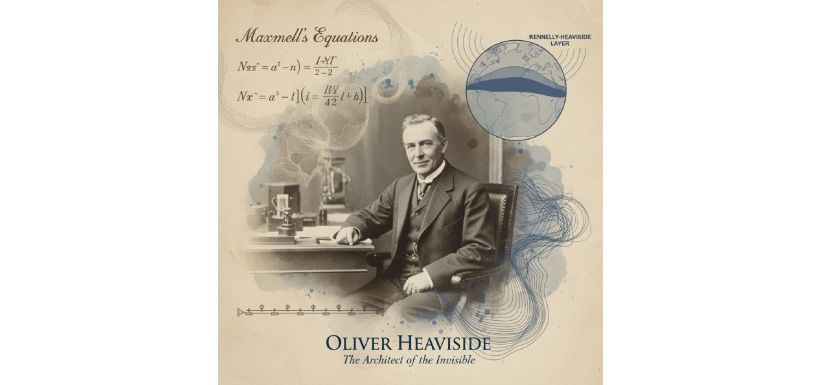
Every so often in the history of science, a figure emerges who is so brilliant, so unconventional, and so far ahead of their time that the established academic world simply doesn't know what to do with them. Today, in our 'Pioneers of Radio' series, we meet perhaps the ultimate example of such a figure: Oliver Heaviside. A self-taught, deaf, and famously eccentric British mathematician and physicist, Heaviside was a man who, working in almost complete isolation, took the dense and complex work of James Clerk Maxwell and reforged it into the elegant, powerful tools that engineers and physicists still use today. He was the man who predicted the existence of the ionosphere, revolutionised our understanding of electrical circuits, and yet lived a life of poverty and near-obscurity.
Early Life and a Difficult Start
Oliver Heaviside was born in Camden Town, London, in 1850. His early life was marked by hardship. A bout of scarlet fever as a child left him with severe hearing loss, a condition that would contribute to his social isolation throughout his life. His family struggled financially, and Heaviside left school at 16 with no formal higher education. In today's world, that might have been the end of his academic prospects. But this was the Victorian era, an age of incredible self-starters, and Heaviside was the archetypal self-taught genius.
He had a famous uncle, Sir Charles Wheatstone (who we've already covered in this series!), a giant of telegraphy and electrical science. This family connection likely provided some early inspiration and perhaps even some guidance. Heaviside threw himself into studying, teaching himself Morse code, telegraphy, and the complex mathematics of electricity. His first and only job was as a telegraph operator, initially in Denmark and then back in Newcastle upon Tyne. This practical experience was invaluable; it gave him a real-world understanding of the problems plaguing long-distance electrical communication. But his mind was restless, and by 1874, he had quit his job to devote himself entirely to his own private research, supported by his parents. I can only imagine the conversations at the family dinner table – a young man giving up a perfectly good job to pursue abstract, unpaid scientific study! It was a bold and, some might say, reckless move, but it was one that would change the world of physics forever.
Taming Maxwell's Equations: From 20 to 4
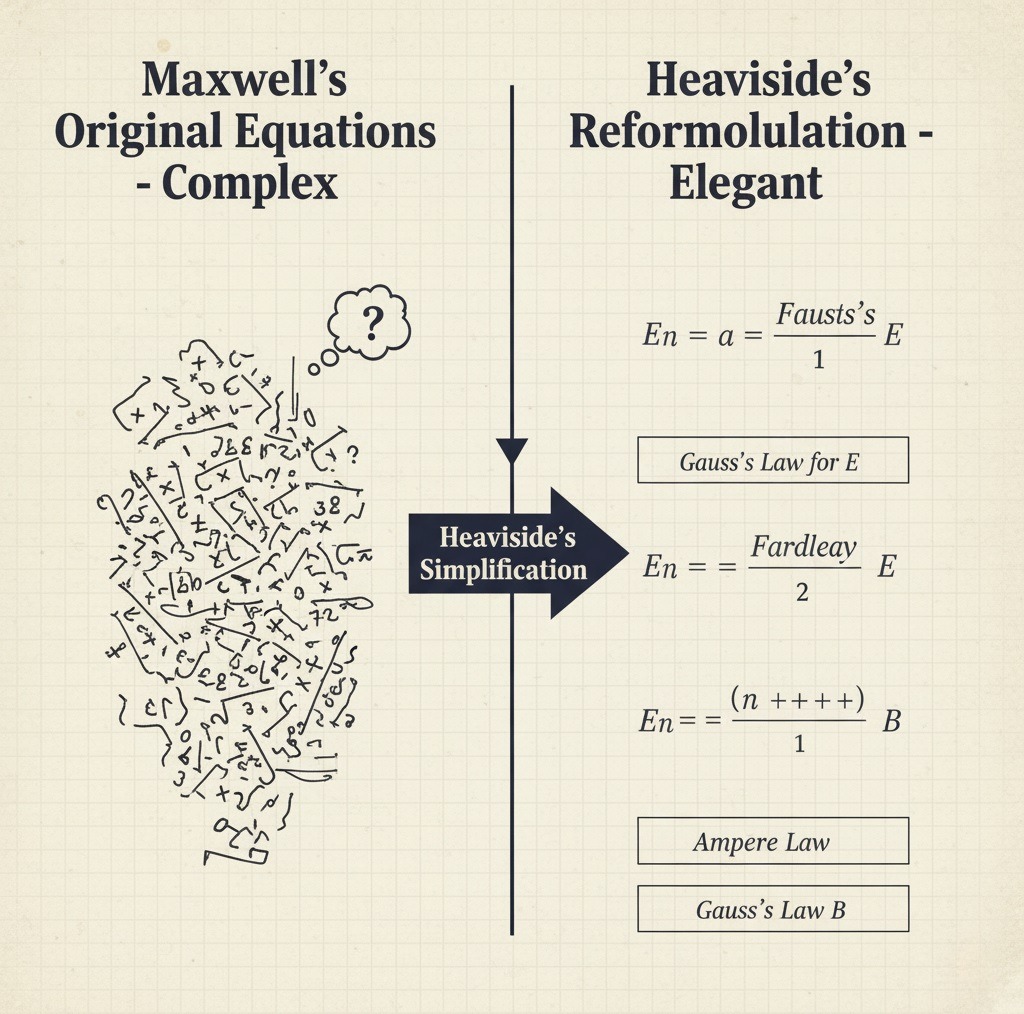
James Clerk Maxwell's original treatise on electromagnetism was a work of profound genius, but it was also, to put it mildly, a bit of a beast. It consisted of 20 complex equations, written in a cumbersome mathematical notation called quaternions. It was incredibly difficult for even seasoned physicists to work with.
Heaviside, working alone in his sparsely furnished room, took on the monumental task of simplifying and clarifying Maxwell's work. He saw the underlying beauty and power in the equations and believed they could be made more accessible. He was one of the key figures who championed the use of vector analysis, a much more intuitive mathematical language for describing forces and fields.
Between 1884 and 1887, Heaviside methodically recast Maxwell's 20 original equations into the four elegant, concise vector equations that are taught to every physics and engineering student today. These are the equations that describe how electric and magnetic fields are generated, how they interact, and how they propagate through space as electromagnetic waves – in other words, radio waves.
This was not just a mathematical tidying-up exercise. Heaviside's reformulation made the theory of electromagnetism vastly more powerful and usable. It was like taking a tangled mess of instructions and rewriting them as a clear, step-by-step guide. It allowed engineers to actually apply Maxwell's theory to solve real-world problems. It's a contribution of such fundamental importance that it's almost impossible to overstate.
The Kennelly-Heaviside Layer: Predicting the Ionosphere
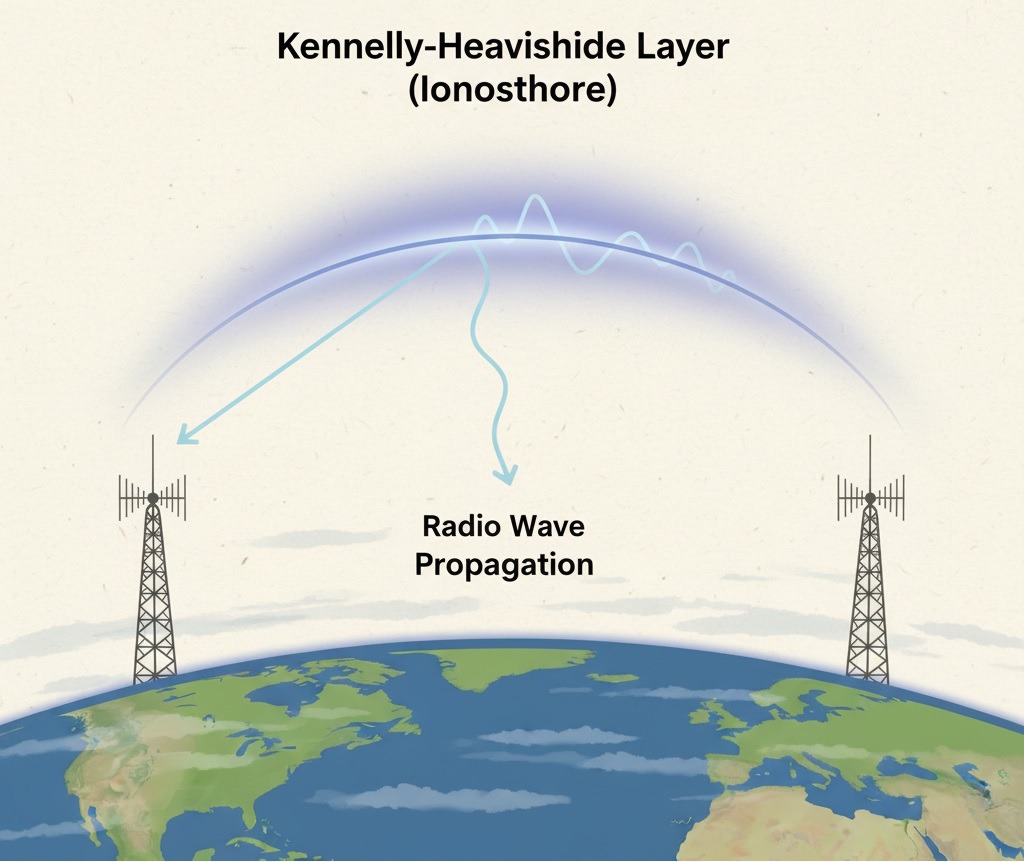
Marconi's successful transatlantic transmission in 1901 was a triumph, but it also presented a major scientific puzzle. Radio waves, like light, were known to travel in straight lines. So how could a signal from Cornwall, England, possibly reach Newfoundland, Canada, when the curvature of the Earth stood in the way?
The answer came in the form of a brilliant theoretical prediction. In 1902, Oliver Heaviside, writing in the Encyclopædia Britannica, proposed the existence of a conducting layer in the upper atmosphere. He theorised that this layer could reflect radio waves, allowing them to bounce between the Earth and the sky and travel far beyond the horizon. It was a bold and imaginative idea, proposed without any direct experimental evidence. Around the same time, the American engineer Arthur E. Kennelly independently proposed the same idea.
This hypothetical layer became known as the Kennelly-Heaviside Layer (what we now call the E-layer of the ionosphere). The existence of the ionosphere was experimentally confirmed in the 1920s, proving Heaviside's prediction correct. His insight was a crucial step in understanding long-distance radio propagation, the very phenomenon that makes worldwide shortwave broadcasting and DXing possible.
Beyond Radio: The Telegrapher's Equation and Loading Coils
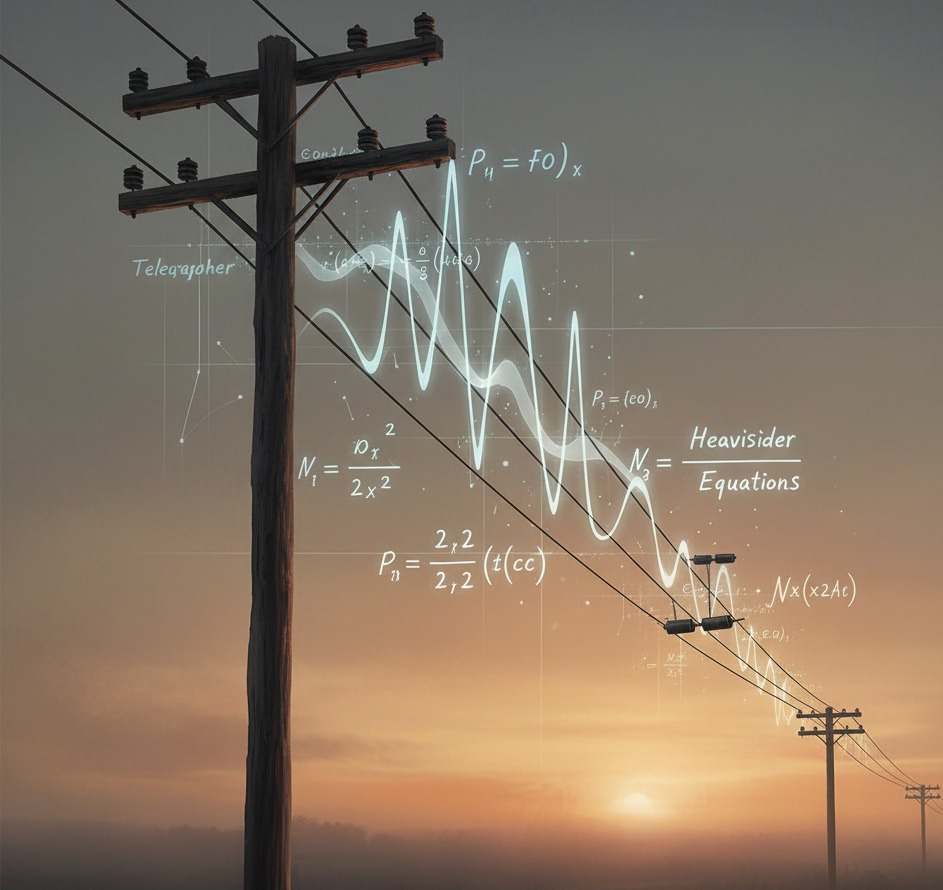
Heaviside's work on long-distance communication wasn't limited to radio. He also made fundamental contributions to telegraphy and telephony. He developed a set of equations, now known as the Telegrapher's equations, that describe how electrical signals propagate along a transmission line. These equations are still used today in the design of high-frequency circuits, transmission lines, and even computer networks.
He also theoretically determined how to eliminate the distortion that plagued early long-distance telephone calls. He showed that by adding inductance to the telephone line at regular intervals, the signal could be preserved over much greater distances. This was the principle behind the loading coils that Michael Pupin would later patent and make a practical reality. It's another example of Heaviside's incredible ability to foresee solutions to complex engineering problems through pure mathematical analysis.
A Life of Isolation and a Prickly Personality
Despite his brilliant mind, Heaviside was a deeply isolated and often difficult man. His deafness, his poverty, and his unconventional mathematical methods all contributed to his estrangement from the mainstream scientific community. He was a vocal critic of the academic establishment, which he felt was too hidebound by tradition and resistant to new ideas.
His writing style was often witty, sarcastic, and unapologetically blunt. He famously referred to his mathematical critics as "the little Peddlingtonians." I can't help but admire his rebellious spirit, even if it didn't always win him friends! He lived a reclusive life, often in poverty, supported by a small pension and the occasional financial assistance from his more established scientific admirers, like Oliver Lodge and George FitzGerald. He was a man who was utterly dedicated to his work, often to the exclusion of everything else. It's a sad irony that the man who did so much to advance the cause of communication lived such a solitary life.
Synergies with Ham Radio: The Unsung Hero of the Shack
So, why should a ham radio operator care about this eccentric, 19th-century theorist? Well, because Heaviside's work is woven into the very fabric of our hobby.
- Maxwell's Equations:Every time a ham thinks about antenna radiation patterns, wave propagation, or the behaviour of electromagnetic fields, they are working with the elegant version of Maxwell's equations that Heaviside gifted to the world.
- The Ionosphere: The very possibility of long-distance HF communication, the thrill of DXing, the nightly skip that carries our signals around the globe – it's all thanks to the ionosphere, the reflective layer that Heaviside predicted.
- Transmission Lines: The Telegrapher's equations he developed are the foundation for understanding how transmission lines work, including the coaxial cable that connects our rigs to our antennas. Concepts like impedance, SWR, and velocity factor all have their roots in his work.
- Inductance: His work on inductance and loading coils is directly related to the principles of antenna tuning and the design of filters and other RF circuits.
Heaviside may not have built a radio or made a single contact, but his theoretical insights are at the heart of everything we do as radio amateurs.
Legacy and Belated Recognition
Oliver Heaviside died in 1925, still a relatively obscure figure outside of a small circle of physicists and engineers. But in the decades that followed, his contributions were increasingly recognised. He was awarded the first Faraday Medal in 1922, and his work became a cornerstone of modern electrical engineering and physics.
His legacy is immense. He was a true pioneer, a man whose brilliant mind saw through the complexities of electromagnetism and laid the theoretical groundwork for much of the technology that defines our modern world. He was a maverick, a rebel, and a genius who, despite personal hardship and professional isolation, managed to leave an indelible mark on the world of science.
Conclusion: The Power of a Singular Mind
Oliver Heaviside's story is a powerful reminder that some of the most important contributions to science and technology come not from large, well-funded laboratories, but from the singular focus of a brilliant and determined mind. He was a man who, working alone, took on the most complex scientific theory of his day and made it accessible and usable. He was a prickly, difficult genius, but a genius nonetheless. He reminds us that true innovation often requires a willingness to challenge the status quo, to think differently, and to pursue the truth, no matter how unconventional the path may be. And for that, he deserves his place among the giants of radio history.
What are your thoughts on Oliver Heaviside and his incredible contributions? Do you think the academic world is more accepting of unconventional thinkers today? Let me know in the comments below! And, as always, if you have suggestions for other "Pioneers of Radio" that you'd like to see featured, don't hesitate to share.
For more information please visit our online store or alternatively contact us and our team will be happy to assist you!