
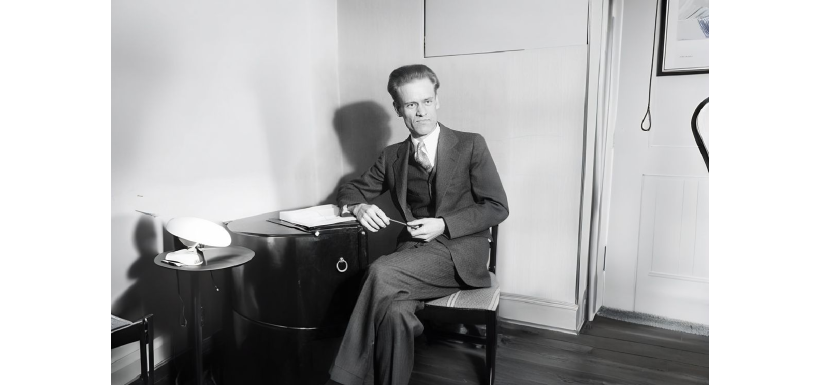
Imagine a world without television. Hard to picture, isn't it? Today, we take for granted the ability to instantly see events unfold across the globe, to be entertained by dramas, comedies, and documentaries, and to learn about the world through the moving images on our screens. But the invention of electronic television was a long and fiercely contested battle, and one of the key figures in that battle was a self-taught farm boy named Philo Farnsworth. As we continue our "Pioneers of Radio" series, we'll journey back to the early days of television, a time when the very idea of transmitting moving images electronically seemed like a far-off dream. While Farnsworth is primarily remembered for his contributions to television, his work is inextricably linked to the foundations of radio technology, sharing principles and innovations that shaped the broader landscape of electronic communication.
Early Life and the Eureka Moment on the Farm
Philo Taylor Farnsworth was born in 1906 near Beaver, Utah, a world away from the bustling laboratories of major electronics companies. His family were devout Mormons, and he grew up in a rural environment, learning the value of hard work and resourcefulness on the family farm. But Farnsworth's mind was anything but rural. He devoured books and technical magazines, teaching himself about science and technology. He was particularly fascinated by electricity and the emerging field of radio, and Popular Science was a firm favourite. The story goes that he even converted his family's home to electric power by utilising a generator attached to an old washing machine.
Now, here's where the story gets truly remarkable. At the age of 14 or 15, while working on his family's farm in Idaho, Farnsworth had a moment of pure inspiration. As he was ploughing a field, moving back and forth in straight, parallel lines, it struck him: an image could be scanned and transmitted in a similar way, line by line, using an electron beam. He later described this moment, saying "If you could train an electron beam across an image just as you read a page, from left to right, line by line, you could capture the entire image." He made detailed notes and diagrams in his journal, outlining his vision for an electronic television system. He even shared his concept with his high school science teacher, Justin Tolman, sketching a diagram of an electronic television system on the blackboard. This sketch, preserved by Tolman, would later become a crucial piece of evidence in Farnsworth's favour. This "eureka" moment, born from observing the simple act of ploughing, is a testament to Farnsworth's extraordinary ability to see the extraordinary in the ordinary. I find it absolutely inspiring how such a profound idea could emerge from such humble beginnings. It makes you wonder how many other groundbreaking inventions might have been sparked by everyday observations.
Developing the Image Dissector: From Idea to Invention
Farnsworth's vision was clear, but turning it into reality would require years of dedicated work and a good deal of ingenuity. Despite his lack of formal training in electronics, he was determined to build a working electronic television system. He knew he needed financial backing to pursue his research. In a remarkable feat of persuasion, Farnsworth convinced two professional fundraisers, George Everson and Leslie Gorrell, to invest in his idea. They saw the potential in his vision, even though it seemed like science fiction at the time. It is worth considering just how persuasive Farnsworth must have been. He was just a teenager, with no formal qualifications, yet he was able to convince seasoned investors to back his venture.
With funding secured, Farnsworth set up a laboratory in San Francisco and began the painstaking work of developing his electronic television system. The heart of his system was the image dissector, a vacuum tube that could convert an optical image into an electrical signal. It was a revolutionary concept.
Here's how it worked, in simplified terms:
- Light to Electrons: An optical lens focused the image to be televised onto a special surface inside the image dissector, called a photocathode. This surface had the unique property of emitting electrons when struck by light. The brighter the light, the more electrons were emitted.
- Electron Image: This created an "electron image" within the tube – a pattern of electrons that corresponded to the light and dark areas of the original image.
- Scanning: Electromagnetic coils surrounding the tube were used to deflect or steer the electron beam, causing it to scan across the electron image line by line, much like reading a page of text.
- Signal Generation: As the electron beam scanned the image, the varying number of electrons were collected by an electron multiplier, producing an electrical current that varied in strength according to the brightness of each point on the image. This fluctuating current was the video signal, which could then be transmitted.
It was a complex and delicate process, but Farnsworth's image dissector had some key advantages over competing technologies, such as Vladimir Zworykin's iconoscope, which was being developed concurrently at RCA. The image dissector, due to its design, could produce a sharper image, especially in low light. On the downside, the image dissector required a lot of light to function properly, which made it less practical for everyday use.

Image: Image dissector tube (credit)
In 1927, in his San Francisco lab, Farnsworth achieved a milestone: the first successful transmission of an electronic image using his image dissector. The image? A simple straight line. It might not seem like much today, but at the time, it was a monumental achievement. His wife, Pem, later recalled the moment, saying that when George Everson asked what they had to show for their investment, Farnsworth replied, "This is it - electronic television."
The Patent Battles with RCA: David vs. Goliath
Farnsworth's success attracted the attention of Radio Corporation of America (RCA), the dominant force in the radio industry at the time. RCA, under the leadership of the formidable David Sarnoff, was also investing heavily in electronic television research, with Vladimir Zworykin leading their efforts. Sarnoff initially tried to buy out Farnsworth, but Farnsworth was determined to remain independent. He wanted to develop his invention on his own terms and, understandably, he wanted to reap the rewards of his hard work.
What followed was a protracted and, frankly, brutal legal battle over key television patents. It was a classic David-versus-Goliath scenario. On one side, you had Farnsworth, the independent inventor, a self-taught farm boy with a revolutionary idea. On the other side, you had RCA, a corporate behemoth with vast resources and a team of top-notch lawyers.
The central conflict revolved around the priority of invention. Who came up with the fundamental concepts of electronic television first? RCA argued that Zworykin's work predated Farnsworth's. Farnsworth, however, had meticulously documented his ideas from a young age. And here's where that high school sketch comes in. Remember Justin Tolman, Farnsworth's science teacher? He testified in court, presenting the drawing that Farnsworth had made for him years earlier. This, along with Farnsworth's own detailed notes and early demonstrations, provided crucial evidence of his prior conception.
The patent interference case dragged on for years, taking a heavy toll on Farnsworth, both financially and emotionally. But he refused to back down. He believed in his invention, and he was determined to defend his intellectual property.
Finally, in 1934, the US Patent Office ruled in Farnsworth's favour, recognizing him as the primary inventor of key electronic television technologies. It was a landmark decision. For the first time, RCA was forced to pay royalties to an outside inventor, and it was a major victory for independent inventors everywhere. It confirmed that Farnsworth's patents were valid and that RCA's system infringed upon them. It was a huge personal triumph for Farnsworth, proving that his early vision had indeed been groundbreaking.
Later Career, Fusion Research, and Legacy
Despite his legal victory, the patent battles had taken their toll. Farnsworth's company, Farnsworth Television and Radio Corporation, struggled to compete with RCA, which had the advantage of its vast manufacturing and broadcasting resources. The company was eventually sold to International Telephone and Telegraph (ITT) in 1949.
After leaving the television industry, Farnsworth turned his attention to other areas, including industrial electronics and, surprisingly, nuclear fusion. He developed a device called the Fusor, which used inertial electrostatic confinement to create a fusion reaction. While not a practical source of power, the Fusor is still used today as a source of neutrons and for research purposes. It's a testament to Farnsworth's continued drive to explore new scientific frontiers. He would also work on technologies as diverse as air-traffic control, the use of ultraviolet light for the detection of disease, and equipment to aid the conversion of saline water.
Farnsworth's contributions to television were not fully recognized during his lifetime. He was often overshadowed by RCA and Zworykin, who received more publicity and, some would argue, more credit than they deserved. But history has been kinder to Farnsworth. Today, he is increasingly acknowledged as the true "father of electronic television," the independent inventor who, against all odds, brought his vision to life.
Connections to Radio and the Electronic Age
It is important to remember that although Farnsworth is primarily known for his work on television, his contributions were deeply intertwined with the foundations of radio technology. The development of television was, in many ways, a natural extension of radio. Both technologies rely on the principles of electromagnetism , and both involve the transmission and reception of signals through the air.

Many of the components used in early television systems, such as vacuum tubes, amplifiers, and oscillators, were initially developed for radio. Farnsworth's work on the image dissector, while specifically designed for television, contributed to the broader understanding of electron optics and vacuum tube technology, which also had applications in radio engineering.

Moreover, Farnsworth's concept of electronic scanning, though initially applied to television, has had far-reaching implications. It's a fundamental principle that underlies not only television but also radar, computer displays, and various types of electronic imaging systems.
Conclusion: The Independent Spirit
Philo T. Farnsworth's story is an inspiring example of how one person's ingenuity and determination can change the world. He was a self-taught inventor, a visionary who dared to challenge the established giants of the electronics industry. He faced scepticism, financial hardship, and intense legal battles, but he never gave up on his dream of creating electronic television.
His legacy extends far beyond the television set. He embodies the spirit of independent invention, the belief that anyone, regardless of their background or formal training, can make a significant contribution to technology. His story reminds us that innovation often comes from unexpected places, driven by passion, perseverance, and a willingness to challenge the status quo. So, the next time you turn on your television, remember Philo Farnsworth, the farm boy who dared to dream of a world connected by electronic images, and who, against all odds, made that dream a reality.
For more information please visit our online store or alternatively contact us and our sales team will be happy to asisst you!
What are your thoughts on Philo Farnsworth and his incredible journey? Do you think independent inventors still have a chance to make a significant impact in today's world of large corporations and complex technologies? Let me know in the comments below! And, as always, if you have suggestions for other "Pioneers of Radio" that you'd like to see featured, don't hesitate to share.