
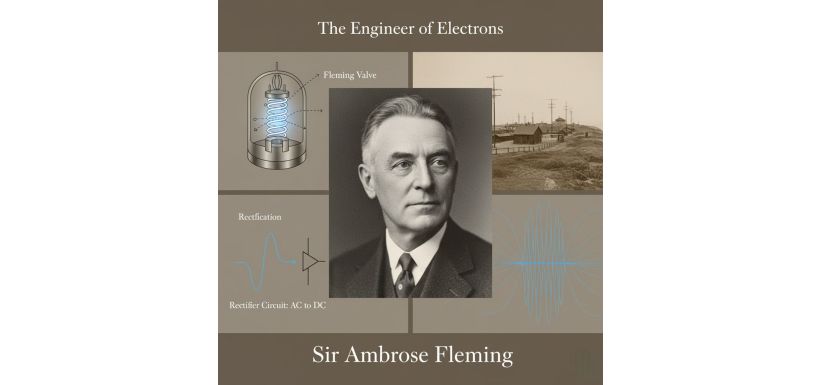
In the bustling dawn of wireless communication, inventors like Marconi were sending powerful sparks across oceans, but they were largely working with blunt instruments. To truly harness the ethereal dance of radio waves, something more delicate and precise was needed at the receiving end. Today, in our 'Pioneers of Radio' series, we turn our attention to Sir Ambrose Fleming, a British electrical engineer and physicist whose single, brilliant invention – the thermionic valve, or diode – provided that missing precision. It was a breakthrough that transformed radio from a scientific curiosity into a practical, mass-market technology and, in doing so, single-handedly ushered in the electronic age.
Early Life and Academic Foundations
John Ambrose Fleming was born in Lancaster, England, in 1849. From a young age, he showed a keen aptitude for science and mathematics, a passion he pursued with unwavering dedication. His academic journey was rigorous and impressive, studying at University College London and then at St John's College, Cambridge. It was at Cambridge that he had the immense privilege of studying under the great James Clerk Maxwell, whose groundbreaking theories on electromagnetism would profoundly shape Fleming's own understanding of the nascent field of radio.
Maxwell’s influence imbued Fleming with a deep theoretical grounding, complementing his practical inclinations. After completing his studies, Fleming embarked on a distinguished academic and professional career. He held various lecturing and professorial positions, including a professorship of electrical technology at University College London (UCL). He quickly gained a reputation as a brilliant experimentalist and an incisive thinker, becoming a leading authority on electrical engineering. His expertise was so highly regarded that he would soon be sought out by one of the most famous names in early radio.
Working with Marconi: The Need for a Better Detector
By the late 1890s and early 1900s, Guglielmo Marconi was achieving astonishing feats with his spark-gap transmitters, sending wireless signals across ever-increasing distances, culminating in the first transatlantic transmission in 1901. However, a major bottleneck in Marconi's system, and indeed in all early radio technology, was the detector at the receiving end.
Early radio receivers relied on crude, unreliable devices like the coherer. As we've seen in previous posts, coherers were metal filings in a tube that would 'cohere' (stick together) when a radio wave hit them, conducting electricity. But they were slow, insensitive, and often required a physical tap to 'decohere' (unstick) the filings after each signal. They were the equivalent of trying to hear a whisper in a hurricane. Marconi desperately needed a more stable, more sensitive, and faster detector to make his wireless system truly practical and commercially viable.
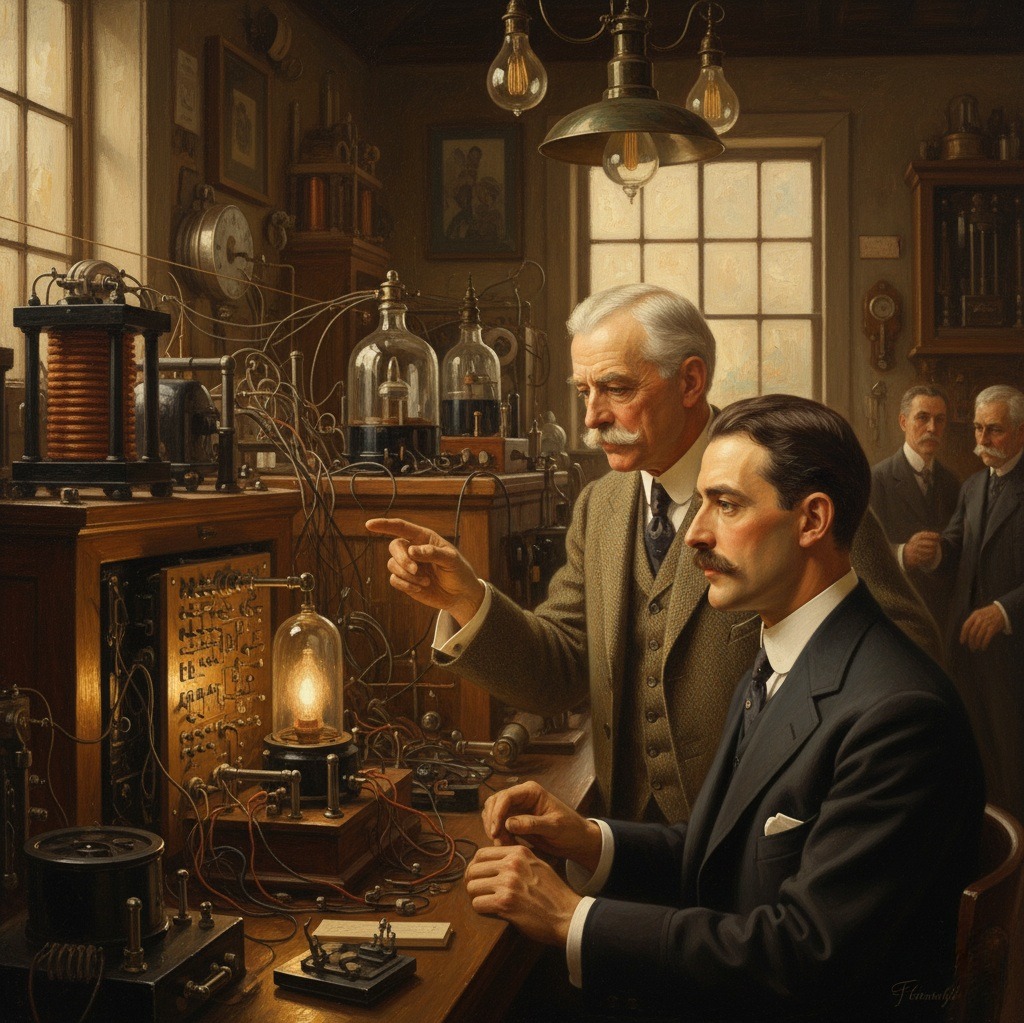
It was precisely this challenge that brought Marconi to Ambrose Fleming. Recognizing Fleming's unparalleled expertise in electrical engineering and vacuum tubes (he had previously worked as a scientific advisor for Edison's electric light company in London), Marconi hired him as a scientific advisor to his Wireless Telegraphy Company in 1899. This collaboration would lead to one of the most significant inventions in the history of electronics.
The Fleming Valve: The Birth of the Diode
Fleming was intimately familiar with the "Edison effect" – the observation, made by Thomas Edison, that an electric current could flow from a heated filament to a separate metal plate inside an evacuated glass bulb, but only when the plate was positive relative to the filament. Edison had noted this curiosity but hadn't found a practical application for it. Fleming, however, saw its potential for radio.
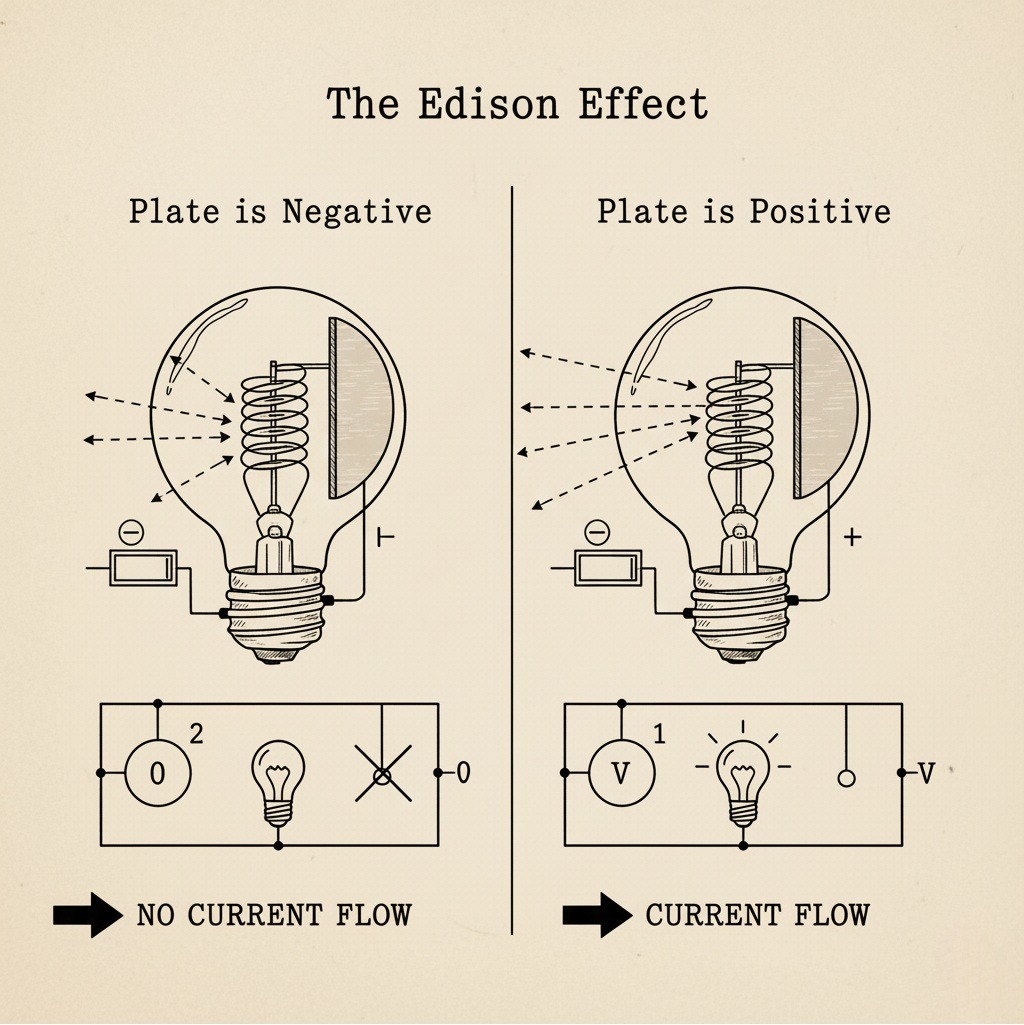
He realised that this one-way electrical flow could be used to detect radio signals. Radio waves are essentially alternating currents (AC), rapidly oscillating between positive and negative. If a device could allow current to flow only when the radio wave was positive, it would effectively convert the AC radio signal into a pulsating direct current (DC) that could then be used to activate headphones or a telegraph sounder. This process is called rectification.
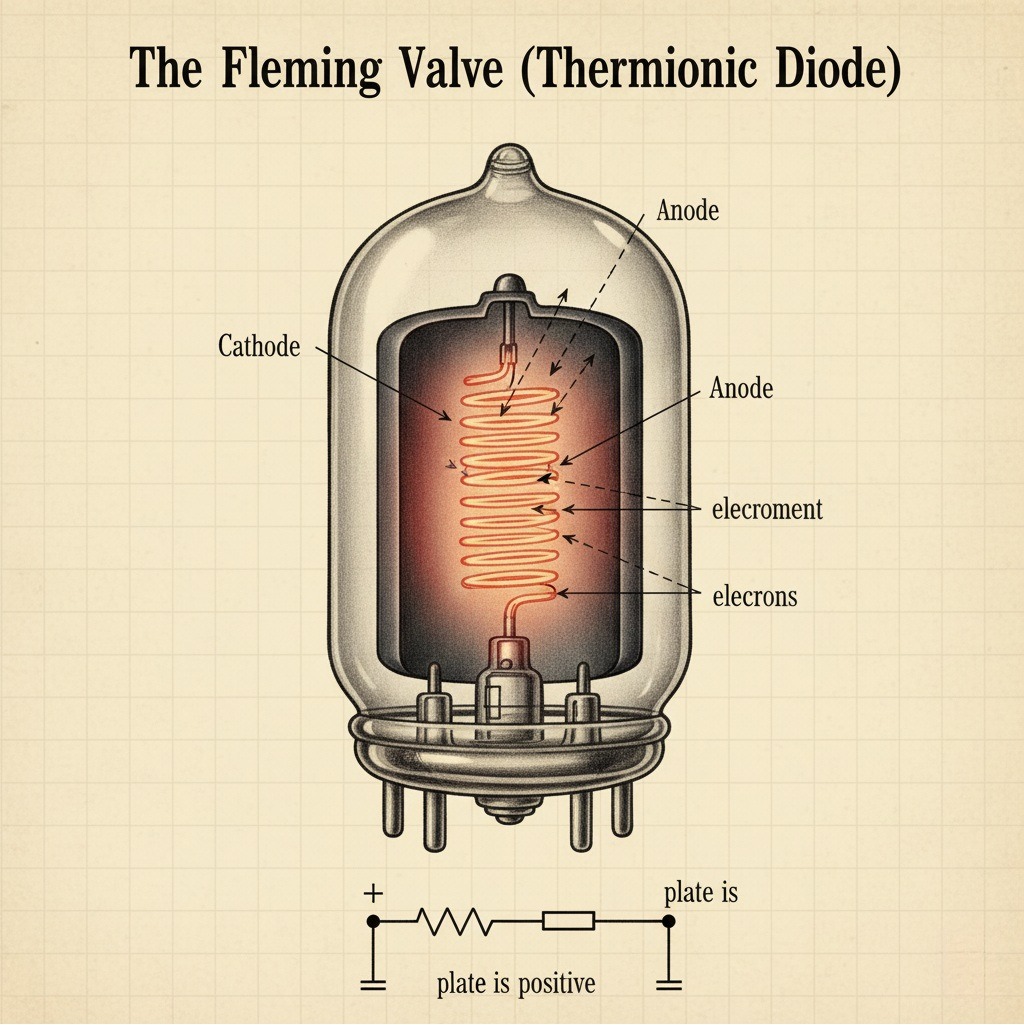
In 1904, after intense experimentation, Fleming created his revolutionary device: the thermionic valve, also known as the Fleming valve, or simply the diode. It consisted of an evacuated glass bulb containing two electrodes: a heated filament (which emitted electrons) and a metal plate (anode).
Here's how it worked as a radio detector:
- Heated Filament:
- One-Way Flow:
- Rectification:
When heated, the filament would glow and emit a cloud of electrons (thermionic emission).
If the incoming radio wave made the plate positive, it would attract these electrons, allowing current to flow through the tube. If the radio wave made the plate negative, it would repel the electrons, and no current would flow.
This meant the AC radio signal was "rectified" – only the positive halves of the wave were passed, converting the continuous alternating radio signal into a series of DC pulses. These pulses could then drive a sensitive earphone, making the radio signal audible.
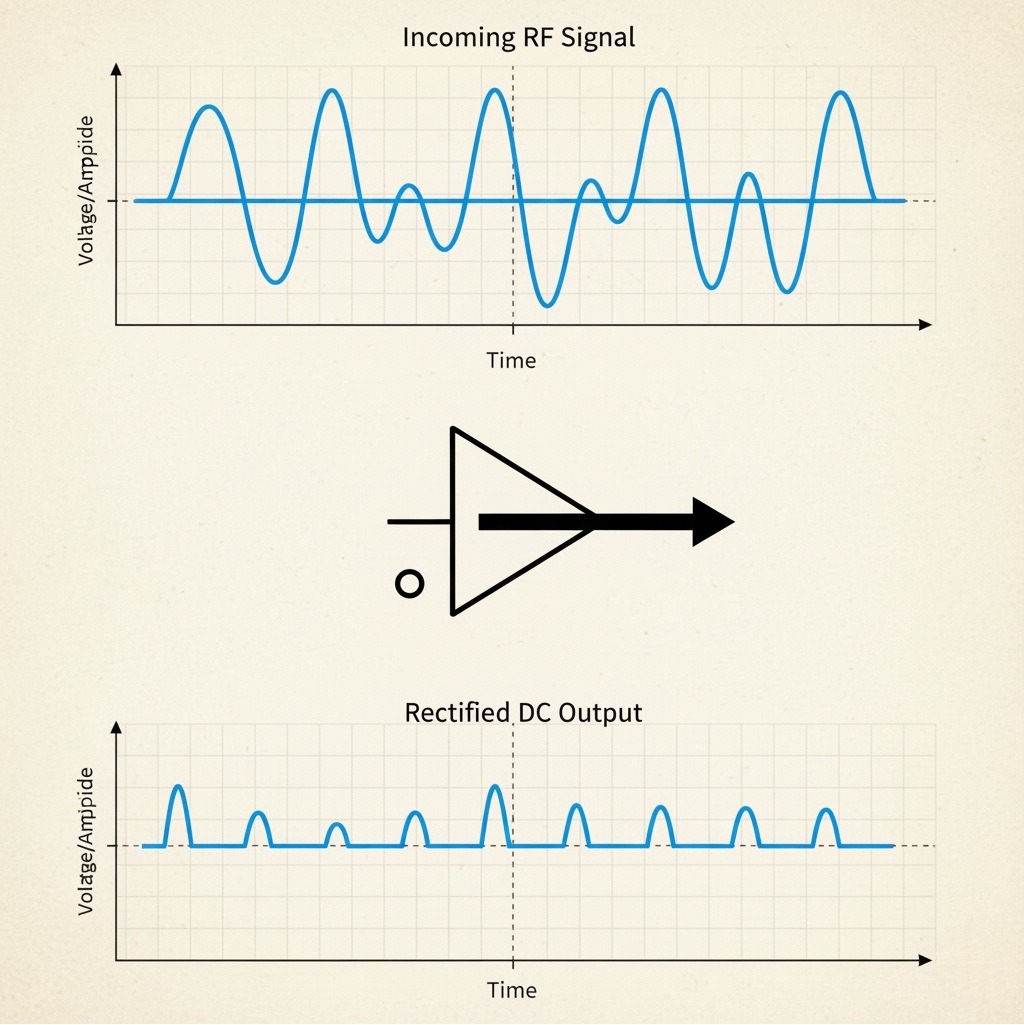
The Fleming valve was a revelation. It was far more stable, sensitive, and reliable than any coherer. It provided a clear, consistent signal, transforming the chaotic buzz of early radio into something approaching clarity. It was the first practical electronic detector of radio waves.
Beyond Detection: The Dawn of the Electronic Age
The impact of the Fleming valve was immediate and profound for radio. Marconi's receivers, equipped with Fleming's diodes, became vastly more effective, allowing for clearer and more reliable long-distance communication. It was a critical step in making radio a commercially viable technology.
But its significance stretched far beyond just radio detection. The Fleming valve was the very first electronic vacuum tube. It was a device that controlled the flow of electrons in a vacuum. This fundamental concept laid the groundwork for all subsequent electronic devices.
- Amplification:
- The Electronic Age:
While Fleming's diode was a rectifier, it opened the door for subsequent inventions. Just a few years later, Lee de Forest added a third electrode (the grid) to create the triode, which could not only detect but also amplify electronic signals. This invention truly unlocked the potential of electronics, making practical radio, telephony, and later television possible.
Before the transistor, vacuum tubes were the workhorses of all electronics. Radios, televisions, computers (the earliest ones were massive arrays of vacuum tubes), radar systems – all relied on the principles established by Fleming's initial diode. He had effectively created the very first building block of modern electronics.
Synergies with Ham Radio: The Foundational Component
For any ham radio operator, Fleming's legacy is deeply embedded in the history and principles of our hobby:
- Rectification:
- Receivers:
- The Valve/Tube Era:
- Understanding Electronics:
The concept of rectification, converting AC to DC, is fundamental to every power supply in every radio shack. While modern radios use solid-state diodes, the principle was established by Fleming's valve.
His diode was the first truly effective electronic detector, the cornerstone upon which all sensitive radio receivers were built. Without it, the coherer would have severely limited radio's development.
For many hams, particularly those who appreciate vintage gear, the "valve radio" or "tube radio" represents a golden age of amateur radio. Fleming's invention sparked this entire era of vacuum tube electronics that dominated radio for half a century.
Studying the operation of a simple diode valve provides a crucial conceptual bridge to understanding how all active electronic components work – controlling the flow of electrons.
Legacy and Recognition
Ambrose Fleming continued his distinguished career, receiving numerous honours for his contributions. He was knighted in 1929. He retired from his professorship at UCL in 1926 but remained active in scientific pursuits. He was a devout Christian and was involved in the creation of the first television broadcast by the BBC.
Sir Ambrose Fleming died in 1945, having lived to see his invention evolve from a simple two-electrode valve into the complex electronic systems that were playing a crucial role in World War II.
Conclusion: The Unsung Hero of Electron Control
Sir Ambrose Fleming may not have been as flamboyant as Marconi or as eccentric as Heaviside, but his contribution to radio and indeed to the entire electronic age was monumental. His thermionic valve was a quiet revolution, a delicate glass bulb that harnessed the invisible flow of electrons and transformed it into a tangible, usable signal. He provided the crucial missing piece that allowed radio to truly flourish, making possible everything from the first clear transatlantic voice calls to the complex computers of today. He was the unsung hero who taught us how to control electrons, and for that, he deserves immense recognition as a true pioneer of radio and modern electronics.
What are your thoughts on the quiet but profound impact of Ambrose Fleming's diode? Do you have any experience with vintage valve radios? Let me know in the comments below! And, as always, if you have suggestions for other "Pioneers of Radio" that you'd like to see featured, don't hesitate to share.
For more information please visit our online store or alternatively contact us, and our team will be happy to assist you!