
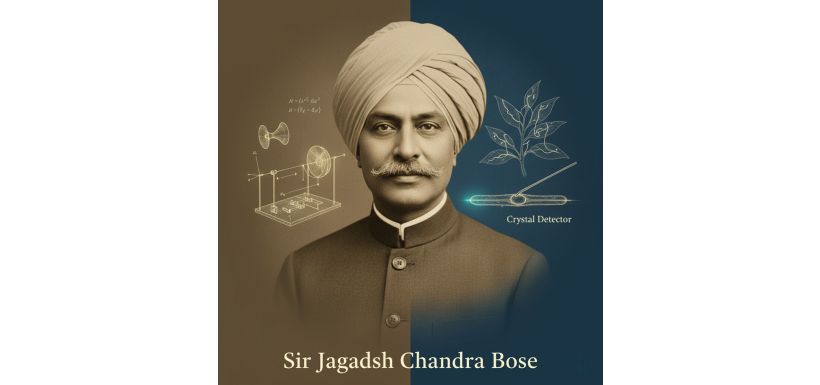
Imagine discovering a hidden chapter in the history of radio, a narrative of pioneering genius that unfolds not in Europe or America, but in British India. Today, in our 'Pioneers of Radio' series, we unearth the story of Sir Jagadish Chandra Bose, a polymath whose work in ultra-high frequency radio waves – what we now call microwaves – was not just groundbreaking, but decades ahead of its time. He was a physicist, a biologist, a botanist, and even an archaeologist, a man whose boundless curiosity led him to make profound contributions in multiple fields, often with limited resources and in the face of significant prejudice.
Early Life and Education: A Foundation in Science and Culture
Jagadish Chandra Bose was born in 1858 in Mymensingh, Bengal Presidency (now Bangladesh), into a wealthy and intellectual Bengali family. His father, Bhagawan Chandra Bose, was a prominent leader in the Brahmo Samaj reformist movement and a respected civil servant. From the very beginning, Bose's upbringing was unconventional and forward-thinking.
In a move that was highly unusual for the time, his father deliberately sent him to a Bengali-medium vernacular school. He believed it was essential for his son to connect with his own culture and people before being exposed to Western education. As Bose himself later recounted, his father told him that "before you can learn English, you must learn your own language." This early immersion in his native culture instilled in him a deep sense of identity and a unique perspective that would inform his later work.
After his early education, Bose attended St. Xavier's College in Calcutta, where he developed a strong interest in the natural sciences. His passion for learning was undeniable, and in 1880, he travelled to England for higher education. He initially intended to study medicine, but due to his own recurring health issues, he switched to natural sciences.
He studied at Christ's College, Cambridge, and University College London, where he had the privilege of learning from some of the leading scientific minds of the era, including the renowned physicist Lord Rayleigh. This exposure to the cutting edge of Western science, combined with his deep roots in Indian culture, created a unique intellectual foundation upon which he would build his remarkable career.
In 1885, Bose returned to India and was appointed as a professor of physics at Presidency College in Calcutta. However, he was immediately confronted with the harsh realities of racial discrimination within the British colonial system. He was offered a salary that was significantly lower than that of his European colleagues. In a principled act of protest, Bose refused to accept his salary for three years, while continuing to fulfil all his teaching duties. It was a silent, dignified protest that eventually led to the authorities conceding, and he was paid in full for his three years of service. This incident reveals the strength of his character and his unwavering commitment to justice and equality.
The Invisible Rays: Pioneering Microwave Optics
In the late 19th century, the scientific world was still reeling from James Clerk Maxwell's prediction of electromagnetic waves and Heinrich Hertz's experimental proof of their existence. Most researchers, including Marconi, were focused on the longer wavelengths of the radio spectrum. But Bose had a different, and remarkably prescient, vision.
He decided to investigate the shortest possible electromagnetic waves, in the millimetre range (from 5mm to 25mm). This was a completely new frontier, a part of the spectrum that was virtually unexplored. Bose's insight was that these high-frequency waves would behave more like light, allowing him to conduct classic optical experiments to study their properties. He was, in essence, pioneering the field of microwave optics.
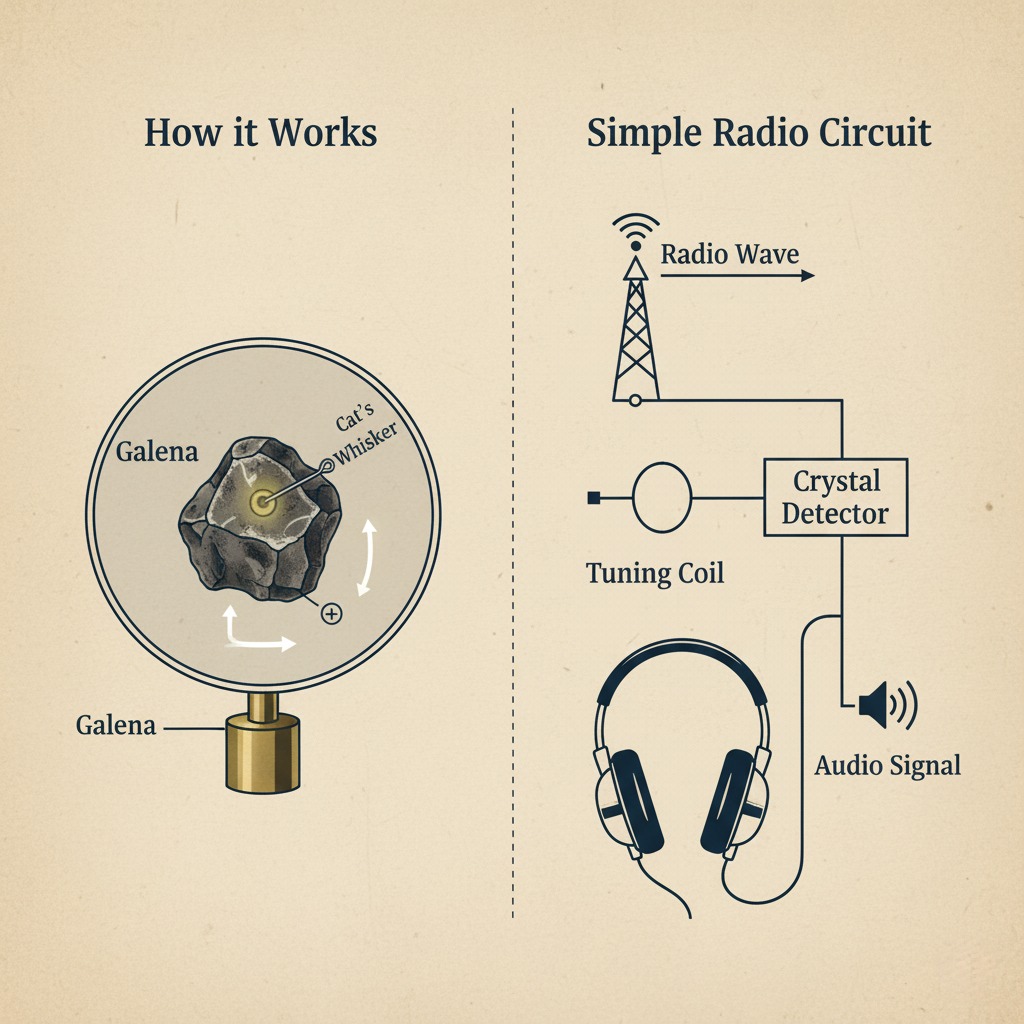
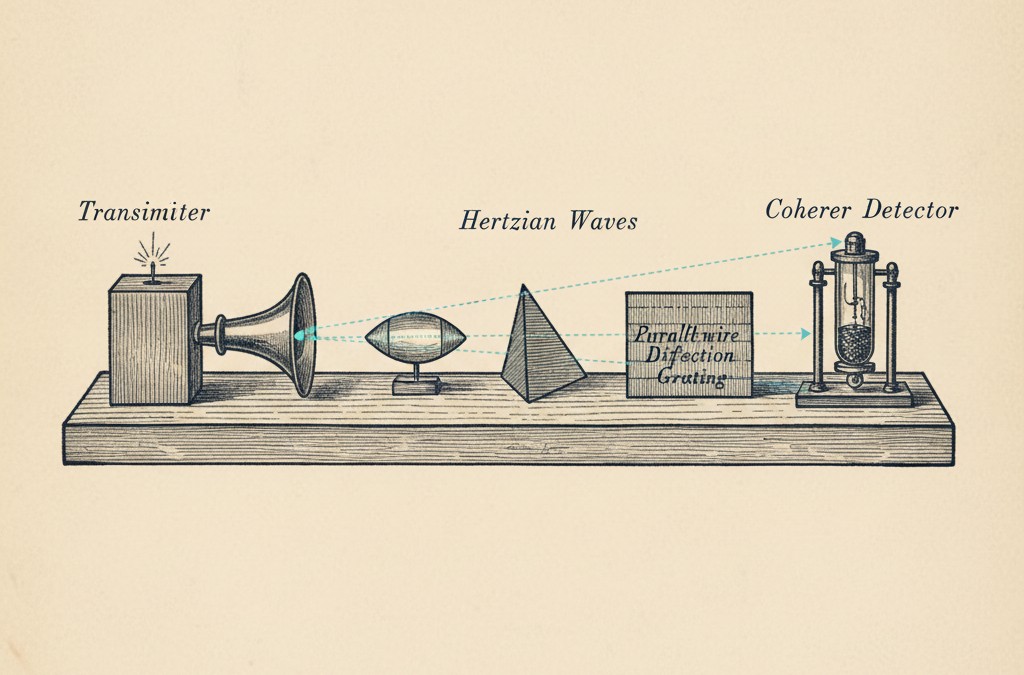
Working in his modest laboratory at Presidency College, often with limited resources and funding, Bose designed and built an incredible array of ingenious instruments. His microwave generator was a compact spark transmitter that could produce waves as short as 5mm, a marvel of miniaturisation compared to Hertz's large and cumbersome apparatus. His microwave detector was a significantly improved version of the coherer, a device that could detect radio waves. He experimented with various materials, and, in a crucial discovery, found that galena (lead sulphide) was an exceptionally effective detector. We now know that his point-contact galena detector was one of the first semiconductor diodes, decades before the term "diode" was even coined.
With his self-built equipment, Bose conducted a series of brilliant experiments. He created a "microwave optics bench," using prisms, lenses, and wire grids to demonstrate that his millimetre waves exhibited all the classic properties of light: reflection, refraction, diffraction, and polarisation. He showed that these invisible waves could be focused, bent, and filtered, just like visible light.
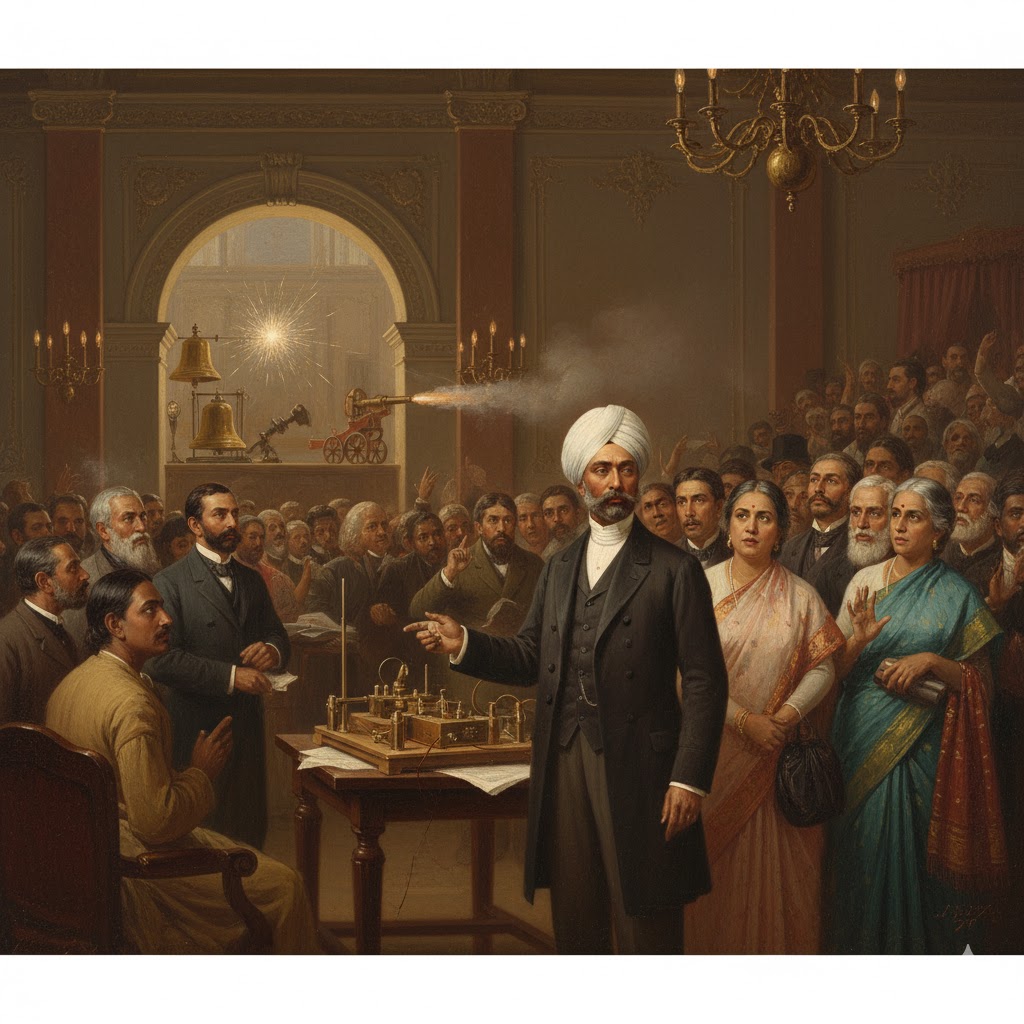
In November 1895, in a public demonstration in Calcutta, Bose transmitted microwaves through a series of walls to a receiver 75 feet away, triggering a remote bell and even firing a small cannon. This was a remarkable achievement, and it took place before Marconi's more famous public demonstrations in England. The following year, in 1896, Bose travelled to London and presented his findings to the Royal Institution, where his lecture and demonstrations were met with awe and admiration.
Despite the groundbreaking nature of his work, Bose was initially reluctant to patent his inventions. He was a pure scientist at heart, driven by a desire for knowledge rather than commercial gain. He believed that scientific discoveries should be shared freely for the benefit of all humanity. This noble, if perhaps commercially naive, stance would later contribute to his work being overlooked in some Western accounts of radio history.
Contributions to Early Radio Technology
Bose's contributions to the practical development of radio were immense. His improved coherers, including a self-restoring version that didn't require tapping after each detection, were a significant advancement in receiver technology. And his discovery of the galena crystal detector was a game-changer. Crystal detectors were far more sensitive and reliable than coherers, and they became the heart of the millions of crystal radio sets that were built by hobbyists and commercial manufacturers in the early 20th century.
He also developed some of the earliest forms of horn antennas and waveguides to direct his millimetre waves, designs that are strikingly similar to those used in modern microwave and radar systems. It's truly astonishing to see how far ahead of his time he was.
Eventually, under pressure from his friends and colleagues, Bose did file for a patent for his galena detector in 1901, which was granted in 1904. But by then, the commercial landscape of radio was already being dominated by Marconi and others.
The Unifying Principle: Living and Non-Living Responses
In a fascinating turn, Bose's research took a new direction around the turn of the century. He had noticed that his coherer detector seemed to exhibit a kind of "fatigue" after prolonged use, and it would "recover" after a period of rest. This reminded him of the response of living muscles. This observation sparked in him a radical new idea: that there might be a fundamental unity between the responses of living and non-living matter.
He shifted his focus to biophysics, inventing the crescograph, an incredibly sensitive instrument that could magnify the movements of plants by a factor of up to 10,000. With this device, he conducted a series of groundbreaking experiments, demonstrating that plants respond to various stimuli – light, heat, electrical shocks, and even chemical agents – in ways that were analogous to the responses of animal tissues. He showed that plants have a kind of "nervous system" that transmits signals, and he even measured the "heartbeat" of plants.
His theory of a universal response in both animate and inanimate matter was controversial, and it was met with skepticism from some in the scientific community, particularly physiologists. But his work is now seen as pioneering in the fields of biophysics and plant neurobiology.
Synergies with Ham Radio: The Unseen Wavelengths
Sir Jagadish Chandra Bose's work has a profound and direct connection to the world of amateur radio.
- Microwave Bands:
- Crystal Detectors:
- Antenna Design:
- The Experimental Spirit:
Every ham who operates on the 10 GHz, 24 GHz, or higher microwave bands is directly engaging with the frequencies that Bose first explored. His self-built apparatus was the forerunner of modern microwave transceivers, and his experimental spirit is alive and well in the amateur microwave community.
The galena crystal detector, which he pioneered, is the heart of the classic crystal radio set, the entry point for countless hams into the world of radio. His work on semiconductor detectors laid the foundation for the diodes that are now ubiquitous in radio circuits.
His early work with horn antennas and waveguides for millimetre waves foreshadowed the complex antenna designs used in high-frequency amateur radio today.
Perhaps most importantly, Bose's hands-on, self-built, experimental approach to understanding electromagnetic waves is the epitome of the ham radio spirit. He built his entire laboratory from scratch, often with limited resources, a practice that is familiar to any ham who has ever built a "homebrew" rig or antenna.
Legacy and Recognition
In 1917, Bose founded the Bose Institute in Calcutta, a research institution dedicated to interdisciplinary studies, a lasting testament to his vision. While his work was overlooked for many years in some Western accounts of radio history, there has been a significant modern reappraisal of his contributions. The IEEE, for example, has recognized him as a "father of radio science" and a pioneer in microwave technology.
He received numerous honours during his lifetime. He was knighted in 1917 and became a Fellow of the Royal Society in 1920. In India and Bangladesh, he is celebrated as a national hero and a scientific icon. He passed away in 1937, leaving behind an incredible legacy of scientific discovery and innovation.
Conclusion: A Visionary of Unity
Sir Jagadish Chandra Bose was more than just a physicist; he was a philosopher of science, a polymath who saw unity where others saw division. His quiet revolution in millimetre-wave technology laid seeds that would blossom into radar, satellite communication, and a deeper understanding of life itself. He reminds us that scientific genius knows no geographical bounds, and that sometimes, the most profound insights come from those who dare to look beyond the obvious, into the unseen wavelengths of the universe. He was a true pioneer, a man whose boundless curiosity and dedication to knowledge continue to inspire scientists and enthusiasts around the world.
What are your thoughts on Sir Jagadish Chandra Bose and his incredible, multidisciplinary contributions? Do you think his reluctance to patent his inventions hindered his recognition? Let me know in the comments below! And, as always, if you have suggestions for other "Pioneers of Radio" that you'd like to see featured, don't hesitate to share.
For more information please visit our online store or alternatively contact us and our team will be happy to assist you!