
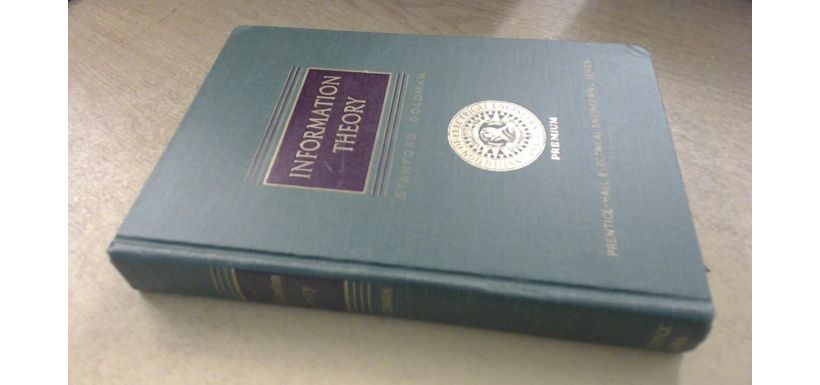
Ever tried to have a conversation with someone at a rock concert? Or maybe strained to hear that crucial bit of news on a fading radio signal? Yeah, noise – it's the bane of any communicator's existence. It's that pesky, unwanted interference that obscures the signal, making it difficult to extract the information you actually want. Now, I've always been a bit of a radio geek, and one of my personal favorite innovators in this field has to be Stanford Goldman. This guy was a noise ninja, a master of understanding and taming the very thing that makes clear communication so difficult. As we continue our "Pioneers of Radio" journey, we'll explore how this unassuming engineer became a key figure in shaping the field of information theory, laying the groundwork for much of the digital communication we rely on today.
From New York City to MIT: A Budding Engineer
Stanford Goldman was born in New York City in 1909, during an era of rapid technological change. While details on his early life are scarce, it is not hard to imagine a young Goldman tinkering with crystal radios and getting hooked on the magic of wireless communication. He pursued his passion for science and engineering at the prestigious Massachusetts Institute of Technology (MIT), graduating with a Bachelor of Science degree in Electrical Engineering in 1930, followed by a Master of Science in 1931, and finally a doctorate in 1933. Now, MIT in the 1930s wasn't exactly a walk in the park. I, like many others, struggled to understand the intricacies of Fourier transforms when first learning about them at university. It is clear that Goldman had no such issues, and it was here that he delved deep into the intricacies of signal processing and, inevitably, the challenges posed by noise. After a short stint at the University of Michigan, he found his niche as an engineer at the General Electric Company (GEC) in Schenectady, NY. This was a pivotal time, coinciding with the development of FM broadcasting, and it seems Goldman was right in the thick of it, contributing significantly to the advancement of this new technology.
Diving Deep into Information Theory: Taming the Noise
See, before the likes of Goldman came along, engineers were tackling communication problems with a somewhat, shall we say, unsophisticated approach. Maybe it was more like, "Let's just crank up the power and hope for the best!" Then came Claude Shannon, with his revolutionary 1948 paper, "A Mathematical Theory of Communication," which essentially birthed the field of information theory. (And yeah, it's a bit of a mind-bender, even for those of us who think we're technically inclined. I still get headaches trying to wrap my head around some of it).
But Shannon wasn't alone. Stanford Goldman was right there, making crucial contributions to this exciting new field. He wasn't about building flashy gadgets; he was more interested in the fundamental principles behind the gadgets. Goldman's forte was understanding the nature of noise itself. He delved deep into the mathematical analysis of different types of noise, like white noise and Gaussian noise. Now, white noise, for those lucky enough never to have studied it, is basically a random signal with equal intensity at all frequencies. Think of it like the static on an untuned radio. Gaussian noise, on the other hand, is a type of noise with a specific probability distribution (the bell curve, anyone?). Goldman's work helped engineers characterize and quantify these different types of noise, which was essential for developing effective strategies to combat them.
He wrote two incredibly influential books: "Frequency Analysis, Modulation and Noise" (1948) and "Information Theory" (1953). Now, don't worry, they're not exactly beach reads. They're dense, packed with equations, and definitely not for the faint of heart. But for anyone serious about understanding the foundations of communication theory, they're essential reading. I remember trying to plow through them in my college days, let's just say it was a humbling experience. In these academic circles, his name started to become synonymous with clarity in a field often mired in complexity.
Syracuse University and Beyond: Sharing the Knowledge
In 1955, Goldman made the transition to academia, becoming a professor of electrical engineering at Syracuse University. There, he continued his groundbreaking research while also shaping the minds of future generations of engineers. One time, I tried to explain some of Goldman's ideas to a friend, and let's just say it didn't go well. I guess that's why he was the professor, and I'm just the guy writing blog posts. He also consulted for major companies, including his former employer General Electric, demonstrating his ability to bridge the gap between theoretical concepts and practical applications.
He mentored numerous students, many of whom went on to have successful careers in communication engineering. He was known for his dedication to teaching and his ability to make complex topics understandable (something I clearly need to work on!). He continued his research at Syracuse, further refining his ideas on information theory and noise analysis, always pushing the boundaries of the field.
The Enduring Relevance of Goldman's Work: It's a Noisy World After All
So, why should you care about Stanford Goldman and his work on noise? Well, it turns out that his ideas are more relevant today than ever before. Think about it: every time you stream a video, download a song, or make a phone call, you're benefiting from the work of pioneers like Goldman. See, we live in a digital world, and digital communication relies heavily on the principles of information theory.
Goldman's work on noise analysis was crucial for the transition from analog to digital communication. In analog systems, noise gradually degrades the signal, leading to a loss of quality. But in digital systems, information is encoded in discrete bits, and as long as the noise doesn't corrupt the bits beyond recognition, the information can be recovered perfectly. This is where error correction codes, which are based on information theory, come into play. These ingenious codes can detect and correct errors introduced by noise, ensuring the reliable transmission of data.
And it's not just about communication. As Professor Sarah Johnson of MIT's Electrical Engineering department once said, "Goldman's insights into the nature of noise were fundamental. We're still building on his work today." His work on noise and information theory has applications in fields as diverse as medical imaging, data storage, and even financial modeling.
Conclusion: The Unsung Hero
For me, Stanford Goldman represents the kind of unsung hero of science that I love to champion. He wasn't chasing fame or fortune; he was driven by a deep curiosity about the fundamental principles of communication. And his work ended up making a real difference in the world. He was a true pioneer, a noise ninja who helped to tame the chaos of unwanted signals and pave the way for the clear, reliable communication we often take for granted.
So, the next time you're enjoying a crystal-clear phone call or a seamless video stream, spare a thought for Stanford Goldman. He's a reminder that sometimes the most important breakthroughs happen behind the scenes, in the realm of equations and theories. And his story is a testament to the power of human curiosity and the enduring impact of fundamental research.
Anyone else out there ever tried to build their own radio receiver and ended up with more static than signal? Or maybe you've got some experience wrestling with noise in your own field? Let me know in the comments! And, as always, if you have suggestions for other radio pioneers you'd like to see featured, don't hesitate to share.
For more information please visit our online store or contact us or team will be happy to assist you!