

Introduction
The late 19th century was a time of incredible scientific breakthroughs, a period when the very fabric of reality seemed to be revealing its hidden secrets. In 1895, in a dimly lit laboratory in Würzburg, Germany, one such secret was unveiled in a moment of pure serendipity. Wilhelm Conrad Röntgen, a meticulous and respected physicist, stumbled upon a phenomenon that would revolutionize science and medicine: X-rays. This is a story not of a radio pioneer in the strictest sense, but of a scientist whose work profoundly impacted our understanding of the electromagnetic spectrum, a crucial step toward the development of radio technology. As part of our "Pioneers of Radio" series, we'll delve into Röntgen's life, his accidental discovery, and its lasting legacy. The story of Professor Röntgen is a testament to the power of observation, and the unexpected paths that scientific inquiry can take.
Early Life and Career of Röntgen
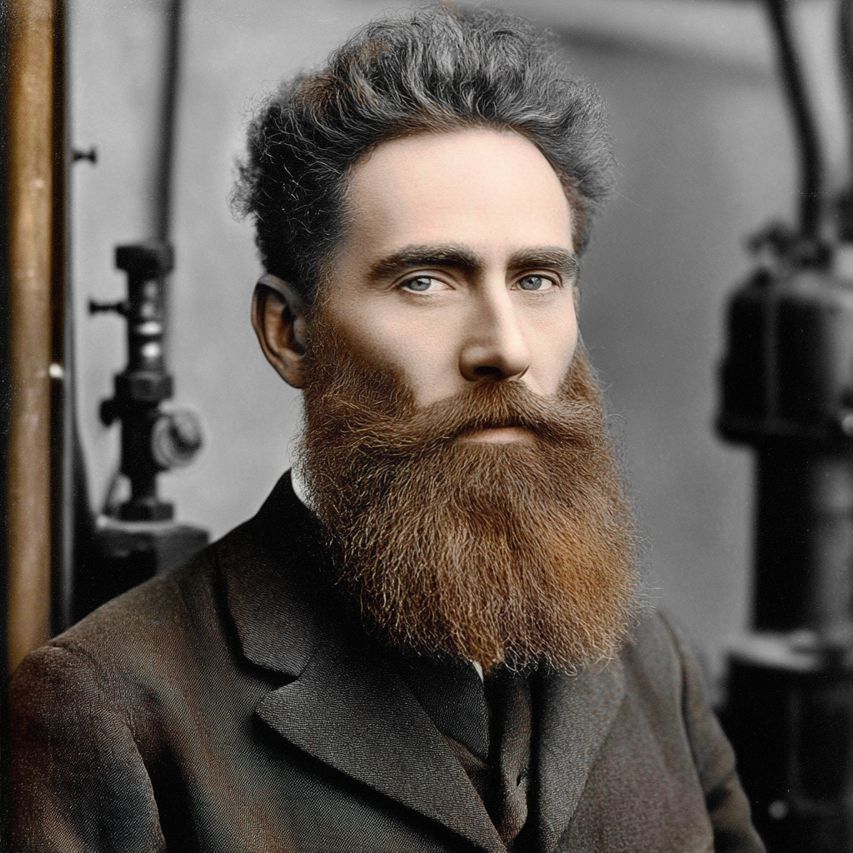
Wilhelm Conrad Röntgen was born on March 27, 1845, in Lennep, a town in the Rhine Province of Germany. His early education was somewhat unconventional, and he was even expelled from one school for refusing to name a fellow student involved in a prank. Despite this setback, his passion for science led him to the Federal Polytechnic Institute in Zurich, Switzerland, where he earned a degree in mechanical engineering. He later pursued his doctorate in physics at the University of Zurich, graduating in 1869.
Röntgen's academic career was marked by a steady progression through various prestigious institutions. He held positions at the University of Strasbourg, the University of Giessen, and finally, the University of Würzburg, where he would make his groundbreaking discovery. Before his work with X-rays, Röntgen was already a well-respected physicist, known for his meticulous experimental work. His research interests were broad, ranging from the specific heats of gases to the properties of crystals, even investigating the influence of pressure of the refractive indices of various fluids. It was during his tenure as Professor and Director of the Physical Institute at Würzburg that his focus turned towards cathode rays, a topic that would change his life, and the world.
The Accidental Discovery
The year was 1895. In his laboratory at the University of Würzburg, Röntgen was deeply engrossed in experiments involving cathode rays. He used a Crookes tube, an early type of vacuum tube, to generate these rays. The setup was relatively simple, but effective: a glass tube evacuated of air, with two electrodes at either end. When a high voltage was applied across the electrodes, a stream of electrons, the cathode rays, would flow from the cathode to the anode.
On the evening of November 8th, while working with the tube covered in black cardboard, he made a startling observation. A nearby screen coated with barium platinocyanide, a fluorescent material, was glowing faintly, even though the Crookes tube was completely covered. Röntgen, a meticulous and thorough scientist, was immediately intrigued. He realized that some unknown form of radiation was being emitted from the tube, passing through the cardboard, and causing the screen to fluoresce. He dubbed these mysterious rays "X-rays," using the mathematical symbol "X" to denote their unknown nature.
Driven by curiosity, Röntgen embarked on a series of experiments to investigate the properties of these new rays. He placed various objects between the tube and the screen, discovering that X-rays could penetrate many materials, including paper, wood, and even thin sheets of metal. He experimented with photographic plates, discovering that X-rays could expose them just like visible light. In one particularly famous experiment, he asked his wife, Anna Bertha, to place her hand in the path of the rays. The resulting image, showing the bones of her hand and her wedding ring, was the first X-ray image of a human body part. This iconic image quickly captured the public's imagination and provided a powerful demonstration of the potential of X-rays.
"On A New Kind of Rays" and the Immediate Impact
Röntgen meticulously documented his findings and, in late December 1895, submitted a paper titled "On A New Kind of Rays" to the Würzburg Physical-Medical Society. The news of his discovery spread like wildfire. Scientists around the world were eager to replicate his experiments and explore the properties of X-rays further. The speed at which this news was disseminated is truly remarkable, especially considering the lack of modern communication technologies.
The scientific community was initially both amazed and skeptical. However, the evidence was undeniable, and Röntgen's detailed descriptions allowed others to quickly reproduce his results. Within weeks, laboratories across Europe and the United States were experimenting with X-rays.
The public was equally fascinated. Newspapers and magazines were filled with stories about the "new photography" that could see through solid objects. While some were wary of this mysterious new force, most were captivated by its potential. Public demonstrations of X-ray equipment became popular attractions.
Perhaps the most significant immediate impact of Röntgen's discovery was in the field of medicine. Doctors quickly recognized the potential of X-rays for medical diagnosis. The ability to see inside the human body without surgery was revolutionary. Within months of Röntgen's publication, X-ray machines were being used in hospitals to locate fractures, diagnose diseases, and even guide surgical procedures. This development forever altered the course of medical practice and saved countless lives.
Röntgen's Legacy and the Connection to Radio
In 1901, Wilhelm Conrad Röntgen was awarded the first-ever Nobel Prize in Physics "in recognition of the extraordinary services he has rendered by the discovery of the remarkable 1 rays subsequently named after 2 him." He continued his research, but remained a modest and private individual, shunning the public attention that his discovery had brought. He passed away in 1923.
Now, how does all this relate to radio? While Röntgen didn't work directly with radio waves, his discovery was a crucial step in understanding the electromagnetic spectrum. X-rays, like radio waves, are a form of electromagnetic radiation. They are all fundamentally the same phenomenon: waves of oscillating electric and magnetic fields traveling at the speed of light. The only difference between them is their wavelength and frequency. X-rays have a much shorter wavelength and higher frequency than radio waves.
Röntgen's work, along with the earlier work of scientists like James Clerk Maxwell and Heinrich Hertz, helped to solidify the understanding of the electromagnetic spectrum as a continuous range of radiation, from very long radio waves to very short gamma rays. This unified understanding of electromagnetic phenomena was essential for the development of radio technology. Before radio waves could be harnessed for communication, scientists needed to understand their nature as part of this broader spectrum. It was research into the electromagnetic spectrum, building on the work of men like Maxwell, Hertz and Röntgen that would pave the way for Marconi's great breakthrough.
In the long term, the discovery of X-rays had a profound and lasting impact. It revolutionized medicine, leading to the development of radiography, radiation therapy, and other life-saving techniques. It also opened up new avenues of research in physics, materials science, and other fields, eventually leading to the development of technologies as diverse as airport security scanners and electron microscopes.
Conclusion
Wilhelm Conrad Röntgen's accidental discovery of X-rays was a pivotal moment in the history of science. His meticulous research and the rapid dissemination of his findings ushered in a new era of scientific exploration and medical advancement. While not directly involved in the development of radio, Röntgen's work on X-rays provided crucial insights into the nature of electromagnetic radiation, contributing to the foundation upon which radio technology was built. His story serves as a powerful reminder of the interconnectedness of scientific disciplines and the often-unpredictable nature of discovery. It is fitting that he should take his place among our Pioneers of Radio.
What do you think of Röntgen's story? Are there any other "Pioneers" you think deserve recognition? Let us know in the comments below!
Fore more information visit our online store or contact us and our team will be happy to assist you!