
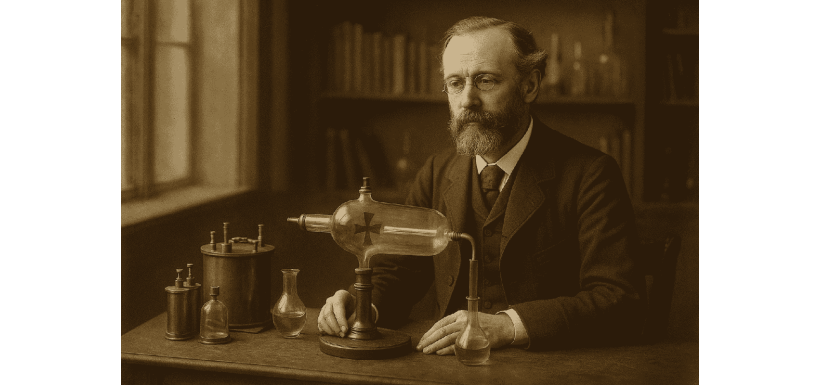
Before the triode valve could amplify a signal, before the cathode-ray tube could display a waveform, and even before the discovery of the electron itself, someone had to create a window into the strange world of electricity in a vacuum. That man was William Crookes, a brilliant and somewhat eccentric British chemist and physicist. Today in our 'Pioneers of Radio' series, we meet the inventor whose beautiful, mesmerising glass tubes not only captivated Victorian audiences but also became the essential tools that led directly to the discovery of the electron and X-rays, paving the way for the entire electronic age. His work is a perfect example of how pure scientific curiosity can lead to the most profound technological revolutions.
Early Life and a Passion for Chemistry
William Crookes was born in London in 1832. He didn't follow a traditional university path; instead, he studied chemistry at the Royal College of Chemistry and quickly developed into a first-rate experimentalist. He was a meticulous and gifted chemist, and his early career was marked by a significant discovery: in 1861, while studying the residues from a sulphuric acid plant, he discovered a new chemical element, which he named thallium, from the Greek thallos, meaning a "green shoot," after the brilliant green line in its spectrum.
This discovery made his name in the scientific community and showcased his incredible skill in the laboratory. He also invented the radiometer – that little glass bulb with spinning vanes you still see in science museums – which rotates when exposed to light. But it was his later work, when he turned his attention from chemistry to physics, that would have the most profound impact on the future of technology. He became fascinated by the strange phenomena that occurred when high-voltage electricity was passed through a glass tube from which most of the air had been removed.
The Crookes Tube: A Window into a New World
In the mid-19th century, scientists were deeply intrigued by what happened when you passed an electric current through a vacuum. Building on the work of earlier physicists like Julius Plücker, Crookes dedicated himself to perfecting the vacuum tube. The challenge was immense. Creating a very high vacuum was incredibly difficult with the pumps of the era. It took immense patience and skill, but Crookes succeeded in producing tubes with a much higher vacuum than his predecessors.
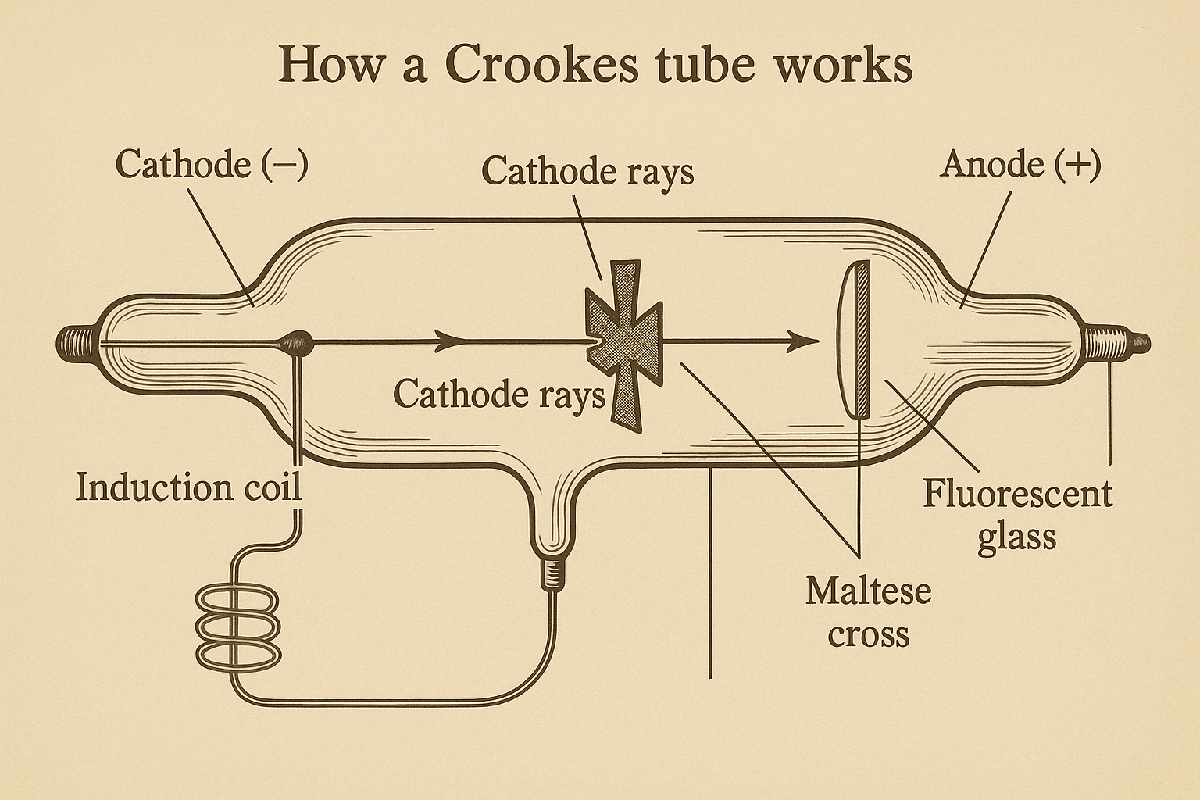
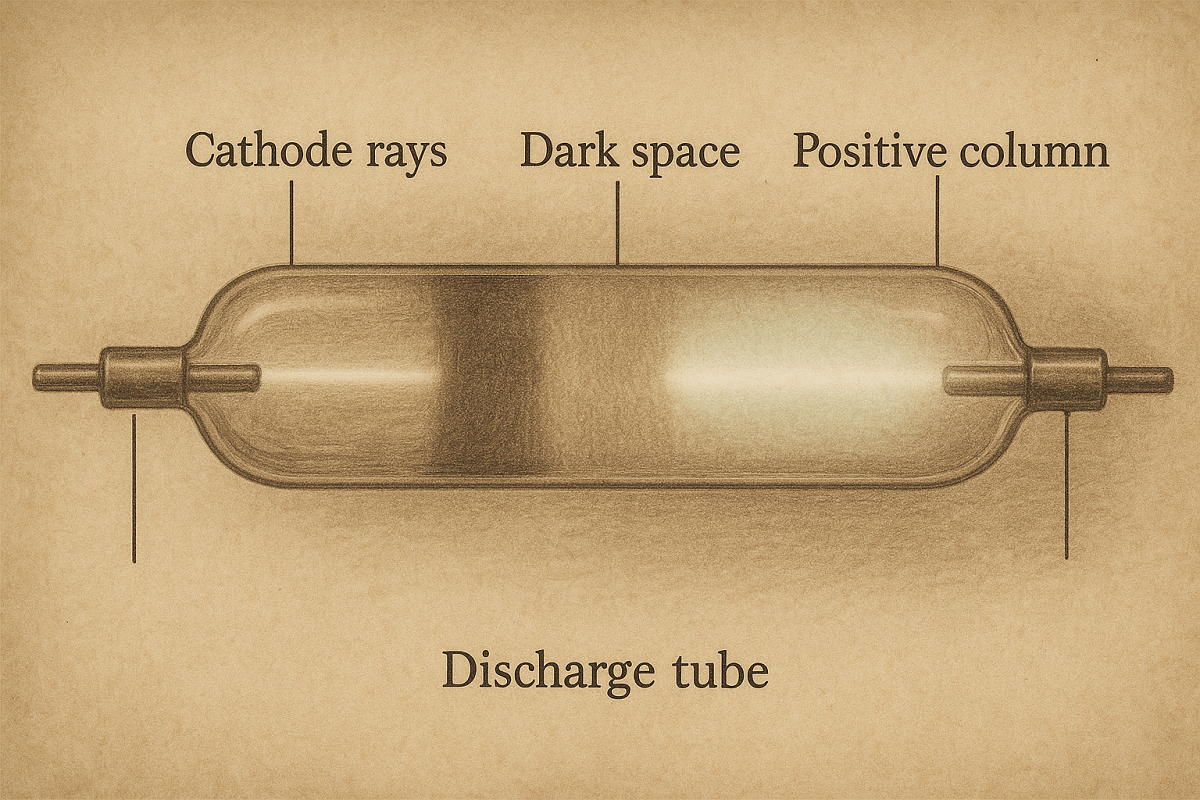
The result was the device that now bears his name: the Crookes tube. It was a simple but elegant piece of apparatus: a sealed glass tube with two electrodes (a cathode and an anode) and an inlet that allowed most of the air to be pumped out. When a high voltage was applied across the electrodes, something extraordinary happened. The remaining gas inside the tube would glow with an eerie light, and mysterious rays would emanate from the cathode (the negative electrode).
Crookes was a master of demonstration, and he designed a series of ingenious tubes to investigate the properties of these "cathode rays":
- The Shadow Effect: He placed a metal object, often in the shape of a Maltese cross, inside the tube. A sharp shadow of the cross would appear on the glowing glass at the far end of the tube, proving that the rays travelled in straight lines from the cathode. When I first saw a demonstration of this, I remember being completely mesmerised. It's such a simple and beautiful way to show the properties of something completely invisible.
- The Paddle Wheel: He placed a tiny, lightweight paddle wheel in the path of the rays. The rays would strike the vanes of the wheel, causing it to spin and travel down a set of rails. This seemed to suggest that the rays were composed of particles that had mass and momentum.
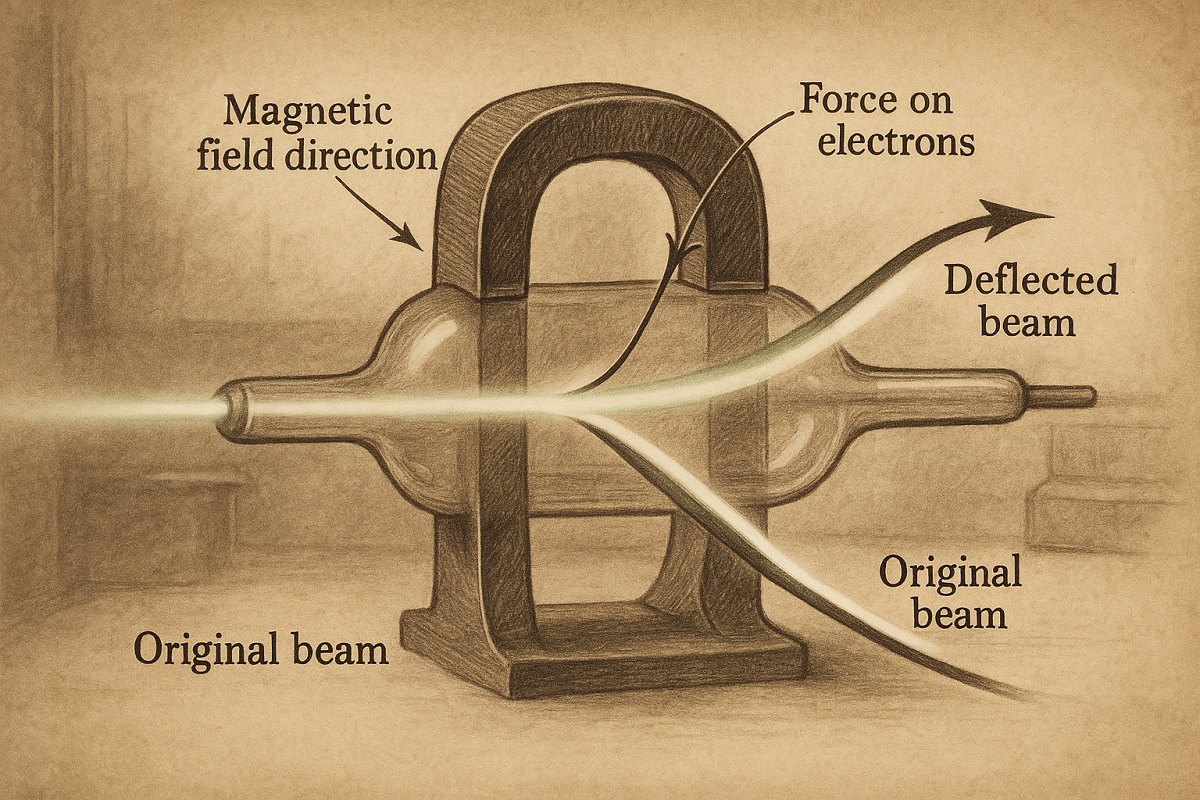
- The Magnetic Deflection: He showed that a magnet held near the tube would bend or deflect the path of the rays, demonstrating that they carried a negative electrical charge.
Based on these stunning experiments, Crookes came to a bold conclusion. He believed he had discovered a "fourth state of matter," which he called "radiant matter." He theorised that in his high-vacuum tubes, the gas was so rarefied that its molecules could travel in straight lines without colliding with each other, behaving as a stream of charged particles. He was remarkably close to the truth.
A Curious Detour: The World of Spiritualism
Now, here's a part of Crookes's story that you won't find in many physics textbooks, and it makes him an even more fascinating character. Alongside his rigorous scientific work, Crookes was deeply involved in spiritualism and psychical research. This was a hugely popular movement in the Victorian era, and Crookes, ever the experimentalist, decided to investigate its claims scientifically.
He conducted séances with famous mediums of the day, like Florence Cook and Daniel Dunglas Home, and he became convinced that he had witnessed genuine psychic phenomena, including levitation and the materialisation of spirits. He published his findings and became a prominent, if controversial, figure in the Society for Psychical Research.
His involvement in spiritualism undoubtedly damaged his reputation in the eyes of some of his more conservative scientific colleagues. They couldn't reconcile his meticulous laboratory work with his seemingly credulous belief in the supernatural. But for Crookes, there was no contradiction. He believed he was simply applying the scientific method to a new and unexplained set of phenomena. It's a fascinating glimpse into the mind of a complex man, a reminder that even the greatest scientists can have unconventional beliefs.
Paving the Way for Giants: The Unintended Legacy
While Crookes's own theory of "radiant matter" was soon to be superseded, his practical invention – the Crookes tube – became one of the most important scientific instruments of the late 19th century. He had, perhaps unwittingly, created the perfect tool for others to make even more profound discoveries.
In 1895, the German physicist Wilhelm Röntgen was experimenting with a Crookes tube when he noticed a mysterious glow coming from a nearby screen coated with fluorescent material. He had discovered a new, penetrating form of radiation, which he called X-rays. His discovery, which earned him the very first Nobel Prize in Physics, was made possible by Crookes's high-vacuum tube.
Just two years later, in 1897, the British physicist J.J. Thomson used a modified Crookes tube to conduct a series of brilliant experiments. He was able to conclusively prove that cathode rays were not a form of radiant matter, but were in fact composed of tiny, negatively charged particles – a particle that was almost 2,000 times lighter than the lightest known atom, hydrogen. He had discovered the electron.
It's an incredible historical sequence. Crookes built the window, Röntgen looked through it and saw something unexpected, and Thomson looked through it and discovered a fundamental building block of the universe.
Synergies with Ham Radio: The Ancestor of All Valves
So, what does a Victorian physicist and his glowing glass tubes have to do with ham radio? Everything!
- The Ancestor of the Valve: The Crookes tube is the direct ancestor of every vacuum tube, or "valve," that followed. John Ambrose Fleming's diode and Lee de Forest's triode were direct descendants of Crookes's experimental tubes. Without the ability to create a high vacuum and control a stream of electrons, the amplification that made radio broadcasting practical would have been impossible.
- The Cathode-Ray Tube (CRT): The Crookes tube is also the direct ancestor of the CRT, the technology that powered oscilloscopes, radar displays, and old television sets for decades. Every ham who has ever used a 'scope to check a signal or admired the waterfall display on a spectrum analyser is using a technology that can trace its lineage back to Crookes's lab.
- A Shared Spirit of Experimentation: Crookes's approach – building his own apparatus, meticulously observing the results, and being open to unexpected phenomena – is the very embodiment of the ham radio spirit. He was a builder, a tinkerer, and a curious explorer, just like so many radio amateurs today.
Conclusion: The Man Who Lit the Way
William Crookes was a brilliant, multifaceted, and sometimes eccentric figure. He was a world-class chemist, a groundbreaking physicist, and a dedicated spiritualist. His legacy in the world of radio and electronics is profound, not because of a single invention that he commercialised, but because he created the essential tool that allowed others to unlock the secrets of the subatomic world.
He made the invisible visible. His beautiful, glowing tubes not only revealed the existence of cathode rays but also provided the means for discovering the electron and X-rays, two of the most important scientific breakthroughs of the modern era. He was a true pioneer, a man whose curiosity lit the way for the electronic age.
What are your thoughts on William Crookes? How do you view his controversial interest in spiritualism in the context of his scientific achievements? Let me know in the comments below! And, as always, if you have suggestions for other "Pioneers of Radio" that you'd like to see featured, don't hesitate to share.
For more information please visit our online store or alternatively contact us and our team will be happy to assist you!