
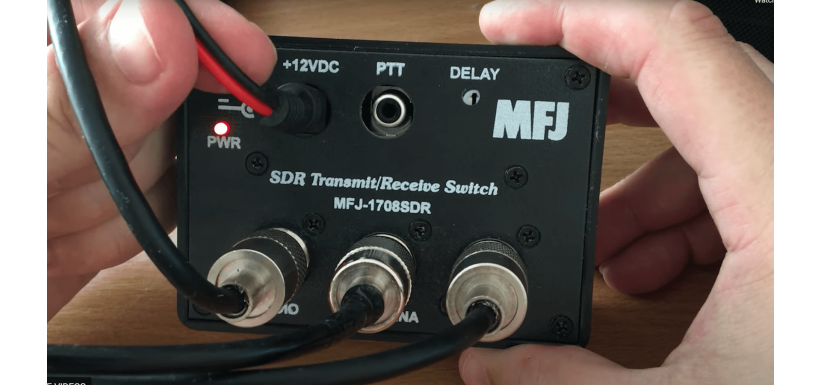
The MFJ-1708SDR is an antenna switch that allows you to use an SDR receiver as a pan-adapter for almost any radio.
A pan-adapter allows you to see all radio stations currently transmitting across an entire band and is useful if you are on HF.
Most radios only have one receiver, so whilst the radio is sweeping for stations, you can’t actually listen to the channel.
Rather than purchasing a new radio that allows you to listen and sweep, you can fit the MFJ-1708SDR box into your current rig. It's a superb option to convert your receiver into a pan-adapter for an affordable price.
Here, we walk you through the steps for using the MFJ 1708SDR and connecting it to the SDR antenna.
What’s in the Box
The antenna switch is a compact box. The device has three SO239 connections for coax cables labelled ‘Radio’, ‘Antenna’ and ‘SDR’. In the top left-hand corner is a connection for the power source.
There is a power cord and a slip of paper in the box, which states that the manual is online ready to view or print.
Setting Up the MFJ-1708 SDR
Using the MFJ-1708 SDR is relatively straightforward:
-
First, attach your primary HF antenna to the central output labelled ‘Antenna’.
-
Next, fit the cable labelled ‘Radio’ to the HF port on your radio. The SDR port is for your RSP link to your laptop or PC.
-
Finally, the unit will need powering with a port on the top left-hand side of the box. Use the cord provided to charge it. A little red light will come on when you have power.
RF Sensing and Protection for the SDR
The MFJ-1708SDR connects the SDR antenna whilst your transceiver is receiving, then grounds the SDR antenna whilst transmitting. It does so through RF sensing technology.
RF sensing means when you transmit on any connected radio, the centre pin of the SDR receiver stays grounded. It protects the SDR receiver whilst you are transmitting. The centre pin of the antenna connection in receive mode is going to the radio and the SDR simultaneously.
When you press transmit, the antenna grounds the SDR and allows the output to transmit from the radio through to the antenna.
It’s a failsafe way to enhance your radio experience and protect your SDR.
The Delay
The delay is for how long the device will keep the SDR muted after you stop transmitting. It is an adjustable feature.
Push-To-Talk Connection
You can connect the PTT ground directly to the back of your radio. When you press the PTT button, it grounds the radio connection to control it rather than using the RF sensor.
The MFJ1708-SDR initiates the switching using the PTT signal. However, as a fail-safe measure, the in-built RF sense circuitry will also provide some security if the PTT connection is lost.
How to Listen
There are two options: listen to the audio via the SDR software or mute the audio on the software and listen to the radio instead.
Multiple listening options will allow you to take advantage of extra features on your radio, like noise processing.
Conclusion
In summary the MFJ-1708SDR allows reception of two receivers with one antenna. This allows you to monitor a frequency on your transceiver whilst tuning your SDR receiver to spot activity on other frequencies. When used in conjunction with SDR radios like the Airspy HF Plus Discovery you can monitor all HF bands ensuring you don’t miss any DX while chatting away.
RF sensing gives instant switching and ensures maximum protection of your SDR receiver when you are transmitting with your transceiver
Overall, the MFJ-1708SDR is an inexpensive way of obtaining a pan-adaptor. It makes listening to your standard radio easier whilst scanning for additional channels. Plus, it features other benefits like RF sensing technology to protect your SDR.
Ready to enhance your listening and sweeping experience? Pick up an MFJ 1708SDR from Moonraker today.
Shop Now