
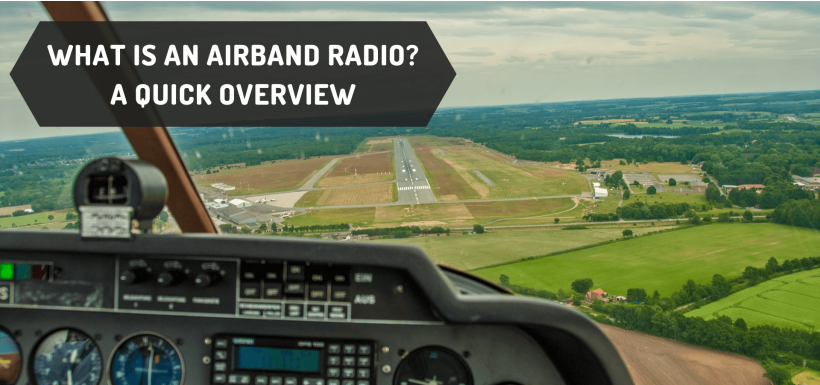
Despite the seemingly endless supply of new technologies relating to communication, many industries continue to rely on the radio as a tried and tested form of communication. One of those industries is aerospace.
The airband radio continues to play a fundamental, if quiet, role in our lives. Its use is prevalent amongst pilots, but it also impacts civilians who might never even lay their eyes on this type of radio.
Keep reading to learn about airband radio in this quick guide, including licensing rules and the approvals you need to get started using one.
What Is an Airband Radio?
Airband radio, or aircraft or aviation band radio, refers to a specific selection of frequencies within the VHF radio spectrum expressly set aside for use by licensed pilots and air traffic controllers in avionics environments.
Frequencies for airband radio typically fall between the 108 - 137 MHz range.
What Is Airband Radio Used For?
Airband radio is exclusively used for aviation purposes and allows direct two-way communication and navigation. The VHF frequencies and channels used for airband differ utterly from what CB radio users communicate with on the ground.
The International Civil Aviation Organisation has specifically allotted these channels for use in avionics. In emergency cases, airband radios also have an emergency frequency of 121.5 MHz, commonly referred to as the International Air Distress (IAD).
What Types of Airband Radio Are Available?
There are broadly three airband radios: handheld, panel-mounted, and ground station. They roughly do the same thing but can be used in different circumstances.
Handheld
As you can probably guess, handheld airband radios are portable and small enough to be carried. They usually have a shorter range than both panel-mounted or ground station radios and often come with around 6 watts of power.
Panel-Mounted
Panel-mounted radios are typically found on aircraft and act in much the same way as a radio mounted in a vehicle on the ground. They are more powerful than handheld models, most using around 8 watts.
Air-to-air communication is much better than ground-to-air because VHF works primarily through a line of sight.
Ground Station
You'll probably be able to guess where the ground station typically resides, but this can refer to a radio on a desk in an airport and one in a vehicle serving a similar purpose.
These radios are sometimes comparable to panel-mounted versions. That said, plenty pack more of a punch.
What Licence Do You Need For Airband Radios?
Licensing for an airband radio can get a little confusing, and it depends on your intended use. Due to the obvious hazard of interfering with aviation communication, it is illegal in most countries around the world to operate an airband radio without a licence.
It is illegal in the UK to listen in on airband radio frequencies and certainly firmly against the law to communicate on them if you aren't involved in aviation. However, owning an airband radio is entirely legal.
Confused? The critical point to remember is that these radios can communicate on the ground also. It is perfectly within the confines of the law, so as long as you don't stray into the aviation frequencies, you're OK.
For those involved in aviation, you will require a licence to use an airband radio, with the Flight Radio Telephony Operator's Licence the most common. You will need to pass the PPL Communications theoretical exam, a radiotelephony practical test, and prove that you have English proficiency to levels 4, 5 or 6.
This licence is required for anybody involved in aviation communication, ranging from pilots to air traffic control staff. Two exceptions exist, with glider pilots who operate on nominated glider frequencies and student pilots under the supervision of an instructor, both exempt from airband licence requirements.
What Else Do You Need to Use Airband Radio?
An approved licence is perhaps the most important, but you must take several other steps before you are legally ready to use airband radios.
First, you’ll need the Civil Aviation Authority or EASA to check and approve your equipment.
The Civil Aviation Authority Approved Maintenance Organisation must approve the radio installation. Further, the Wireless Telegraphy Act Radio Licence covers the installation and legitimate use of the radio. The CAA will issue this on behalf of the Office of Communications.
Once you have all of these steps completed and your licence approved and ratified, you are ready to go and can freely and legally use your equipment.
In terms of equipment, you’ll need a few items to create your setup, depending on your intended use. If you just wish to listen and own it, you might only need a scanner to access VHF frequencies designated for aircraft bands. Pilots and other operations will need a scanner and the radio itself. It’s up to you to decide whether you need a handheld, mounted or ground station.
What Are Airband Radio Etiquettes?
As with other forms of radio communication, enforcing rules and laws can be tricky because it's virtually impossible to track who is saying what, especially when people want to conceal information. However, there is plenty of etiquette that most, if not all, tend to stick by when communicating on airband frequencies.
Any communication should be limited to messages concerning flight safety or flight regularity. Anything regarding personal information, public correspondence, passenger service, or convenience is strictly prohibited.
While it may be difficult to prosecute infractions, it's certainly not impossible, and it's not unheard of for the CAA to revoke licences because of repeated infractions.
Got Questions? Contact Moonraker Today!
If you're looking to dip your toes into the exciting world of aviation, then you will need to think about an airband device at some point. We know this can be a complex subject matter that deals with a hugely important area of expertise, so if you have any questions or concerns about airband radios, don't hesitate to contact Moonraker. We'll be happy to walk you through everything you need to know and help you find the perfect radio to match your needs and situation.