
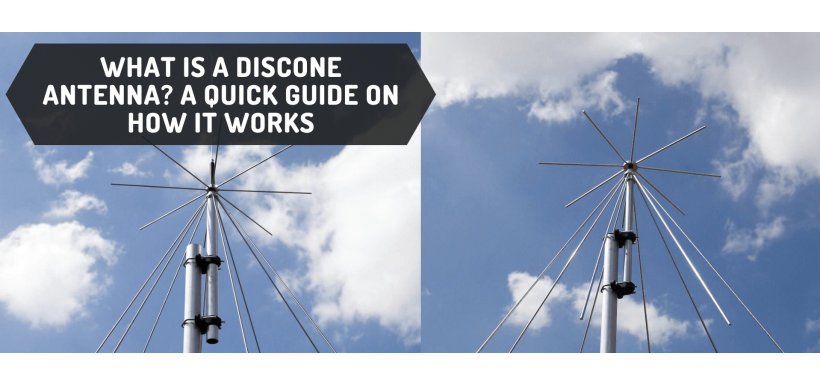
Discone antennas have wideband coverage, so they have always been an attractive option for amateur radio users and home scanner hobbyists. Plus, discone antennas are unobtrusive; with a simple construction, you could even consider building your own.
Coverage is vast and far-reaching so that you can pick up amateur radio, air traffic control, and public safety. These antennas are suitable for indoor and outdoor use.
If you haven’t used a discone antenna before, then find out what you’ve been missing out on and whether one would enhance your listening experience.
What Is a Discone Antenna?
A discone antenna is a type of biconical antenna which replaces one of the standard cones with a disc. It’s arranged so that the cone sits underneath the disc. There’s an insulator between the cone and disc, which is essential for the antenna to function properly.
More commonly used for receiving rather than transmitting, the discone first appeared towards the end of the Second World War and received its patent in 1945. It was intended for aircraft use and was immediately adopted by the military.
Discone antennas are ideal for UHF and VHF applications where the signal is close to ground level, allowing listeners to pick up transmissions from a great distance away.
How Does a Discone Antenna Work?
There’s a difference between a ‘true’ discone antenna and the version most amateur enthusiasts and hobbyists use.
A true discone antenna has a solid metal disk on top of a solid metal cone. This covers two octaves of bandwidth. The usual hobbyist version lacks a solid metal body; instead, several metal rods create an open cone with the disk placed on top.
This simple construction means that some amateur radio operators build their own antenna. However, the size of the components must be within a certain ratio for the device to work properly.
This antenna is omnidirectional and works by the cone and circular disk, creating the energy of a much larger round object, the type you might see on top of a tall building or tower. It’s pretty ingenious!
The discone is known as a resonant antenna. It works because feeder energy meets the RF antenna and spreads over the cone's surface. This power can be directed towards or away from objects depending on the distance.
Most experts recommend an elevated mount to avoid interference with other structures, including trees, but before you get carried away, there are rules about taking down mature trees, and you might need planning permission to avoid committing an offense.
There may also be other regulations about sitting antenna on your property depending upon where you live.
What Are Discone Antenna Applications?
Discone antennas are ideal for UHF and VHF applications, including PMR, the fire service and also radio astronomy. They can even help track geological changes on the earth’s surface and locate underground resources.
Remember, that whilst it’s legal to listen to many radio transmissions, you should always bear in mind that they must comply with the law and any licensing requirements set by Ofcom when accessing radio frequencies.
What Are The Pros and Cons of Using Discone Antenna?
Pros
-
The discone antenna is one of the few wideband omnidirectional antennas available.
-
The vertical radiation pattern is extremely narrow, so antennas are most sensitive to distant signals rather than a nearby RF source, ideal for the hobbyist looking for optimal range.
-
A discone antenna can receive a wide range of frequencies from all directions because it is omnidirectional – it doesn’t need to be pointed towards the source of the signal.
-
A discone antenna can work indoors, although its reception will be weaker, diminished by passing through the walls of the building.
-
The design makes installation easy, and it doesn’t require any external fittings compared to a monopole tower antenna.
-
There is no need for a ground connection
Cons
-
Discone antennas are not of any use for transmitting, just for receiving
-
The wide draw of the antenna is offset by the fact that you’ll almost certainly bring a lot of interference from the many different frequencies.
-
The vertical radiation pattern is very narrow, making a discone antenna more sensitive to distant signals than those from a nearby source.
-
Discone antennas are typically big and heavy, so they are more suitable for outdoor use and are not portable.
-
These antennas are more sensitive to higher frequencies, so they tend to pick up these more than lower ones.
Are Discone Antennas Any Good?
Discone antennas are super good because they offer a wide spectrum of distant transmissions, so they’re ideal for a user who wants wide bandwidth reception. However, they’re often overlooked as a piece of kit just because they cannot transmit.
Discone antennas are also suitable for indoor use, but they have drawbacks.
Discone antennas can be large and prone to interference, which is the disadvantage of harvesting so many distant signals and frequencies. However, the construction concept is simple, and the price point won’t break the bank.
Got Questions? Contact Moonraker Today!
If you’re interested in learning more about our range of discone antennas, get in touch with us here at Moonraker.
We can help you with the finer points of Discone antennas and other radio equipment to enhance your favourite hobby. We stock all the leading brands and partner competitive pricing with impartial guidance and professional advice.