
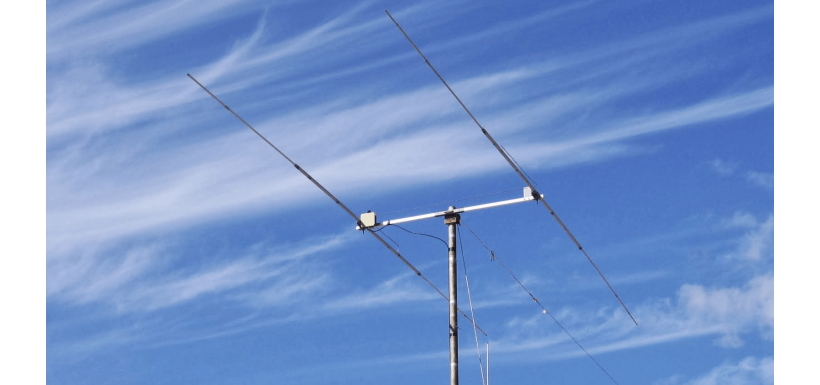
The name HB9CV may not be familiar to you, but chances are you've seen countless in your lifetime. Now and again, a design or piece of equipment defies our modern desire to upgrade simply because it’s so effective.
This antenna has been in use since its invention in 1954. While many more complex antennas have come out since then, its reliability and performance have made it a mainstay in the ham and amateur radio community. So what is this best-kept secret, and what can you do with it? Keep reading to find out.
What Is an HB9CV Antenna?
The HB9CV is the most popular directional antenna in the world, invented by Swiss amateur radio enthusiast Rudolf Baumgartner in the 1950s. He designed a reasonably simple antenna with two dipoles. In part because of its simplicity, it remains hugely popular, especially among ham radio users. It’s more prevalent even than the three and four-element versions that have appeared since.
It is generally used for communication between two points over a medium range with ham radios and is arranged in an H shape when constructed. Many HB9CVs are portable or are attached to a permanent point, which helps to gain better coverage.
What Is the Performance of the HB9CV Antenna?
Considering it has remained a mainstay across Europe for nearly 65 years since its introduction, it'll be no surprise to hear that the performance of the HB9CV is excellent for what it is. Its low price, portability, clear signal, and ability to pick up low-frequency transmissions ensure this antenna is still going strong after all these years.
There are a few variables that can, however, affect overall performance. The first is the length of the beams, which are the two metal rods that make up the H shape. The shortest you'll generally see is 50 cm, with the longest stretching to several metres. Typically, the longer the beams, the better the coverage, but even a small HB9CV antenna placed at the highest point around can receive and send signals between 50 and 70 miles away.
It tends to have a gain of 3.6 to 6.5dBd, although this is extendable through modifications. Its coverage can go up substantially with adjustments or different models.
Advantages of HB9CV Antenna
The HB9CV hasn’t remained the most popular directional antenna for all these decades without having numerous advantages, so let's dive in and look at what continues to make it so popular after all these years.
Easy to Assemble & Use
One of the best aspects of the HB9CV is how easy it is to assemble and use. You can put the antenna together in a matter of minutes, and you can easily be chatting away in less than 10 minutes if you have everything set up and ready to go.
Portable
The portability of the HB9CV has earned it the nickname of being a hand-held antenna, and some models come fit for that purpose with an ergonomic grip. You can take it out into the field to pick up a signal without struggling to hold onto it.
Many portable versions of the HB9CV fold down — or quickly disassemble — meaning they’re easy to store away quickly after use. Perfect for trips out and great if you're using public transport.
Good with Low Signals
Where the HB9CV shines in performance is its ability to pick up low signals. Having two elements picking up signals rather than just one means it has a handy boost compared with more simplified models. Although, you should bear in mind that the two beams need to be a certain distance apart, or they begin to overlap and cause interference.
Easily Adjustable & Manoeuvrable
The whole point of a portable HB9CV is that it is easily manoeuvrable. As any ham radio enthusiast will tell you, the ability to move an antenna a metre here or a metre there or even invert the elements can make all the difference.
It's common for people to modify their HB9CV antennas by shortening or lengthening the beams. Some ham radio users will build their own from scratch. The simple design is that easy to replicate.
Limitations of HB9CV Antenna
While the HB9CV is an excellent antenna and packs a pretty sizable punch for what it is, it doesn't come without a few drawbacks.
Weather Damage
An HB9CV affixed to a roof will have a rough time if a big storm occurs. Like many antennas, its top-heavy design at the end of a long boom makes it particularly susceptible to damage in high winds, and it's probably a good idea to take it down if you know something big is approaching.
Weather damage is not an issue with portable models. It’s another reason the easy assembly and disassembly is an advantage.
Limited Coverage
While the HB9CV certainly put out an excellent performance for what it is, in terms of cost and design, it is limited compared to something more substantial. These are very different antennas and will cost much more to erect, but it depends on how you want to use your ham radio.
Got Questions? Contact Moonraker Today!
It’s hard to think of many other designs that have stayed the same over 60 decades and remain hugely popular. The success and longevity of the HB9CV are mind-blowing, and its straightforward design has proven reliable time and time again. This antenna, designed even before humans went into space, continues to set the benchmark.
If you're just moving into amateur radio communication, the HB9CV is a great place to start. Its versatility, low cost, and high performance mean it's the perfect entry point into this exciting world without splurging on something expensive and difficult to assemble. Keep it simple and head over to Moonraker for the best HB9CVs on the market and much more.