
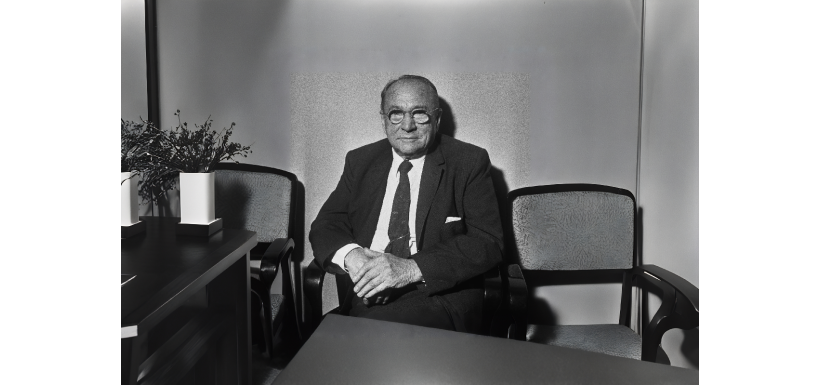
Imagine a world without television. No nightly news, no gripping dramas, no live sports broadcasts beamed directly into your living room. It's almost unthinkable today, isn't it? We're so accustomed to the constant flow of visual information that it's easy to forget the decades of painstaking research and innovation that made it all possible. Before television became the ubiquitous medium it is now, someone had to figure out how to capture and display images electronically. And one of the key figures in that pioneering effort was a Russian-American engineer named Vladimir K. Zworykin. As we continue our "Pioneers of Radio" series, we'll explore the story of this visionary inventor, whose work, while primarily focused on television, was deeply intertwined with the foundations of radio technology and forever changed the way we see the world.
Early Life and Education in Russia: A Foundation in Physics
Vladimir Kosma Zworykin was born in Murom, Russia, in 1888, into a relatively prosperous merchant family. From a young age, he displayed a keen interest in science and technology. He pursued this passion at the St. Petersburg Institute of Technology, where he studied electrical engineering. It was here that he encountered Boris Rosing, a professor who was conducting pioneering experiments in what he called "electrical telescopy."
Rosing's work was focused on using cathode-ray tubes (CRTs) to display images. CRTs, which were also used in oscilloscopes and other scientific instruments, generate a focused beam of electrons that can be deflected by electric or magnetic fields. Rosing's idea was to use a CRT to display an image, but his system for capturing the image was still mechanical, using a rotating mirror drum.
Zworykin was deeply impressed by Rosing's experiments and became his student assistant. This early exposure to the challenges and possibilities of electronic image transmission would profoundly shape his future career. He learned firsthand about the intricacies of vacuum tubes, electron beams, and the challenges of converting light into electrical signals.
During World War I, Zworykin served in the Russian Signal Corps, gaining practical experience with radio communication. This further solidified his understanding of the broader field of electronics and wireless technology.
Immigration to the US and Early Work at Westinghouse: A New Beginning
The Russian Revolution of 1917 and the ensuing civil war disrupted Zworykin's life and career. Like many other Russian intellectuals and professionals, he decided to emigrate to the United States, arriving in 1919.
He initially found work at the Westinghouse Electric Corporation in Pittsburgh. While at Westinghouse, he continued to pursue his interest in television, although his ideas were met with limited enthusiasm from his superiors. The prevailing view at the time was that mechanical television systems, like the one being developed by John Logie Baird, were the more promising approach.
Nevertheless, Zworykin persevered, and in 1923, he filed a patent application for an all-electronic television system. The key component of this system was a new type of camera tube that he called the iconoscope. This early iconoscope, however, was not yet a practical device. It lacked the sensitivity and resolution needed for a viable television system. It was a promising concept, but it needed further development.
RCA and the Birth of Electronic Television: Resources and a Vision
In 1929, Zworykin had a fateful meeting with David Sarnoff, the ambitious and visionary leader of the Radio Corporation of America (RCA). Sarnoff, who had risen from humble beginnings to become a dominant figure in the radio industry, was convinced that television was the next big thing. He was looking for a way to make electronic television a reality, and he saw in Zworykin the potential to achieve that goal.
Sarnoff offered Zworykin a position at RCA, providing him with the resources, the engineering team, and the financial backing he needed to fully develop his electronic television system. It was an opportunity Zworykin couldn't refuse.
At RCA, Zworykin focused on refining the iconoscope and developing a companion picture tube, which he called the kinescope. These two inventions were the crucial breakthroughs that made all-electronic television practical.
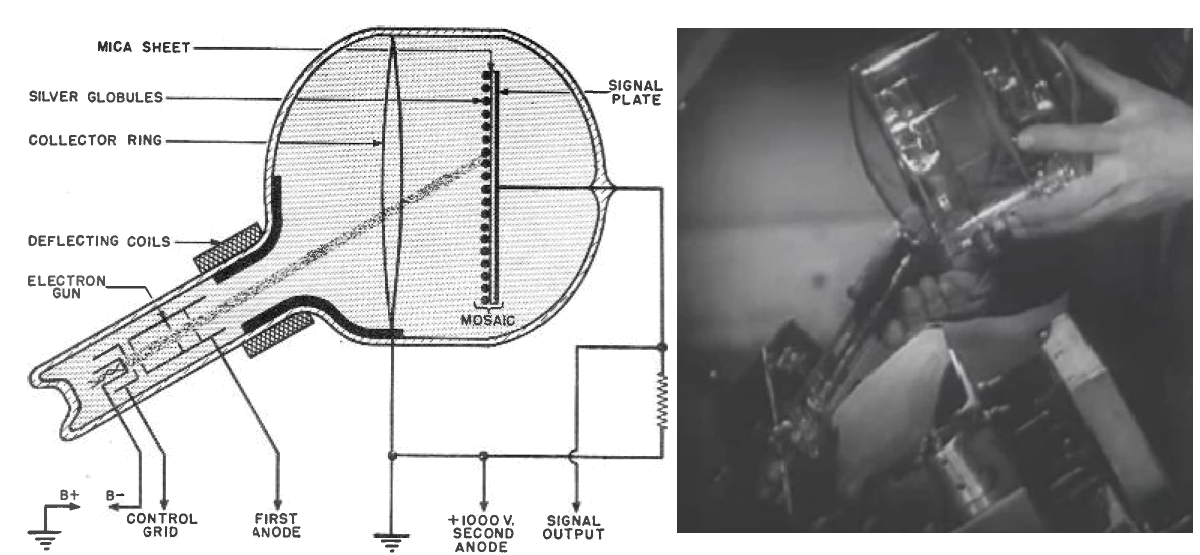
Image: Diagram and Iconoscope from a TV Camera (Source)
The iconoscope was a revolutionary device. It was the first electronic camera tube that could convert a visual image into an electrical signal with sufficient sensitivity and resolution for television broadcasting. Here's how it worked, in simplified terms:
- Light to Charge: The image to be televised was focused onto a special plate inside the iconoscope. This plate was covered with a mosaic of tiny, light-sensitive elements (essentially, miniature photoelectric cells). When light struck these elements, they emitted electrons, creating a pattern of electrical charges that corresponded to the light and dark areas of the image.
- Electron Beam Scanning: An electron beam, generated by an electron gun within the tube, was systematically scanned across the mosaic plate.
- Signal Generation: As the electron beam scanned the plate, it neutralized the electrical charges on the photosensitive elements. This caused a varying electrical current to flow, creating the video signal that represented the image.
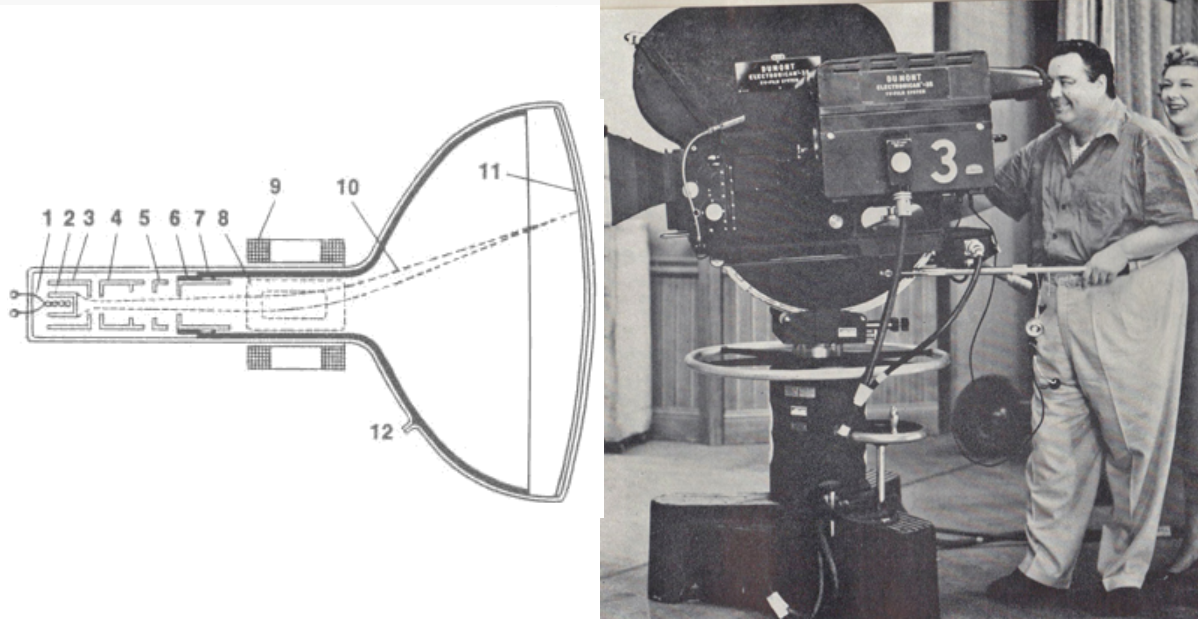
The kinescope, on the other hand, was the picture tube in the television receiver. It was essentially a cathode-ray tube, similar in principle to the tubes used in oscilloscopes. Here's how it worked:
- Electron Beam: An electron gun at the back of the tube generated a focused beam of electrons.
- Deflection Coils: Electromagnetic coils surrounding the neck of the tube were used to deflect the electron beam, causing it to scan across the screen line by line, just like in the iconoscope.
- Phosphor Screen: The inside of the screen was coated with phosphor, a material that emits light when struck by electrons.
- Image Reproduction: The incoming video signal from the iconoscope (or, more accurately, from a television transmitter that had received the signal from an iconoscope) was used to modulate the intensity of the electron beam. As the beam scanned across the screen, it caused the phosphor to glow with varying brightness, recreating the original image.
Zworykin's iconoscope and kinescope, working together, formed a complete electronic television system. It was a far cry from the clunky mechanical systems of the past. It offered the potential for higher resolution, flicker-free images, and a much more compact and reliable design.
RCA began demonstrating Zworykin's system in the late 1920s and early 1930s, generating considerable excitement. However, it's important to note that the development of electronic television was a collaborative effort, with contributions from many inventors and engineers. Philo Farnsworth, for example, was developing his own electronic television system independently, and a lengthy patent battle ensued between Farnsworth and RCA (which we covered in a previous post!).
World War II, the Electron Microscope, and Later Work
The development of commercial television was put on hold during World War II, as resources were diverted to the war effort. Zworykin, like many other scientists and engineers, contributed his expertise to military research. He worked on developing infrared imaging devices, such as the "sniperscope" and "snooperscope," which allowed soldiers to see in the dark. He also contributed to the development of guided missiles.
Beyond his work on television, Zworykin made significant contributions to the development of the electron microscope. The electron microscope, which uses beams of electrons instead of light to create images, allows for much higher magnification and resolution than traditional optical microscopes. Zworykin's expertise in electron optics, gained through his television research, was directly applicable to this field.
In his later years, Zworykin became interested in medical electronics, exploring the use of television technology for medical diagnosis and research. He envisioned using miniature television cameras to view internal organs and using computers to analyze medical images.
Connections to Radio and the Electromagnetic Spectrum
Although Zworykin is primarily known for his work on television, his contributions were deeply intertwined with the foundations of radio technology. Here's why:
- Vacuum Tubes: Both early radio and early television relied heavily on vacuum tubes. De Forest's Audion, the first practical amplifier, was essential for both technologies. Zworykin's work at Westinghouse and RCA involved improving vacuum tubes, making them more reliable and efficient.
- Signal Transmission and Reception: Both radio and television involve the transmission and reception of electromagnetic waves. The principles of modulation (encoding information onto a carrier wave), amplification (boosting the signal strength), and demodulation (extracting the information from the carrier wave) are fundamental to both technologies.
- Electron Optics: Zworykin's expertise in manipulating electron beams, which was crucial for his television inventions, was also relevant to certain types of radio tubes, such as klystrons and magnetrons, used in high-frequency radio and radar systems.
- Shared Infrastructure: Early television broadcasts often used existing radio infrastructure, such as transmitters and antennas. The development of television also spurred further advancements in electronics, which benefited radio technology as well.
In essence, radio and television are two sides of the same coin, both relying on the principles of electromagnetism and electronic signal processing. Zworykin's work, while focused on the visual aspect of communication, was deeply rooted in the same scientific and engineering foundations as radio.
Legacy and Lasting Impact
Vladimir K. Zworykin is often called the "father of modern television," and for good reason. His inventions, the iconoscope and the kinescope, were the crucial breakthroughs that made all-electronic television a reality. He received numerous awards and honours throughout his career, a testament to his groundbreaking contributions.
But his legacy extends beyond television. His work on electron optics, vacuum tubes, and signal processing had a broader impact on the field of electronics, influencing areas like radar, medical imaging, and scientific instrumentation. He was a true pioneer, a visionary engineer who helped to usher in the age of electronic visual communication.
Conclusion: Seeing the World Anew
Vladimir Zworykin's story is a testament to the power of human ingenuity and the transformative potential of technology. He took the dream of transmitting moving images electronically and turned it into a reality, changing the way we communicate, learn, and experience the world. His work, while primarily focused on television, was deeply connected to the foundations of radio technology, illustrating the interconnectedness of scientific and engineering advancements. He gave us the "electron's eye," allowing us to see things far beyond the reach of our own vision, from the microscopic world within cells to the vast expanse of the cosmos. And in doing so, he helped to shape the 20th century and beyond.
What are your thoughts on Vladimir K. Zworykin and the invention of electronic television? How do you think his work compares to that of other pioneers like Philo Farnsworth? Let me know in the comments below! And, as always, if you have suggestions for other "Pioneers of Radio" that you'd like to see featured, don't hesitate to share.
For more information please visit our online store or alternatively contact us and our team will be happy to assist you!