CLICK HERE FOR THE LATEST CODE PLUG
What is the Moonraker Code Plug?
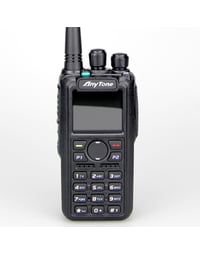
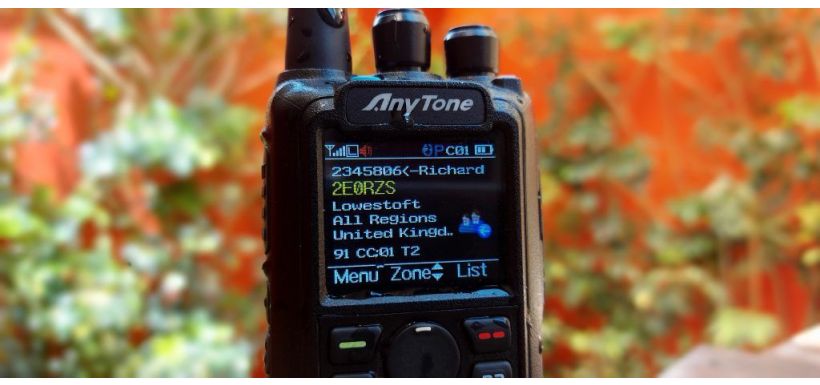
The purpose of this code plug is to provide Moonraker’s customers with an Anytone DMR Radio they can use out of the box upon purchase. This is a “Generic UK Code Plug” produced to cover the entire United Kingdom and Northern Ireland.
The code plug is created from publicly available information mainly the ETCC website, DMR network websites, repeater websites, RSGB website and by doing Google searches.
Please note that some repeaters may appear that are not on DMR – this is due to many repeaters showing as licenced for numerous digital modes and may also show a Colour Code and DMR Network. We have listed all repeaters that are licenced for DMR but also checked network websites to try eliminating as many as possible that are on other digital modes.
Due to the number of repeaters in the UK covering several DMR networks which have access to numerous talk groups, we have had to simplify the code plug to cover 2 channels per time slot for each DMR repeater. This then requires users to utilise the “Digi Moni” and “Manual Talk Group Dial” functions (similar features available on the Retevis/TYT monoband radios using Experimental tools).
There is also some non-amateur content such as PMR446 and Marine. Any non-amateur content added to this code plug is done as Rx Only due to legal reasons.
For some people, this may be the backbone on which you develop your own code plug.
How Do I Download the Code Plug?
Simply click on the link at the top of this page to down load the file.
You will need to Unzip the code plug file a PC using Windows is required which requires a program such as WinRAR.
The zip file contains 5 files:
- Contacts file - which also needs to be unzipped
- Code plug RDT file
- CPS/FW doc file - which advises how to update your CPS/FW
- CPS/FW file - which requires unzipping
- A read me file - our instructions
There are some abbreviations. As FM and DMR analogue share the same frequencies (except for the calling channel), FM channels are prefixed with “A” and DMR channels are prefixed with “D”. Analogue and DMR Gateways are in one zone – DMR Gateways are prefixed “MB6” and Analogue Gateways are prefixed “MB7”. DMR repeater channel names start with 3xx (for GB3xx) and xx (for GB7xx) and the talk group/slot (where necessary). Channel names are limited to 16 characters/spaces, so names have to be shortened.
Regions are based on the Phoenix UK DMR network split – South East England [SE], South West England [SW], North West England [NW], Midlands [MID], East England [EE], Scotland [Scot], North East England [NE], Wales [WM} and Northern Ireland [NI].
Code Plug Problems?
If there are any issues / errors with the code plug, then please email us at Anytone Contact. We will review the request and depending on the severity of the issue, we may issue an amended code plug. If there is an error with repeater information, we also suggest advising the repeater keeper who can request the ETCC to correct the information on their website.
For hardware issues, please contact the vendor from where you purchased the Anytone DMR Radio.
Note, that the answers to most questions are usually within the possession of the person asking the question – by this we mean that the download contains quite a few files of information, and it is also ideal to review your code plug within the CPS to check the content.
What is DMR?
DMR stands for Digital Mobile Radio. It is the international standard that has been set for two-way radios.
The aim of the DMR standard is to create a digital radio system with low complexity and low cost that allows users to communicate across a digital network. DMR also allows equipment from different manufacturers to work together, allowing users to shop around rather than being locked into a proprietary system.
The European Telecommunications Standards Institute (ETSI) is responsible for the creation and maintenance of the DMR standard.
What is a DMR Repeater?
DMR radios are able to communicate with each other directly but this is not always an ideal situation. Signals between radios connecting directly to each other can be hampered by obstructions in the line-of-sight between them such as trees, buildings, and other objects.
A DMR repeater allows radios to send their communications via a central point which repeats the message to the rest of the system. By installing a repeater high up (often on top of a building) the calls to the repeater are less affected by the obstructions. It also allows radios located far away from the repeater in opposite directions to communicate with each other, effectively increasing the range of the system.
Repeater stations can be connected together by either retransmitting received signals (parroting) or by sending received signals to other repeaters on the system via other methods (internet, unidirectional transmitter, etc). With these methods, the range of the system is only limited by the amount of infrastructure.
The Anytone DMR Radio Range
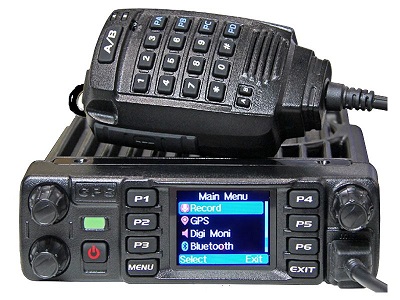
Anytone AT D578UV
The new Anytone will come in various models but we only offer the D578UVPRO which has V2 Firmware and is the latest from Anytone. Frequency Range: TX 144-146 430-440MHz RX 136-174,400-470MHz. Power: VHF 50W/25W/10W UHF 50W/25W/10W.
Shop Now
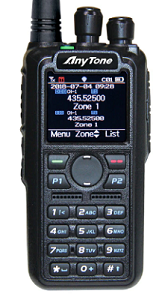
Anytone AT-D878UVII
Anytone AT-D878UVII PLUS BLUETOOTH Digital DMR Dual-band Handheld Commercial Radio with Roaming and GPS VHF/UHF Dual-band Digital/Analog Part 90 DMR commercial transceiver with 1.77 inch colour TFT display and GPS.
New AT-D878UVII Plus model includes DMR Roaming, faster processor and larger memory for future enhancements. Ideal for Fire, Search & Rescue, EMS, Police, Sheriff, Forestry and Security operations. Frequency coverage 140-174 / 400-480 MHz.
Shop Now
Anytone AT-D878UV
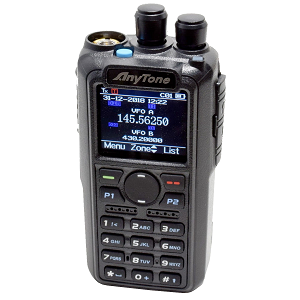
Anytone AT-D878UV PLUS BLUETOOTH Digital DMR Dual-band Handheld Commercial Radio with Roaming and GPS VHF/UHF Dual-band Digital/Analog Part 90 DMR commercial transceiver with 1.77 inch colour TFT display and GPS.
New AT-D878 model includes DMR Roaming, faster processor and larger memory for future enhancements. Ideal for Fire, Search & Rescue, EMS, Police, Sheriff, Forestry and Security operations. Frequency coverage 140-174 / 400-480 MHz.
Shop Now