
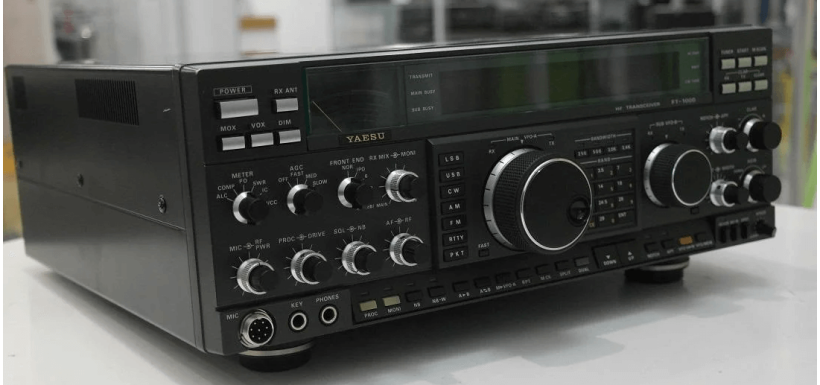
A transceiver is a device that marries a radio transmitter and a receiver - hence the name. It is designed to transmit and receive signals. A HF transceiver is designed to transmit and receive High Frequency radio waves in a band 3 to 30 megahertz (MHz).
An interesting tidbit: transceivers can be found in various electronic items used daily, from smartphones to radio. In smartphones, the transceiver is built right into the phone!
HF transceivers are commonly used for aviation transmissions, by weather stations, the military, and within maritime operations. But they're also popular with amateur radio enthusiasts - you may be one of them! Join the club!
HF Radio Waves
High-frequency radio waves are classified as frequencies within the band 3 MHz to 30 MHz, designated by the International Telecommunication Union (ITU).
HF radio signals utilise ionospheric propagation, rather than the limited methods of VHF and UHF frequencies which have restrictive line-of-sight transmission.
These high-frequency radio waves are transmitted from a base unit or mobile device into the atmosphere, bouncing off the ionosphere and then returning to the land - otherwise known as skip or skywave propagation. At that point, they can be received by another transceiver tuned into the same radio band. If you're a ham radio operator, you know that drill.
HF transceivers are suitable for long-distance and inter-continental communications. Specialised antennas can also help increase the signal reach.
The HF band takes up a significant element of the shortwave band of frequencies. There is no official definition of the shortwave band, but the range always includes all of the high frequency band (HF), which extends from 3 to 30 MHz (100 to 10 metres); above the medium frequency band (MF), to the bottom of the VHF band.
What Are the Features of a Typical HF Transceiver?
Most HF transceivers have a core of standard features with additional functionality offered by more expensive brands.
All transceivers have the basics to state the obvious such as speakers and volume controls, but some are better at cutting out background noise, interference and there will be some form of Digital Signal Processing (DSP), plus lots of other techie stuff!
Most models have sophisticated LED screen displays, with multi-coloured waterfall display’s and touch-screen technology. Features such as real-time spectrum scope allows you to graphically view the location of the signal on the different bands.
Price is typically commensurate with features, meaning the more advanced HF transceivers are generally more expensive.
Applications of an HF Transceiver
Long-distance Communication
HF radio signals can be sent and received across thousands of miles using an HF transceiver, offering a quick and seamless connection between far-flung locations.
Subject to propagation which can shift during the year and thanks to ionospheric transmission, using an HF transceiver is also less subject to disruption by ground-based objects such as tall buildings or mountainous regions.
Emergency Correspondence
An HF transceiver offers communication in emergencies where other forms of contact are rendered impossible either by distance or the failure of conventional communication infrastructures.
How to Choose an HF Transceiver
First make sure you have the correct licence to use a HF Transceiver - yes you will need a ham radio license. The UK Foundation licence includes the HF bands.
Think about your usage. Would you be stationary, or would something more portable suit you better?
Some transceivers are designed for vehicle mounting if you are out and about. Make sure that compact doesn’t mean difficult and fiddly to use. Small buttons may not play well with large fingers!
Choosing a transceiver with a generously proportioned display screen makes it easier to interpret the information. Most transceivers offer an LCD Display, but check whether the model you are interested in is single-colour or multi-colour. Different colour options can make the transceiver easier to read, especially with a waterfall feature. Note that most displays can be personalised to the user's preferences.
Usability is key for a first-time user. Check the reviews carefully. Do other people find it easy to use? Are the buttons intuitive? Is there a comprehensive instruction manual in case you need assistance?
Review the different scan functions and make sure it works for you. Also, make sure there are sufficient memory channels that allow you to save different radio frequencies to access your favourites at the touch of a button.
Some transceivers offer a degree of programmability. We'll be honest: this may not be interesting to an amateur radio operator just beginning their journey. An experienced user will undoubtedly appreciate the variety, as programmability allows for customisation for established enthusiasts.
Connectivity options can make a transceiver versatile and multi-functional. Some models will connect to your PC via USB or Com Port..
The brand is relevant. Big-name brands will cost more but provide reassurance to newbies. HF Transceivers are not a cheap piece of kit so in most cases you should get what you paid for.
Looking for an HF Transceiver? We’ve Got You Covered. Shop Moonraker!
If you’re a new radio enthusiast, find your first transceiver at Moonraker - the radio experts with professional and impartial advice and a range of brands to suit all budgets.
Moonraker also caters to the seasoned radio professional with sophisticated transceivers for use at base or in the field. We also offer a comprehensive range of antennas and other essential accessories to optimise your radio experience.
Shop Moonraker for all your radio needs.
Frequently asked questions
What is an HF radio used for?
Because HF radio is unique in its ability to support long-distance communications, it is popular with weather forecasters, the military, aviators and marine operators.
Humanitarian organisations also use HF radio for effective communication in areas where conventional infrastructure is absent or destroyed.
It is also widely used by HAM radio hobbyists.
What’s the difference between HF and VHF?
VHF (Very High Frequency) operates at a higher frequency range than HF, but its propagation is ‘line of sight’ rather than the skip or skywave propagation of HF. Because of this, VHF is usually limited to shorter-range communications.
What does HF mean?
HF stands for High Frequency, a frequency range of 3 to 30 MHz. Ham radio users and enthusiasts use the HF Frequencies in order to communicate around the world.