

You've passed your Foundation or Intermediate exam and you're itching to get on HF—but which antenna should go up first? A compact vertical that fits in the corner of the garden, or a wire doublet strung between the house and a tree? The internet is full of passionate advocates for both, and they're all partly right. The truth is, neither antenna type is universally "better"—your choice depends on your garden size, mast height, operating goals, and budget. In this guide, we'll compare the real-world performance of multiband verticals against horizontal antennas like doublets and G5RVs, so you can make an informed decision and start working DX without breaking the bank or the peace with your neighbours.
Key Takeaways
- Verticals offer naturally low take-off angles but demand an effective ground system—skimp on radials and you'll lose efficiency and signal strength
- Horizontal antennas (doublets, G5RVs) can deliver up to 5 dB ground gain at optimal heights, but struggle to produce low-angle radiation when installed below 10 m
- Your available mast height and garden space are the biggest deciding factors, not just the price tag
- Budget solutions exist for both approaches: £150–£400 can get you on all HF bands with realistic expectations
- A good ATU is essential for horizontals; verticals may need one too depending on your rig and target bands
- Neither type is "better" in all scenarios—each excels under different QTH constraints and operating styles
The New HF Operator's Dilemma
You've just earned your licence and you're ready to explore the HF bands. You've been reading the forums, watching YouTube reviews, and asking at the local club—and now you're more confused than ever. Some operators swear by verticals ("I worked VK6 on 5 W with mine!"), while others insist that only a horizontal wire antenna will give you consistent performance ("Verticals are just dummy loads!").
Both camps are sharing their genuine experiences, but they're often describing very different installations in very different gardens. A vertical with 32 buried radials in sandy soil will outperform a doublet at 6 m every time for DX. But that same vertical with four randomly laid radials will struggle against a well-sited G5RV at12 m.
This post cuts through the noise with evidence-based comparisons, real-world trade-offs, and practical advice for UK gardens and budgets. Whether you're eyeing a compact vertical or planning a wire antenna installation, we'll help you choose the right starting point for your QTH.
How HF Antennas Actually Radiate
Before we dive into specific antenna types, let's establish three concepts that will help you understand the trade-offs: radiation angle, ground gain, and ground systems.
Radiation angle is the vertical angle at which most of your signal leaves the antenna. For DX work—especially on 20 m, 17 m, 15 m, 12 m, and 10 m—you want a low radiation angle (typically 10–25°) so your signal refracts off the ionosphere at a shallow angle and travels long distances. Higher angles (45–90°) produce shorter skip distances, which is excellent for Near Vertical Incidence Skywave (NVIS) contacts out to about 500 km on40 m and 80 m, but poor for intercontinental DX.
Ground gain is a phenomenon that occurs with horizontal antennas when they're installed at certain heights above ground. When your antenna is at approximately 0.5 λ to 1.0 λ high, the direct radiation from the antenna and the ground-reflected signal combine constructively at low angles, giving you up to 5 dB more signal in the DX direction compared to the same antenna in free space. The catch? On 40 m, 0.5 λ is about 10 m; on 20 m it's5 m. If your horizontal antenna is much lower than this, the reflected signal cancels some of the low-angle radiation, pushing your pattern upwards.
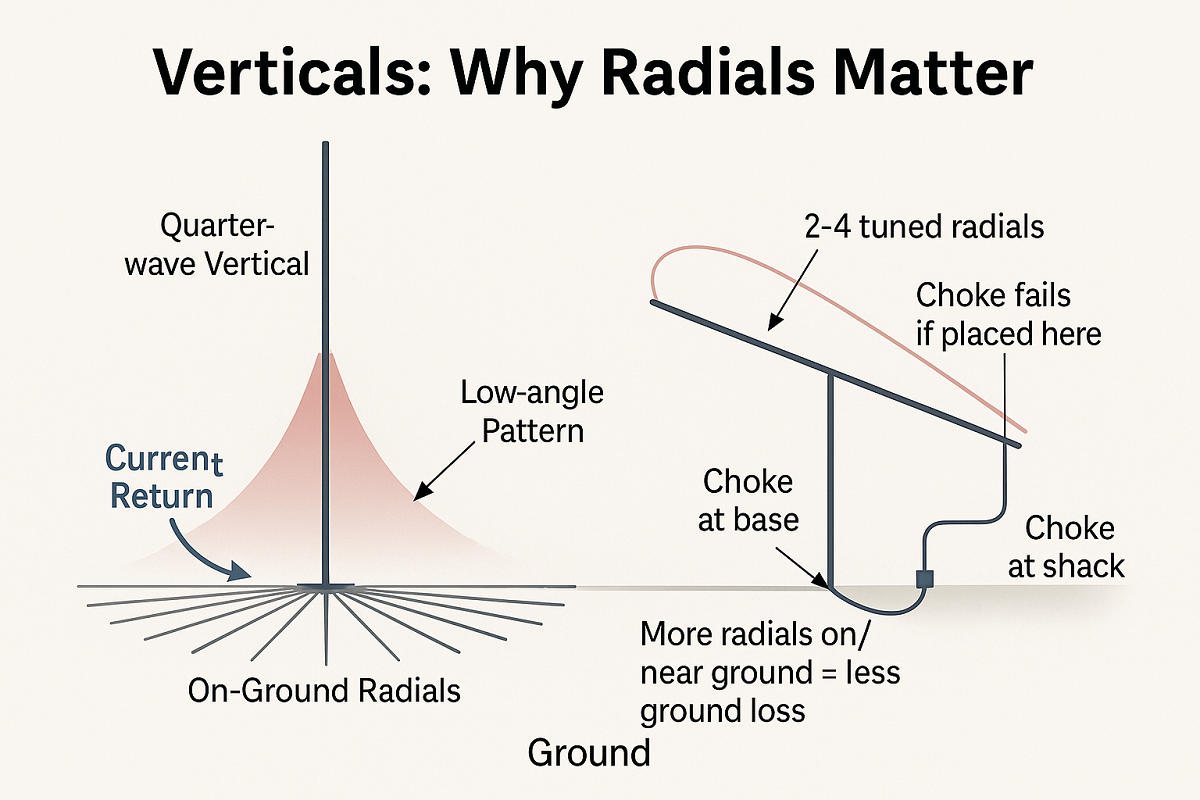
Ground systems matter primarily for verticals. A quarter-wave vertical relies on the ground (or a radial system) to provide the "missing half" of the antenna. Poor ground conductivity or inadequate radials create losses—sometimes several dB—and reduce your effective radiated power. Even 8–16 radials can transform a mediocre vertical into a respectable performer; 32 or more radials approach the theoretical maximum efficiency.
With these principles in mind, let's examine each antenna type.
Multiband Verticals—The Reality Check
Multiband verticals are popular for good reasons: they're compact, relatively simple to install, and they produce naturally low radiation angles even when mounted at ground level. If you have a small garden, difficult neighbours, or planning restrictions, a vertical might be your only practical option for HF.
What You Get
A typical multiband vertical is between 5 m and 10 m tall and covers anywhere from 5 to 10 HF bands (commonly 40 m through 6 m, with some models extending to 80 m or 160 m with loading coils or additional radials). Because the antenna is oriented vertically, its radiation pattern has maximum gain at low angles—typically 10–20° on the higher bands—making it well-suited for DX work.
Verticals are also relatively forgiving of installation height. While a horizontal antenna needs to be high to avoid ground losses, a vertical mounted at ground level (or on a short mast) still produces a usable low-angle pattern. This makes them ideal for small gardens, rooftop installations, or portable operation.
What You Sacrifice
The Achilles' heel of any vertical is the ground system. A vertical antenna is essentially one half of a dipole; the other half is provided by the ground or a radial system. If you skimp on radials—or if your soil has poor conductivity—you'll lose signal in two ways: increased ground losses (heating the earth instead of radiating RF) and a distorted radiation pattern.
The general rule of thumb from the ARRL Antenna Book (25th edition) is that you'll see significant improvements up to about 16 radials, with diminishing returns beyond 32 radials. Even 4 radials are better than none, but you're leaving several dB on the table. In practice, most successful vertical installations use at least 16radials, each a quarter-wave long (or longer) on the lowest band.
Verticals also tend to be noisier on receive than horizontal antennas, because they're closer to ground-level noise sources (power lines, LED lighting, broadband routers, plasma TVs) and because their omnidirectional pattern doesn't discriminate against local QRM.
Finally, bandwidth can be an issue. Many multiband verticals use traps or loading coils to resonate on multiple bands, and these introduce some losses and narrow bandwidth on certain bands. You may need an ATU to operate across an entire band, especially on 40 m and 80 m.
Comparison: Moonraker Vertical Antennas
Here's a snapshot of typical multiband vertical performance (specific models and prices available in our vertical antenna range):
| Feature | GPA-80 | SE HF X-80 | SE HF-360 |
|---|---|---|---|
| Bands Covered | 7–10 HF bands | 9–11 bands (inc. WARC) | 10+ bands, 160m–6m |
| Height | 5–7 m | 7–9 m | 9–11 m |
| Radials Required | 16 minimum | 16–32 recommended | 32+ for best results |
| Matching | Manual ATU often needed | Built-in matching, some bands may need ATU | Integrated ATU or broad band match |
| Installation | Simple, 1–2 hours | Moderate, guy ropes on taller models | More complex, requires solid mount |
| Best For | Small gardens, portable use, beginners | All-round HF DXing, limited space | Serious DX, low-noise RX, multi-op |
Prices typically range from £150 to £500+ depending on band coverage and build quality. See specific models and current pricing in our catalogue.
Horizontal Doublets & G5RVs—Height is King
Horizontal antennas—whether a simple doublet, a G5RV, or an off-centre-fed dipole (OCFD)—offer a different set of trade-offs. They can deliver excellent gain and low noise, but only if you can get them high enough. If you have a large garden, tall trees, or a high mast, a horizontal wire antenna can outperform a vertical across most HF bands.
What You Get
When installed at the right height (typically 0.5 λ or higher on your lowest operating band), horizontal antennas benefit from ground gain: the interaction between the direct signal and the ground-reflected signal produces constructive interference at low angles, giving you up to 3–5 dB more signal than the same antenna in free space. This is "free gain" that you don't get with a vertical.

Horizontal antennas are also generally quieter on receive. Because they're physically higher and oriented horizontally, they're less sensitive to local ground-level noise sources. Many DXers report that a well-sited doublet at 12 m or higher provides a noticeably cleaner receive compared to a vertical, especially on 40 m and 80 m.
Another advantage: horizontal antennas are more forgiving of imperfect ground. Because the current flows along the wire (not through the earth), you don't need an elaborate radial system. A simple 1:1 current choke at the feed point is usually sufficient to prevent common-mode currents.
What You Sacrifice
The big trade-off is height. If you can't get your horizontal antenna high enough, the low-angle radiation suffers dramatically. A doublet installed at 5 m on 20 m will have most of its radiation at 45–60°, which is excellent for NVIS work within the UK and Europe, but poor for working DX beyond about 1,500 km. The same antenna at12 m will produce strong low-angle lobes and work the world.
Another practical challenge: horizontal antennas require space. A full-size 40 m doublet needs about 20 m of horizontal span, plus additional space for guy ropes or support structures. If you're in a small garden or a terrace, this simply isn't feasible.
Finally, you absolutely need an ATU. The feed point impedance of a doublet or G5RV varies wildly across the HF bands—from under 50 Ω on some bands to over 1,000 Ω on others. Most modern transceivers have a built-in ATU, but it may not handle the full impedance range. You'll likely need an external manual or automatic ATU, especially if you're using ladder line (which is recommended for efficiency).
Comparison: Moonraker Wire & Horizontal Antennas
Here's how typical horizontal antennas compare (specific models and prices available in our wire antenna range):
| Antenna Type | Bands Covered | Min. Span | Recommended Height | Tuner Required? | Best For |
|---|---|---|---|---|---|
| G5RV (full-size) | 80m–10m (some coverage all bands) | 31 m | 10–15 m | Yes, wide-range ATU | Classic all-rounder, larger gardens |
| G5RV (half-size) | 40m–10m | 15.5 m | 8–12 m | Yes | Smaller gardens, good compromise |
| 40m Doublet | 40m–6m with ATU | 20 m | 10–15 m | Yes | NVIS + DX mix, rag-chewing |
| Off-Centre-Fed Dipole (OCFD) | 80m–6m (or40m–6m) | 20-40m | 10–15 m | Built-in balun, ATU recommended | Easier matching, multi-band |
| End-Fed Half-Wave | 40m–6m typical | 20 m (Sloper or inverted-L) | 8–12 m | Usually includes matching unit | Stealth installs, single support point |
The key message: if you can achieve 10 m or more height and you have the horizontal space, a wire antenna will often give you better overall HF performance than a vertical, especially on the higher bands. But if you're limited to 6–8 m masts or less than 15 m horizontal span, a vertical with good radials may be the more practical choice.
Real-World Station Examples
Let's ground this in concrete scenarios that reflect typical UK gardens and budgets.
- Scenario 1: Small Terraced Garden (10×8 m), 6 m Mast
- Scenario 2: Suburban Plot (20×15 m), 10 m Mast + Tree Support
- Scenario 3: Restricted Site (HOA, Conservation Area, Stealth Required)
- Scenario 4: Caravan/Portable Operation
Best option: Multiband vertical with 16 radials
In a constrained space like this, you simply don't have room for a full-size horizontal antenna, and 6 m isn't high enough to realise ground gain on 20 m and above. A compact vertical (5–7 m tall) with 16 quarter-wave radials on your lowest band will give you low-angle coverage on all the higher bands. Expect good DX performance on 20 m, 17 m, 15 m, 12 m, and 10 m when conditions support it. On 40 m, you'll work Europe reliably and occasionally break through to other continents.

Installation tip: If you're on clay soil (common in southern England), bury your radials 5–10 cm deep to improve conductivity. If you're on sandy or rocky soil, surface radials are acceptable and easier to adjust.
Moonraker recommendation: GPA-80 Vertical Antenna
Best option: 40 m doublet fed with ladder line, plus an external ATU
With this much space and a 10 m support, you're in an excellent position for a horizontal wire antenna. A 40m doublet will give you fundamentals on 40 m and 20 m, and harmonics (with an ATU) on 30 m, 17 m, 15 m, 12m, 10 m, and 6 m. At 10 m height, you'll have decent low-angle radiation on 20 m and above, and useful NVIS coverage on 40 m for UK and European contacts.
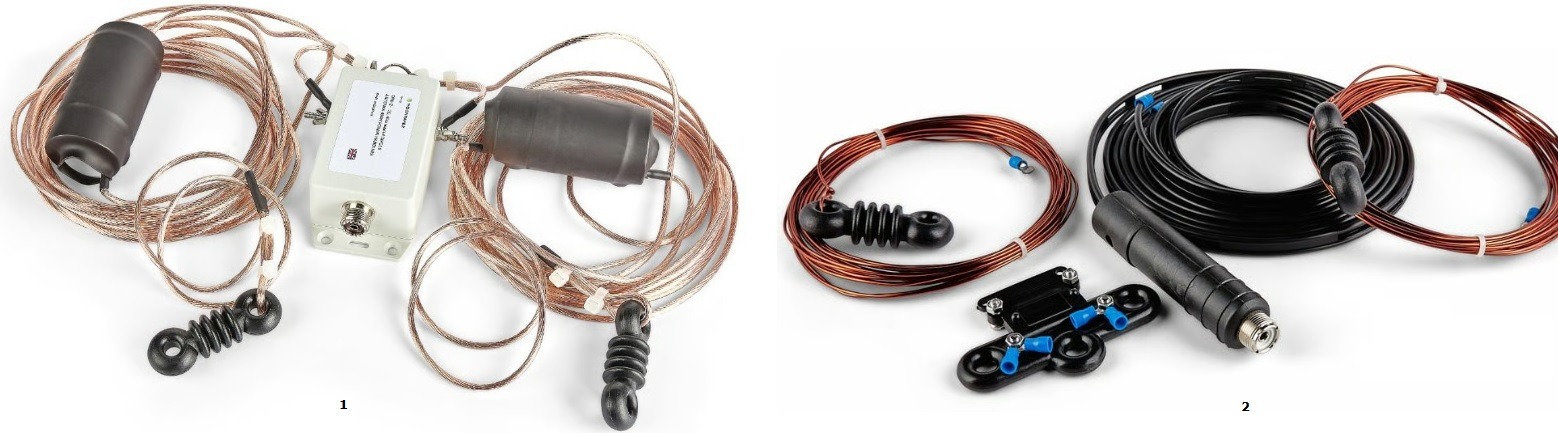
Feed it with 450 Ω ladder line down to a 4:1 balun and external ATU near your rig. This keeps losses low even when the feed point impedance is high on some bands. Use a good 1:1 current choke at the antenna feed point to suppress common-mode currents.
Installation tip: If you only have one tall support (say, a 10 m mast near the house), consider running the doublet as an inverted-V with the ends at 2–3 m. You'll lose a little gain compared to a horizontal installation, but it's still effective and fits smaller gardens.
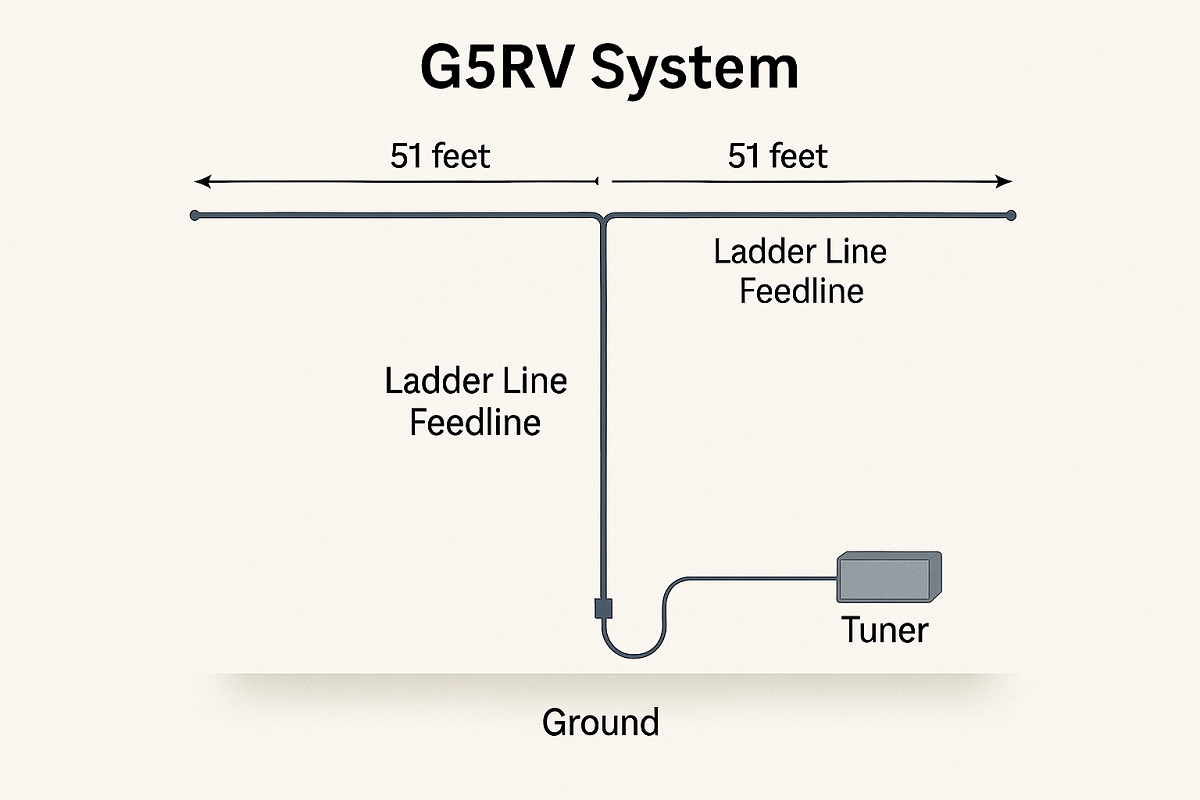
Moonraker recommendation: 40m doublet kit or G5RV with ladder line
Best option: Vertical disguised as a downpipe or an end-fed Sloper
If you're facing planning restrictions or appearance covenants, you have a few sneaky options. Some operators have successfully installed verticals that look like rainwater downpipes (paint them black or grey and mount them on the side of the house). Alternatively, an end-fed half-wave antenna can be run as a Sloper from a chimney or roofline down to a rear fence—virtually invisible from the street.

Neither of these is optimal from a performance standpoint, but they'll get you on HF. For the vertical, use as many hidden radials as you can manage (run them in the loft space, under roof tiles, or buried in the garden). For the end-fed, aim for the highest possible mounting point and keep the wire away from metal gutters and other conductors.
Moonraker recommendation: Compact vertical or end-fed wire kit
Best option: Collapsible vertical or portable doublet on fibreglass poles
For portable or holiday use, weight and setup time matter. A short collapsible vertical (with a compact radial kit that fits in a bag) can be assembled in 15 minutes and gets you on the air quickly. Pair it with an ATU and you’ll cover most HF bands.

Alternatively, a portable 20 m or 40 m doublet suspended between lightweight fibreglass poles gives you better performance if you have the space and time to set it up. Many SOTA and field-day operators prefer this approach for the improved signal quality and lower noise.
Moonraker recommendation: Portable vertical or portable wire antenna kit
Common Pitfalls & How to Avoid Them
Even experienced operators make these mistakes when installing their first HF multiband antenna. Here's how to sidestep the most common traps.
- Pitfall 1: Skipping the Radials (Verticals)
- Pitfall 2: Installing Horizontals Too Low
- Pitfall 3: Ignoring Common-Mode Currents
- Pitfall 4: Tuner Myths
- Pitfall 5: Not Measuring Your Installation
"I'll add radials later" is the most common lie we tell ourselves. In reality, you'll operate for six months with a mediocre signal, wonder why everyone else is louder than you, and eventually give up on the vertical altogether.
Fix: Budget for radials from day one. You don't need expensive wire—14 AWG or 16 AWG solid copper wire from the hardware shop works fine. Cut 16 radials to a quarter-wave on your lowest band (20 m for a 40 m vertical, for example) and either bury them 5 cm deep or lay them on the surface. Use a central hub (a brass or stainless ring) and crimp or solder all the radials together at the antenna base. This is non-negotiable for good performance.
Browse radial wire and connectors in our accessories range
If you hang a doublet at 5 m and expect it to work DX on 20 m, you'll be disappointed. At that height, most of your signal is going up at 50–70°, which is perfect for chatting across the UK but hopeless for working VK or ZL.
Fix: Either get the antenna higher (10 m minimum for 20 m DX work) or accept that your horizontal antenna will excel at NVIS and regional contacts. There's no shame in optimising for NVIS—40 m and 80 m doublets at modest heights are superb for UK and European nets, and you'll still work some DX when the bands are open. Just set realistic expectations.
If you're experiencing RF in the shack (rig resets, USB disconnects, buzzing in the headset), you almost certainly have common-mode current on the outside of your coax. This happens when your antenna isn't perfectly balanced or when your feedline becomes part of the radiating system.
Fix: Install a 1:1 current choke (also called a "common-mode choke" or "balun") at the antenna feed point. For HF, a choke made from 8–12 turns of coax on a ferrite toroid (mix 31 for bands up to 30 MHz, or mix 43 for broader coverage) is effective. You can also use a commercial snap-on ferrite choke. Additionally, place another choke where the coax enters your shack. This will dramatically reduce RF problems.
Shop our range of baluns and RF chokes
Some operators believe that if the SWR is under 2:1, they don't need an ATU. While it's true that most modern rigs will operate happily into a 2:1 SWR, you may still be losing power due to mismatch losses in the feedline, and your rig's internal protection circuits may be limiting output power without telling you.
Fix: For wire antennas like doublets and G5RVs, an external ATU is essential. Even if your rig has a built-in ATU, it may not handle the extreme impedances you'll encounter on some bands (especially with ladder-linefeed). A good manual or automatic ATU will let you operate across the entire band with low SWR, protecting your rig and maximising your effective radiated power.
Explore our ATU range for HF operation
Many new operators install an antenna, see that the SWR is "low enough," and assume everything is fine. But SWR alone doesn't tell you if your antenna is resonant, if your radials are working, or if your feedline losses are acceptable.
Fix: Invest in an antenna analyser (such as a Nano VNA or similar). These affordable tools let you measure resonance, feed point impedance, and SWR across the entire HF spectrum in seconds. You'll quickly spot problems like insufficient radials (high resistance), poor balun performance, or coax issues. It's the difference between guessing and knowing.
Check our test equipment and analysers
Safety Callout
Always operate within your licence terms and local band plans. Use common-mode chokes at feed points and shack entry to reduce RF on the braid and protect your equipment. Before raising any mast or antenna, check for overhead power lines and maintain a safe distance—if a mast falls, it must not be able to contact power lines under any circumstances. Follow the manufacturer's guidelines for wind loading, guy rope tension, and maximum mast height. If in doubt, consult a professional rigger or your local club's technical experts.
Budget Breakdowns & Buying Smart
One of the most common questions is: "How much do I need to spend to get on HF properly?" The answer depends on your expectations, but here are three realistic budget tiers that we see working well for UK amateurs.
- Tier 1: £150–£200 (DIY-Friendly Entry Level)
- Tier 2: £250–£350 (Best Value for Most Operators)
- Tier 3: £400+ (Performance Step-Up for Enthusiasts)
At this level, you're looking at a basic commercial vertical or a wire antenna kit plus a simple ATU.
Vertical option:
Entry-level multiband vertical (covering 40 m–6 m): ~£120–£150
16 radials (DIY from hardware-shop wire): ~£20–£30
Coax and connectors: ~£20–£30
Total: ~£160–£210
Horizontal option:
Half-size G5RV or 40 m doublet kit (wire, balun, insulators): ~£80–£100
Manual ATU: ~£50–£80
Coax and connectors: ~£20–£30
Total: ~£150–£210
What you'll achieve: Reliable contacts across the UK and Europe on most bands; occasional DX when conditions are good; excellent for learning and experimenting.
What you'll compromise on:Lower build quality, manual tuning, some bands may require patience or an external ATU.
This is the sweet spot for serious HF operation without overspending.
Vertical option:
Mid-range multiband vertical (9+ bands, better matching, sturdier construction): ~£200–£280
Commercial radial kit (16–32 pre-cut radials): ~£40–£60
Low-loss coax and quality connectors: ~£30–£50
Total: ~£270–£390
Horizontal option:
Full-size G5RV or OCFD with balun and ladder line: ~£120–£180
Automatic ATU (internal or external): ~£100–£150
Low-loss coax: ~£30–£50
Total: ~£250–£380
What you'll achieve: Consistent DX performance across all HF bands; better build quality and durability; less time spent tuning and troubleshooting; improved noise performance.
What you'll compromise on: You're still not at "top-tier" components, but for most stations this is more than adequate.
Browse our mid-range verticals | Explore wire antennas and ATUs
If you're chasing rare DX, contesting, or you simply want the best antenna system your budget allows, this tier delivers noticeable improvements.
Vertical option:
Premium multiband vertical (10+ bands, 160 m–6 m, integrated matching, low-loss traps): ~£350–£500
Professional radial system (32–64 radials, proper hub, burial kit): ~£80–£120
High-quality low-loss coax (RG-213 or better): ~£50–£80
Total: ~£480–£700
Horizontal option:
High-end OCFD or trapped dipole with remote balun: ~£200–£300
Tilt-over or crank-up mast (10–12 m): ~£250–£400
Automatic remote ATU: ~£150–£250
Low-loss coax: ~£50–£80
Total: ~£650–£1,030
What you'll achieve: Maximum performance from your antenna; lower noise floor; easier operation; better DX and contest results; longer lifespan and less maintenance.
When it's worth it: If you're a regular operator, serious about DX or contesting, or you plan to stay at the same QTH for many years, this investment pays dividends. If you're still exploring the hobby or may relocate soon, stick with Tier 2.
Sidebar: Ground System on a Budget
You don't need expensive "radial wire" to build an effective ground system. Here's how to do it economically:
- Wire: 14 AWG or 16 AWG solid copper wire from a hardware or electrical wholesaler (often sold as "earth wire" or "single-core cable"). Avoid stranded wire—it corrodes faster when buried.
- Length: Quarter-wave on your lowest band is ideal, but even shorter radials help. For 40 m, that's about 10m per radial; for 20 m, about 5 m.
- Quantity: Aim for 16 minimum; 32 is better. Radials don't have to be equal length or perfectly straight—any conductive path back to the antenna base helps.
- Installation: Bury them 5–10 cm deep if you can (helps with soil conductivity and keeps them out of the lawn mower). If burial isn't practical, lay them on the surface and peg them down.
- Connection: Use a central hub—a brass or stainless ring, or even a large copper washer. Crimp or solder all radials together, then connect to the antenna's ground terminal. Keep connections clean and weatherproof.
Cost for 16×10 m radials: ~£25–£40 depending on wire gauge and supplier.
Find radial wire and connectors in our accessories section
Moonraker's Vertical & Horizontal Antenna Range
We stock a comprehensive selection of HF antennas to suit every garden size, budget, and operating style. Whether you're looking for a compact vertical for a small plot or a full-size wire antenna for serious DX work, we've got you covered—and our team is always happy to talk through your specific QTH and help you choose the right solution.

Vertical Antennas at Moonraker
From entry-level multiband verticals to premium models covering 160 m through 6 m, our range includes options for every level of operator.
Featured Verticals:
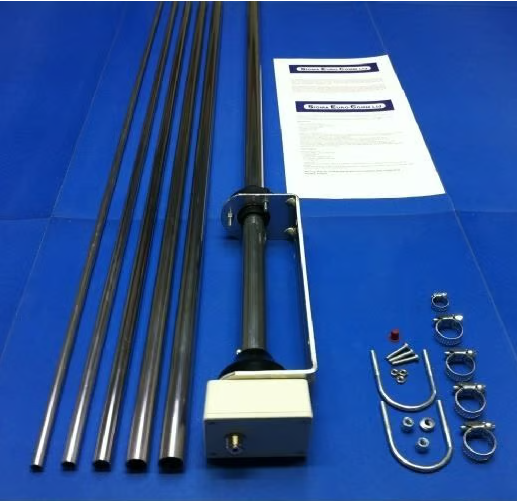
- Model name and manufacturer: GPA-80 Vertical Antenna - Moonraker
- Bands covered: 80, 40, 30, 20, 17, 15, 12, 10, 6m (3.5-57MHz) with any external tuner
- Height and base diameter: 6m and fit mast diameter ranging 25 to 42mm
- Radial requirements: External ATU for perfect SWR
- Key features: Low Cost, covers 80-6m bands, Aluminium Vertical
- Price: £99.95
- Best suited for: Small Garden and covert operations
- Model name and manufacturer: X-80 - Sigma
- Bands covered: 80m through 6m
- Height and base diameter: 6m length, base cradle 60cm in diameter (approximate)
- Radial requirements: Plug and play, ATU required to work 80m through 6m bands.
- Key features: End fed aluminium vertical, can be pole mounted at ground or elevated depending on user.
- Price: 109.99
- Best suited for: Small garden or going portable
- Model name and manufacturer: SE HF-360 - Sigma
- Bands covered: 80m-6m (using an ATU)
- Height and base diameter: 5.4m length and Max pole mounting width - 1.5inch/38mm
- Radial requirements: ATU for 80-6m bands, max width of pole 38mm
- Key features: All mounting hardware supplied, 5.4m length
- Price: £139.99
- Best suited for: Small gardens

Browse our complete range of vertical HF antennas
Horizontal & Wire Antennas at Moonraker
From classic G5RVs to modern off-centre-fed dipoles, our wire antenna selection covers all HF bands and installation scenarios.
Featured Wire Antennas:
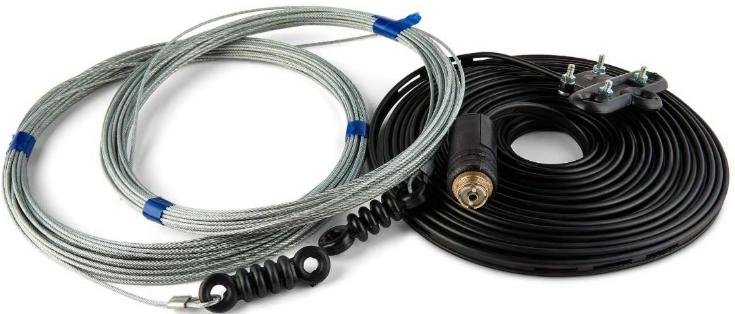
- Model: Full-Size G5RV
- Bands covered: 80, 40, 20, 15, 10m
- Total length and recommended height: 102 Feet and 3-4m approximate
- Feed system: Ladder Line
- Key features: Length of 102 Feet, recommended 45-90 Feet of coax
- Price: £44.95
- Best suited for: Suitable for portable operations, allowing operators to set up temporary stations in various locations, Attic or Garden Installations.
- Model: Half-Size G5RV
- Bands covered: 80, 40, 20, 15, 10m
- Total length and recommended height: 51 feet and 3-4m approximately
- Feed system: Ladder line
- Key features: Max Power 500W, Overall length is roughly 51 Feet
- Price: £36.95
- Best suited for: Ideal for smaller gardens, lofts, or portable setups
- Model: 40m Doublet Kit
- Bands covered: 20 and 40m
- Total length and recommended height: 12m and approximately 4m
- Feed system: Coax, built-in balun
- Key features: 400W CW Power, 500W SSB
- Price: £99.95
- Best suited for: Small gardens, can be dog-legged, Inverted (V or L), or bent with little change in performance.
- Model: OCFD 80m - 6m
- Bands covered: 10, 15, 20, 40, 80
- Total length and recommended height: Approximately 135.85 Feet and 30 to 35 Feet above ground
- Feed system: Coax, Built-in balun
- Key features: Multiband Operation, Feed Point Impedence, Installation Height
- Price: £99.95
- Best suited for: Ideal for all-round HF operation in larger gardens


See all our wire and horizontal antennas!
Essential Accessories for Your HF Antenna System
A great antenna is only as good as its supporting components. We stock everything you need for a complete installation:
- Baluns & RF Chokes
- 1:1 current chokes for vertical and wire antennas
- 4:1 and 6:1 voltage baluns for doublets and OCFDs
- Weatherproof enclosures rated for UK climates
- Antenna Tuning Units (ATUs)
- Manual and automatic ATUs for wide impedance ranges
- Balanced (ladder line) and unbalanced (coax) inputs
- Remote ATUs for mast-mounted installations
- Coax & Feedline
- Low-loss 50 Ω coax (RG-213, RG-8, Ecoflex)
- 450 Ω ladder line for efficient doublet feeds
- Weatherproof connectors (PL-259, N-type, BNC)
- Masts & Supports
- Tilt-over and crank-up masts (6 m–12 m)
- Wall brackets and ground mounts
- Guy rope kits and anchor points
- Ground System Components
- Radial wire (copper, tinned copper, bare copper)
- Radial hubs and crimp connectors
- Ground rods and clamps
Making Your Decision: A Practical Framework
By now you should have a good sense of the trade-offs, but how do you decide? Here's a step-by-step framework that works for most operators:
Step 1: Assess Your QTH Constraints
Start with what you can't change:
- Garden size: Measure your longest available span for a horizontal antenna (house to fence, house to tree, etc.)
- Maximum practical height: What's the tallest mast you can install (considering planning permission, wind loading, neighbours, and your own comfort with heights)?
- Neighbours and restrictions: Are you in a conservation area, HOA, or leasehold with appearance covenants?
- Soil type: Clay, sandy, rocky? (Affects radial effectiveness for verticals)
Step 2: Define Your Operating Preferences
What kind of operating do you enjoy most?
- DX chaser: Low-angle radiation is critical; prioritise height for horizontals or good radials for verticals
- Rag-chewer / net participant: NVIS coverage is valuable; a modest-height horizontal or a vertical both works well
- Contester: You need reliability and quick band changes; consider an antenna that covers all bands you plan to operate
- Experimenter: You'll probably build and modify several antennas; start simple and affordable
Step 3: Match Antenna Type to Your Situation
Use these decision prompts:
"I have less than 10 m garden and less than 8 m mast height" → Vertical antenna (with at least 16 radials)
Browse our vertical range
"I can get a wire to 12 m or higher and have 20 m+ horizontal span" → Horizontal doublet or G5RV
Explore our wire antennas
"I have space for a horizontal but only 8–10 m height" → Horizontal for NVIS + regional, or vertical for DX
Consider starting with a vertical and adding a horizontal later for band/mode diversity
"I want to try both types" → Start with a vertical, then add a doublet
Many successful operators run both: vertical for DX on the higher bands, horizontal for NVIS on 40 m and80 m
This also gives you antenna diversity for different ionospheric conditions
Step 4: Budget and Install
Once you've chosen your antenna type, refer to the budget breakdowns (Tier 1, 2, or 3) and plan your installation. Don't forget to budget for mast, coax, ATU (if needed), and accessories.
Not sure which specific model is right for you? Give us a call on +44 (0)1908281705 or email we're happy to talk through your QTH and help you choose the right antenna for your garden, budget, and operating goals.
Summary & Next Steps
Choosing your first HF multiband antenna doesn't have to be overwhelming. The key is to match the antenna type to your QTH constraints and operating style, rather than chasing "the best" antenna in the abstract.
If you have limited space or low installation height: A multiband vertical with a proper radial system will give you low-angle DX capability across all the HF bands. Don't skimp on the ground system—those radials are what make or break a vertical's performance.
If you have the space and height for a horizontal wire: A doublet or G5RV will often outperform a vertical, especially on the higher bands, thanks to ground gain and lower noise. But you absolutely need 10 m or more of height to realise the benefits on 20 m and above.
If you're torn between the two: Consider starting with a vertical for immediate DX capability, then adding a horizontal wire later for NVIS and band diversity. Many successful stations run both types and switch between them depending on band conditions and the target.
Neither antenna type is universally "better." Both can work the world on a budget if you set realistic expectations, measure your performance, and optimise your installation for your specific QTH.
Ready to Get on HF?
Browse our vertical antenna range and wire antenna collection, or call the Moonraker team for personalised advice. We'll help you choose the right antenna for your garden, budget, and operating goals—and we stock all the accessories you need for a complete installation.
What's your garden size and mast height? Drop a comment below and we'll suggest a starting point. Operating this weekend? Tag us with your first QSOs on your new antenna—we'd love to hear how you get on!
Coming next in our HF Station Building series: Common-Mode Chokes—The 5-Minute Mod ThatTransforms Your Station
References
- ARRL Antenna Book, 25th Edition (2024). Chapter 3: "The Effects of Ground" and Chapter 9: "Multiband Antennas"
- RSGB HF Antennas for All Locations, 3rd Edition (2023). Chapters on vertical antennas and horizontal wire antennas
- ON4UN's Low-Band DXing, 6th Edition (2021). Chapter 7: "Vertical Antennas" and Chapter 9:"Horizontal Antennas"
- IARU Region 1 HF Band Plans (current as of October 2025)
- Rudy Severns, N6LF. "Modeling and Understanding Small Transmitting Loop Antennas," QST May 2008and "A Closer Look at Ground Systems for HF Verticals," QEX July/August 2010
- Moonraker Technical Support Library: Installation guides and setup tutorials-
- Ham Radio - Buyers Guides
- CB Radio - Buyers Guides
- Scanners - Buyers Guides
- Marine Radio - Buyers Guides
All measurements and performance claims are based on modelling over average ground (conductivity 5 mS/m, dielectric constant 13) and verified against published literature. Your results will vary depending on local soil, terrain, and installation quality. We recommend using an antenna analyser to verify resonance and optimise your specific installation.
This article was published on 2 October 2025 and reflects current product availability and amateur radio regulations in the UK. Always operate within your licence conditions and IARU Region 1 band plans.
For more information please visit our online store or alternatively contact us and our team will be happy to assist you!